Indian scientists clone buffalo: report
June 7, 2009
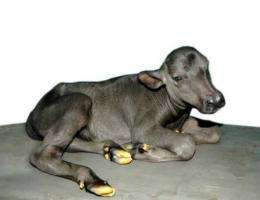
Cloned buffalo calf 'Garima,' seen here at an undisclosed location in India. Scientists in the Indian state of Haryana have reportedly cloned a buffalo using foetal tissue in order to boost the species' population.
Scientists in the Indian state of Haryana have cloned a buffalo using foetal tissue, according to a report.
The female calf named Garima weighed 43 kilograms (95 pounds) and was born at the National Dairy Research Institute in the city of Karnal in northern India, according to the Hindu newspaper.
"Garima is absolutely healthy and we are fully optimistic about her survival," institute director A.K. Srivastava was quoted as saying.
India cloned the world's first buffalo in February, but it died of pneumonia within a week of its birth after being created from the ear tissue of a female buffalo.
Scientists cloned Garima using tissue from a foetus as part of a "hand-guided cloning technique" which allows the sex of the calf to be chosen.
Srivastava said India has the largest population of buffaloes in the world and that cloning would increase the percentage of elite animals in the species.
(c) 2009 AFP
-
China produces 6th recloned calf
Jan 03, 2006 |
not rated yet |
0
-
Britain to probe report of clone's calf
Jan 10, 2007 |
not rated yet |
0
-
Cloned horse gives birth
May 01, 2008 |
not rated yet |
0
-
Fertility doctor says he's on the brink of cloning human: report
Apr 22, 2009 |
not rated yet |
0
-
Dubai claims world's first cloned camel
Apr 14, 2009 |
not rated yet |
0
-
Fast photon control brings quantum photonic technologies closer
9 hours ago |
5 / 5 (4) |
0
-
Engineers build first sub-10-nm carbon nanotube transistor
Feb 01, 2012 |
4.9 / 5 (33) |
30
-
Something old, something new: Evolution and the structural divergence of duplicate genes
Jan 31, 2012 |
4.6 / 5 (7) |
1
-
The hidden nanoworld of ice crystals: Revealing the dynamic behavior of quasi-liquid layers
Jan 30, 2012 |
5 / 5 (5) |
1
-
Stock market network reveals investor clustering
Jan 27, 2012 |
3.9 / 5 (23) |
8
-
Factors affecting beet root cell membrane
Feb 12, 2012
-
Stem cell question.
Feb 10, 2012
-
Protease cleavage
Feb 10, 2012
-
Pertubance in a model
Feb 10, 2012
-
Cancer drugs and Alzheimer's, Oh my!
Feb 09, 2012
-
Squishing cells
Feb 09, 2012
- More from Physics Forums - Biology
More news stories
Plants use circadian rhythms to prepare for battle with insects
In a study of the molecular underpinnings of plants' pest resistance, Rice University biologists have shown that plants both anticipate daytime raids by hungry insects and make sophisticated preparations to ...
1 hour ago |
5 / 5 (2) |
0
|
Study finds fish of Antarctica threatened by climate change
A Yale-led study of the evolutionary history of Antarctic fish and their "anti-freeze" proteins illustrates how tens of millions of years ago a lineage of fish adapted to newly formed polar conditions ...
3 hours ago |
5 / 5 (2) |
0
|
Explosive evolution need not follow mass extinctions, says study of ancient zooplankton
Following one of Earth's five greatest mass extinctions, tiny marine organisms called graptoloids did not begin to rapidly develop new physical traits until about 2 million years after competing species became ...
3 hours ago |
5 / 5 (1) |
1
|
Writing a new code for life?
On "Star Trek, the aliens often look so human that crew members fall in love with them. But in real life, scientists in the field known as astrobiology can't be sure alien life would even be carbon-based like us, or use DNA ...
6 hours ago |
5 / 5 (5) |
1
Lens produces hours of scientific work in seconds
A new form of microscope which can produce results in seconds rather than hours dramatically speeding up the process of drug development - is being developed by researchers at the University of Strathclyde ...
7 hours ago |
4.3 / 5 (6) |
1
|
First-of-its-kind stem cell study re-grows healthy heart muscle in heart attack patients
Results from a Cedars-Sinai Heart Institute clinical trial show that treating heart attack patients with an infusion of their own heart-derived cells helps damaged hearts re-grow healthy muscle.
Sensing self and non-self: New research into immune tolerance
At the most basic level, the immune system must distinguish self from non-self, that is, it must discriminate between the molecular signatures of invading pathogens (non-self antigens) and cellular constituents that usually ...
Missing dark matter located: Intergalactic space is filled with dark matter
Researchers at the University of Tokyos Institute for the Physics and Mathematics of the Universe (IPMU) and Nagoya University used large-scale computer simulations and recent observational data of gravitational ...
Scientists discover reason for Mt. Hood's non-explosive nature
(PhysOrg.com) -- For a half-million years, Mount Hood has towered over the landscape, but unlike some of its cousins in Oregons Cascade Mountains and many other volcanoes around the Pacific Rim ...
Smoking bans lead to less, not more, smoking at home: study
Smoking bans in public/workplaces don't drive smokers to light up more at home, suggests a study of four European countries with smoke free legislation, published online in Tobacco Control.
Radiation treatment transforms breast cancer cells into cancer stem cells
Breast cancer stem cells are thought to be the sole source of tumor recurrence and are known to be resistant to radiation therapy and don't respond well to chemotherapy.
Jun 07, 2009
Rank: not rated yet
Jun 07, 2009
Rank: 1 / 5 (2)
Jun 07, 2009
Rank: 5 / 5 (1)
Seriously though, I think this is more a precursor to human cloning rather than an attempt to address food issues.
Jun 23, 2009
Rank: not rated yet
The idea is not to clone them for meat but clones the ones with high milk yeald. A very small percentage of Indians eat beef/buffalo meat.
Jun 24, 2009
Rank: not rated yet