New cleaning protocol for future 'search for life' missions
June 8, 2009 New cleaning protocol for future 'search for life' missions

Enlarge

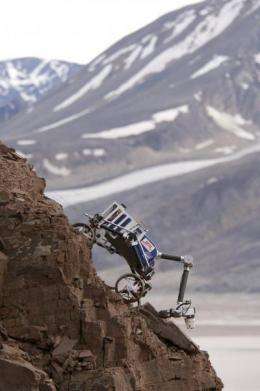
This photo shows the testing of next generation rovers onboard the Arctic Mars Analogue Svalbard Expedition. This "Cliffbot" rover is being designed to sample rock outcrops on Mars and the Moon where scientifically relevant samples are easier to access. Credit: Photo courtesy of Kvell Ove Storvik, Arctic Mars Analog Svalbard Expedition (AMASE). Rover courtesy of the Jet Propulsion Laboratory, California Institute of Technology.

Scientists have developed a new cleaning protocol for space hardware, such as the scoops of Mars rovers, which could be used on future "Search for Life" missions on other planets.

The new protocol was developed as part of a project to investigate life that exists in extreme Arctic environments, which are the closest analogue we have on Earth to the surface of . The studies are also designed to help guide future NASA and ESA planetary missions.

Published today in the journal Astrobiology, the decontamination protocol was developed and tested by scientists at the University of Leeds and NASA. It deals with the dilemma known as 'forward contamination' - ensuring that bugs from Earth don't hitch a ride across space and jeopardise the integrity of samples collected by rovers.

The decontamination protocol involves a cocktail of chemicals that were applied and tested on various sampling devices, including a glacial ice core drill and a rover scoop.

"We are trying to avoid a case of mistaken identity," says Professor Liane Benning, a biogeochemist from the University of Leeds and co-author of the paper.

"We know that on Mars, if present, any biological signatures will be extremely scarce. Therefore it is essential that we are able to minimise 'background noise' and to document just how clean our sampling devices really are before we use them," she adds.

"We are now able to fully decontaminate sampling devices in the lab and field to null levels of detectable organic biosignatures, before any samples are collected. Importantly, this new procedure doesn't just sterilise, but it also cleans off any trace organic molecules of dead organisms," says Professor Benning.

The work was carried out as part of the Arctic Mars Analog Svalbard Expeditions (AMASE) which uses Svalbard (a set of islands in the Arctic ocean at 74-80˚N) as an international test site for NASA and ESA "Search for Life" instrumentation scheduled to fly on future Mars missions.

Svalbard is an excellent terrestrial analogue environment to Mars as life is scarce and it has a similar geology and many pristine glaciers.

"This work also enabled recent habitability and biomarker preservation studies in the extreme glacial settings of Svalbard. In addition, this work will guide future planetary missions, especially those to icy regions in the Solar System, such as Mars, or the moons of Jupiter and Saturn (Europa and Enceladus) where we are interested in understanding the potential habitats of cold-loving organisms living in ice," says Dr Jennifer Eigenbrode, NASA research scientist.

This work was carried out during the 2005 and 2006 field seasons of AMASE and was funded by a NASA ASTEP award to co-author Andrew Steele at the Carnegie Institution of Washington and grants from the Earth and Biosphere Institute at the University of Leeds to Liane G. Benning.

Source: University of Leeds (news : web)


print this article email this article download pdf blog this article bookmark this article     Stumble it Digg this share on Facebook retweet share on Reddit add to delicious
Rate this story - 4.8 /5 (4 votes)


June 8, 2009 all stories

Comments: 0

4.8 /5 (4 votes)
  • Stumble this up

  • Digg this

  • share this

  • hide
  • Related Stories

  • Is there life on Mars?
    created Nov 01, 2005 | popularity not rated yet | comments 0
  • Mars equipment is field-tested in Norway
    created Aug 15, 2007 | popularity not rated yet | comments 0
  • Frozen Microbes Reveal How To Test For Martian Life
    created Oct 05, 2005 | popularity not rated yet | comments 0
  • Cold case: Looking for life on Mars
    created Mar 22, 2006 | popularity not rated yet | comments 0
  • Major milestone for detecting life on Mars
    created Sep 09, 2004 | popularity not rated yet | comments 0


  • hide
  • Relevant PhysicsForums posts

  • Sideral question
    created 21 hours ago
  • Doppler shifted blackbody spectrum
    created 23 hours ago
  • Earth v. Moon
    created Nov 21, 2009
  • help me with coordinates and orbits
    created Nov 21, 2009
  • More from Physics Forums - General Astronomy

Other News

Baby can wait as expectant dad finishes spacewalk (AP)

Baby can wait as expectant dad finishes spacewalk

Space & Earth / Space Exploration

created 12 hours ago | popularity 3 / 5 (2) | comments 0

(AP) -- A spacewalking astronaut put aside the impending birth of his daughter and blazed through his first-ever venture outside the International Space Station on Saturday.


Unseasonably hot and dry weather combined with strong winds to fan scores of blazes in the country's southeastern states

Australia issues 'catastrophic' alerts as fires rage

Space & Earth / Environment

created 18 hours ago | popularity 4 / 5 (3) | comments 0

Australia has issued "catastrophic" alerts after record-breaking temperatures and wild lightning storms sparked more than 100 fires across the country, officials said Saturday.


Commuters wait on the platform shrouded by fog in London

Climate change not man-made, say majority of Britons: poll

Space & Earth / Environment

created Nov 15, 2009 | popularity 3.3 / 5 (15) | comments 46

Less than half of Britons believes that human activity is to blame for global warming, according to a poll carried out for The Times newspaper and published on Saturday.


Mysteriously warm times in Antarctica

Mysteriously warm times in Antarctica

Space & Earth / Earth Sciences

created Nov 18, 2009 | popularity 4.2 / 5 (21) | comments 28

(PhysOrg.com) -- A new study of Antarctica's past climate reveals that temperatures during the warm periods between ice ages (interglacials) may have been higher than previously thought. The latest analysis ...


UN: Fight climate change with free condoms (AP)

UN: Fight climate change with free condoms

Space & Earth / Environment

created Nov 18, 2009 | popularity 3.1 / 5 (11) | comments 24

(AP) -- The battle against global warming could be helped if the world slowed population growth by making free condoms and family planning advice more widely available, the U.N. Population Fund said Wednesday.