Quantum Mysticism: Gone but Not Forgotten
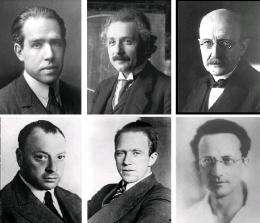
June 8, 2009 By Lisa Zyga
Some of the physicists who made early contributions to quantum mechanics (left to right, top row first): Neils Bohr, Albert Einstein, Max Planck, Wolfgang Pauli, Werner Heisenberg [Credit: Deutsches Bundesarchiv (German Federal Archive), Bild183-R57262], and Erwin Schrödinger.
Does mysticism have a place in quantum mechanics today, or is the idea that the mind plays a role in creating reality best left to philosophical meditations? Harvard historian Juan Miguel Marin argues the former - not because physicists today should account for consciousness in their research, but because knowing the early history of the philosophical ideas in quantum mechanics is essential for understanding the theory on a fundamental level.
In a recent paper published in the European Journal of Physics, Marin has written a short history, based on a longer analysis, of the mysticism controversy in the early quantum physics community. As Marin emphasizes, the controversy began in Germany in the 1920s among physicists in reaction to the new theory of quantum mechanics, but was much different than debates on similar issues today. At the turn of the last century, science and religion were not divided as they are today, and some scientists of the time were particularly inspired by Eastern mysticism. In his analysis, Marin lays out each player’s role and perspective in the controversy, and argues that studying the original interpretations of quantum mechanics can help scientists better understand the theory, and could also be important for the public in general.
“Becoming aware of this subject would help general audiences realize that there are many other alternatives besides the ones offered by the disjunction between science and religion,” Marin told PhysOrg.com. “Science vs. religion is a very recent forced choice that the founders of quantum mechanics would have never recognized, much less accepted.”
Mind Matters
The controversy boils down to the age-old question of the nature of reality. As Einstein (a firm realist) once asked, does the moon exist only when looked at? Although such a viewpoint seems unlikely in our everyday lives, in quantum mechanics, physicists’ observations can sometimes affect what they’re observing on a quantum scale. As the famous Copenhagen interpretation of quantum mechanics argues, we cannot speak about an objective reality other than that which is revealed through measurement and observation.
As Marin explains, the debate of consciousness in quantum theory began around 1927 when Einstein accused Neils Bohr of introducing a mysticism incompatible with science. Bohr denied the accusation and blamed it on Einstein misunderstanding him when he said that humans are both actors and observers in the world. Yet while Bohr believed that quantum processes occurred without the need for observers, he also sympathized with the idea that an extension of quantum theory might help in understanding consciousness.
Einstein, for his part, adamantly opposed any subjectivity in science. He disagreed with Bohr’s view that it is unscientific to inquire whether or not Schrödinger’s cat in a box is alive or dead before an observation is made. Einstein devoted much of his later life to searching for elements of reality to make quantum mechanics a theory based on realism. For instance, the EPR paradox (Einstein-Podolsky-Rosen paradox) thought experiment in 1935 attempted to restore realism and causality to the theory.
On the other hand, Wolfgang Pauli truly did harbor some of the views that Einstein accused Bohr of. Pauli favored a hypothesis of “lucid mysticism,” a synthesis between rationality and religion. He speculated that quantum theory could unify the psychological/scientific and philosophical/mystical approaches to consciousness. Pauli’s perspective was influenced by the philosopher Arthur Schopenhauer, whose views on reality were in turn influenced by Eastern religions.
Still other physicists had different views. Marin argues that Max Planck, an adherent of Christianity, framed the controversy as the objectivity of science and Christianity against the mysticism of Schopenhauer and his popularization of Buddhism and Hinduism. Planck considered religion (Christianity) and science compatible based on his opinion that they are both based on objectivity but refer to distinct facets of reality. Meanwhile, Paul Dirac rejected any kind of religious vocabulary, arguing that “religion is a jumble of false assertions with no basis in reality.”
The mysticism controversy also expanded into the public realm, starting in 1929 with first astrophysicist Arthur Eddington’s popular book The Nature of the Physical World. Although the book distorted many concepts, his defense of mysticism caught the attention of the international media. (Eddington was most famous for confirming Einstein's theory of relativity by measuring an eclipse, which catapulted Einstein into fame.)
In the next few years Werner Heisenberg and Erwin Schrödinger leaned toward the side of mysticism, irritating Einstein and Planck. For others, the choice was not clear cut. Marin argues that the mathematician John Von Neumann intentionally used ambiguous terms when discussing the philosophy of quantum equations, meaning he could fit on either side. “He was a genius at linguistic innovation and came up with German terms that could support many different interpretations,” Marin said.
In 1958, Schrödinger, inspired by Schopenhauer from youth, published his lectures Mind and Matter. Here he argued that there is a difference between measuring instruments and human observation: a thermometer’s registration cannot be considered an act of observation, as it contains no meaning in itself. Thus, consciousness is needed to make physical reality meaningful. As Schrödinger concluded, "Some of you, I am sure, will call this mysticism. So with all due acknowledgement to the fact that physical theory is at all times relative, in that it depends on certain basic assumptions, we may, or so I believe, assert that physical theory in its present stage strongly suggests the indestructibility of Mind by Time."
Cultural Reflections
As Marin notes, Schrödinger’s lectures mark the last of a generation that lived with the mysticism controversy. As Marin explains, quantum mechanics up to World War II existed in a predominantly German context, and this culture helped to form the mystical zeitgeist of the time. The controversy died in the second half of the century, when the physics culture switched to Anglo-American. Most contemporary physicists are, like Einstein, realists, and do not believe that consciousness has a role in quantum theory. The dominant modern view is that an observation does not cause an atom to exist in the observed position, but that the observer finds the location of that atom.
As Marin has shown, the mysticism controversy in quantum mechanics did not involve just a few physicists and mystics (as it seems to today), but at one time it attracted the physics community at large. Some of the ideas have since resurfaced, such as in Eugene Wigner’s 1961 paper on the subject, which inspired popular books such as The Tao of Physics and The Dancing Wu Li Masters, which seek to connect quantum physics to Eastern mysticism for a new generation, along with the recent film What the Bleep Do We Know?
“But here it was scientists vs. non-scientists,” Marin explained. “Today it is seen as science vs. religion, but at the time of the foundation of quantum mechanics it was not. There were religious physicists on both sides of the controversy. Most of the important physicists held what we could call today religious beliefs, whether Western or Eastern. When we speak today of the ‘two cultures,’ sciences and humanities, we are referring to the famous early ‘50s lecture by C.P. Snow, in Britain, lamenting the division. German thinkers of the previous decades were barely into that phase of discipline specialization. At the turn of the century, mathematics and physics were still distinguishing themselves from the ‘natural philosophy’ that gave birth to them.”
Marin hopes that scientists today might gain a new perspective on their research by considering how the founders of quantum mechanics viewed the theory.
“Whenever I read scientific articles citing the classic equations conceived by German scientists, it seems to me they could have been improved by researching how the scientists themselves interpreted their own equations,” Marin said. “Among contemporary quantum field theories, the important gauge theories are indebted to the work of [Hermann] Weyl and Pauli. Yet many physicists today would be shocked if they learned how Weyl and Pauli understood the concept ‘field’ when they wrote their classic articles. They were both immersed in mysticism, searching for a way to unify mind and physics. Weyl published a lecture where he concluded by favoring the Christian-mathematical mysticism of Nicholas of Cusa. Moreover, Pauli's published article on Kepler presents him as part of the Western mystical tradition I study.
“For those who do not favor the Copenhagen interpretation and prefer the alternative proposed by David Bohm, I would suggest reading Bohm's many published dialogues on the topic of Eastern mysticism,” he added. “Eddington and Schrödinger, like many today, joined forces to find a quantum gravity theory. Did their shared mysticism have a role to play in whatever insights they gained or mistakes they made? I do not know, but I think it's important to find out.”
More information: Juan Miguel Marin. “’Mysticism’ in quantum mechanics: the forgotten controversy.” European Journal of Physics. 30 (2009) 807-822.
Copyright 2009 PhysOrg.com.
All rights reserved. This material may not be published, broadcast, rewritten or redistributed in whole or part without the express written permission of PhysOrg.com.


Naturalistic Approach:
Well, even if you take a 100% naturalistic approach to this question, and simply define "mind" as the functioning of the "Brain," then the mind DOES influence reality.
It's as simple as that, without even considering quantum theory, and regardless of the total nature of "mind," my brain inlfuences it's environment in any number of ways, both directly and indirectly.
Just as heat tends to flow from a hot reservior to a cold one, the same thing happens in my brain. So even in terms of nothing more than thermodynamics, the "brain" influences the environment, and therefore, reality.
To say otherwise is totally ridiculous.
Every keystroke I have made here in this message displaced energy, air, heat, nutrients, etc, and even has a tiny gravitational effect due to displacing matter. All of this, of course, caused by the functionality of the "Brain."
So if a naturalist defines "mind" as simply what goes on inside the brain, then the "mind" definitely does influence and alter reality, both in classical physics and in quantum theory.
Else you would have a fundamental contradiction of basic concepts of physics. In pure naturalism, every part of reality has impacts on every other part of reality, either directly or indirectly.
Absolute non-sense. The revolution that was quantum mechanics was primarily a epistemological one and still is. That physicists did not wrap their heads around this straight away is taken advantage of by Marin.
Bohr got it right, though did not refer to then existing philosophy of mind,... Einstein either mentioned mysticism in jest or didn't understand Bohr.
This is a typical misconception of the issue. The mind does NOT influence reality. The mind effects our CONCEPTION of it.
@magpies - Thank you! I was going to post just that.
How can ANY one state that something we do not fully understand does or does not do something? Until you have the facts to back it up, you can not correctly say one way OR the other.
My two cents? Personally I do feel that just the act of observing something has some impact on the observed, ranging from quantum uncertainty all the way to Quantum_Conundrum's example of direct physical interaction.
You unavoidably influence what you study or percieve, and while our understanding of this process may be limited to our perceptions, I would stake a decent amount of money on a bet saying that we also influence things in ways we are just begining to understand.
Shelf this argument until we have a complete understanding of the mind. :)
One important thing is that when the controversy first developed many of those physicists considered QM to be a fundamental and complete theory but it is nowadays obvious that it is neither.
Basing one's understanding of physical reality on a fundamental theory which successfully describes every aspect of it is fine but basing such understanding on a model which is known to be incomplete, inconsistent and full of absurdities is not fine. Especially when the implications of the model are as absurd as is the case with Copenhagen interpretation which among other things requires one to drop causality (of course dropping causality invalidates all the science including Copenhagen interpretation so it's just absurd).
The only rational interpretation of QM is the ensemble interpretation also called statistical one which is devoid of any mysticism.
Bohr got it very wrong, I have a quote for you:
"Niels Bohr brainwashed a whole generation of physicists into believing that the problem (of the interpretation of quantum mechanics) had been solved fifty years ago." (Murray Gell-Mann, Noble Prize acceptance speech, 1976)
"It is not surprising that our language should be incapable of describing the processes occurring within the atoms, for, as has been remarked, it was invented to describe the experiences of daily life, and these consist only of processes involving exceedingly large numbers of atoms. Furthermore, it is very difficult to modify our language so that it will be able to describe these atomic processes, for words can only describe things of which we can form mental pictures, and this ability, too, is a result of daily experience. Fortunately, mathematics is not subject to this limitation, and it has been possible to invent a mathematical scheme - the quantum theory - which seems entirely adequate for the treatment of atomic processes" - Heisenberg, On Quantum Physics
"The more you see how strangely Nature behaves, the harder it is to make a model that explains how even the simplest phenomena actually work. So theoretical physics has given up on that. - Richard Feynman, Quantum Mechanics"
"I think it is safe to say that no one understands Quantum Mechanics. - Richard Feynman, Quantum Mechanics"
"One does not, by knowing all the physical laws as we know them today, immediately obtain an understanding of anything much. - Richard Feynman, Quantum Mechanics"
As for the rest of the article, I really have only one comment:
Ted "Theodore" Logan: "SOEKRATES: the only true wisdom consists in knowing that you know nothing! ...Wow, dude, that's us!"
Bill S. Preston, Esq.: "Oh yeah!"
http://www.iop.or...30/4/014
Yes, I agree, I am also aware of all those quotes you cited, they mostly affirm my point that Copenhagen interpretation is no longer considered satisfactory in physics.
R.P.Feynman happens to be my favorite physicist due to his intuitive approach, honesty and especially due to his brilliant lectures which I recommend to anyone interested in physics.
We may live in world too reluctant for this, but some 50 years from now, kids (yeah kids!) sitting home at quantum desk computers and experience the quantum parallelisms and teleportation as the most usual things net to them, will laugh very very loud to hear that long ago there was a time when people though that brain is only a classical computer.
Quantum Enigma, by Bruce Rosenblum & Fred Kuttner (Duckworth, £9.99)
Physics has an embarrassing problem. It affects to be a rigorous, hard-headed science, yet quantum mechanics, its most successful theory (it has never made a wrong prediction), seems to rub up inevitably against the problem of consciousness, and even quasi-mystical interpretations of the universe. Why? Because of the extremely odd fact that you can choose to demonstrate either of two contradictory possibilities simply by deciding which experiment to perform. And it is not just "observer-dependent" in a weak sense; by observing a photon, you cause the photon to be there and nowhere else. Before you observed it, it wasn't just in some specific location of which you were ignorant, it was in no particular place at all, or in many places at once.
This excellent book provides patient and luminous explanations of the weirdness, and a critique of the normal pragmatic reply: "Whatever works." The physicist-authors agree that it works (lasers, transistors and so on), but argue that the "enigma" of what it means has been swept under the carpet for too long. They end with a series of fascinating speculations as to what it might imply, if taken seriously, for theories of consciousness and cosmology. The physicist Niels Bohr said that if you are not shocked by quantum physics, you don't understand it. Rosenblum and Kuttner have done a brilliant job of shocking the reader anew.
http://books.guar...,00.html
or=B[R]
Here or stands for observed reality, B is our %u201Ctrue%u201D body, R is %u201Ctrue%u201D reality and the brackets depict some unknown function performed by B.
Everything we observe and study, our perceived reality, is in or.
B[R] is in metaphysical space, the %u201Cnoumenal%u201D world of Kant (and acknowledged by many others, e.g. Schopenhauer, Quine).
It is very important to notice that or is a conscious %u201Cphenomenon%u201D. It is the integrated conscious observation of all humankind. It gives us matter, but also space and time.
R, which includes B, and its function [], can be literally anything as long as or results from B[R].
Since or is in conscious %u201Cspace%u201D it is tempting to speculate that B[R] is in conscious %u201Cspace%u201D as well.
This can be called mystiscism, but, except for the speculation, it is simple logic.
Dames,
See the article "What if there is only one universe?", where myself and Hyperion independantly mention Kant's transcedental deduction, in that context.
But either way, well designed thought experiments are cool.
The main issue is that it cannot be defined as it is just a subjective state of human mind.
This is non-issue, the main issue of QM is that it is incomplete, inconsistent and leads to absurd conclusions when we attempt to interpret it's mathematical formalism.
No, they have completely different issues. You assume that if we don't understand A and B then A and B have to be connected somehow which is simply not true.
This is nonsense, QM never made a wrong prediction? Where did you get it from? It sounds like you have completely misunderstood some badly written popular article on the subject. Although in QM you can have superposition of states predictions are probabilistic and can be easily verified. For example if theory says something is a mix of '0' and '1' and both have equal probability while experiments consistently give '1' then the prediction is proven wrong. QM has made countless wrong predictions, if it weren't for renormalization which uses mathematical tricks to overcome it's divergences it would be a complete failure.
One of the biggest failures when it comes to predictions of QM is the infinite vacuum energy and therefore cosmological constant which is of course completely wrong.
Also you cannot "choose to demonstrate either of two contradictory possibilities simply by deciding which experiment to perform." If it were true the theory would be completely useless. The results are no longer contradictory once you take your measuring apparatus into account. There are plenty of contradictions in QM but mostly in the realm of how and why it works and not it's immediate predictions.
It was not my idea to define B[R] as a subset of or. But simply because or is in conscious space I speculate that B[R] is in conscious space as well, just to equate dimensions at both sides. I know I cannot say anything about R, nor about B (except that it must be part of R).
The formula tells us something about neurological research on the generation of consciousness. In my opinion that doesnot make any sense, for atoms, molecules, cells, tissues, they all are part of or. And or itself is a conscious phenomenon.
If at all consciousness is a generated state, then that generation takes place in B[R], that means in metaphysical space.
Thank you for the reference to your book.
Regarding the PhysOrg article, "What if there is only one universe?", I was not clear above; I did not write the article, only user comments at the end, where we discuss a similar topic.
You actually said that subjective state cannot be defined as it is just a subjective state. Did I miss something?
It was solved 50 years ago!
The book is a very concise and frank discussion of the copenhagen interpretation of quantum electrodynamics, its strengths and weaknesses (and yes, there are emperically demonstrable weaknesses that have nothing to do with mysticism). These same problems are the same ones that lead Richard Feynmann to say:
"You see, my physics students don't understand it either. That is because I don't understand it. Nobody does." (QED, The Strange Theory of Light and Matter, by Richard P. Feynmann - Ch. 1, pg. 9)
Even Feynmann could not entirely dismiss the issues raised here. He in stead chose to say, "they probably don't matter." Unfortunately, his 'non-denial' comment with only a 'qualified' dismissal has since encountered some real problems.
No wonder a previous poster gave us a a superb quote which I repost now:
"Niels Bohr brainwashed a whole generation of physicists into believing that the problem (of the interpretation of quantum mechanics) had been solved fifty years ago." (Murray Gell-Mann, Noble Prize acceptance speech, 1976)
Stick your head in the sand if you will, but don't be surprised when the other end gets mistaken for your head. Narrow minded dogma for no other purpose than athiestic ax grinding has always been a poor substitute for real science, even if you're an athiest.
Incidentally, "Quantum Enigma" does not defend, or even propose the existence of diety or the validity of mysticism. They stick to science a lot better than most of the critics of this article have so far done.
Secondly, mysticism and consciousness are not equivalent. Somehow consciousness is derived from natural laws, and quantum non-locality might be an essential aspect for consciousness. Cosmic non-locality as a natural aspect of 'cosmic' enlightened consciousness is a natural hypothesis, and should not automatically regarded as "unrealistic", since "Einstein's barrier" is only a postulate.
The Maxwell/Poincaré/Lorentz upper limit for signal speed (an assumption automatically implied by the very use of the Lorentz coordinate transforms) is the obvious reason why people reject mysticism and religion. Believers of the unproven postulate that c is an upper limit for signal speed call themselves "realists", but this is something they believe in.
Its humourous that 7 more dimensions and dark matter/energy are regarded as OK premises to explore hypothesis in in physics now (as long as you don't suggest that these have anything going on but dull gravity and not any depth of organisation yet). But not yet in neurology or psychology, where to suggest they exist is heresy.
The descriptions of 7 higher dimensions and an active "unseen" universe from "mystic" traditions that are pan-cultural are completely compatible with the physics theories of today. Mysticism is dangerous heresy in most religions though it should be pointed out. And science as a community could be described as one of those churches.
The common experience in all cultures by some of experiencing observations of other dimensions, non-locality of information transfer, both spacial, and temporal, and Dark matter/energy complex behaviour is annoying and jealousy inspiring to those who have not shared those observations. Especially when taking photos to show around is not yet possible. But If "mysticism is dead" then it must only be because of a snowball of acceptance that our consciousness has extradimensional and dm/de components and senses, and is a valid tool for observation.
As far as consciousness changing reality directly? Maybe morpheus had the best answer for that ;-) "nobody can be told what the matrix is, they have to see it for themselves!" Lolz
Is well worth reading. eg:
"The rift between mysticism and the modern sciences derives mainly from elements of scientism in the latter: certain branches of the natural sciences, broadly disavow subjective experience as meaningless, misunderstanding the limitations of the ancient languages. That said, several areas of study in biology (work of Mae Wan Ho and Lynn Margulis are two examples) and philosophy address the same issues that concern the mystic, and modern physicists now struggle to understand a multiple dimensional reality that mystics' have attempted to describe for millennia. Physicist David Bohm speaking of consciousness expressing itself as matter and/or energy would be completely understood by the mystic, whatever his cultural/religious heritage."
""...Spiritual transcendence and religion have little in common. In fact, if we look closely, we can see that these two have been the fundamental antagonists in our history,"
" "As the observing self begins to transcend... deeper or higher dimensions of consciousness come into focus. All of the items on that list are objects that can be directly perceived in that worldspace. Those items are as real in [that] worldspace as rocks are in the sensorimotor worldspace and concepts are in the mental worldspace. If cognition awakens or develops to this level, you simply perceive these new objects as simply as you would perceive rocks in the sensory world or images in the mental world. They are simply given to awareness, they simply present themselves, and you don't have to spend a lot of time trying to figure out if they're real or not."
"Of course, if you haven't awakened to [this] cognition, then you will see none of this, just as a rock cannot see mental images. And you will probably have unpleasant things to say about people who do see them"
;-)
here a good example of a contemporary "quantum mystic" working on hypothesis of behaviour of darkmatter/energy and higher dimensions from a physics point of view. Not that I think he's got it all right. I doubt his contention that em forces are important. unless they are active in other dimensions from normal matter.
http://www.dapla.org/
We are kind of in a galileo type paradigm change in these times.
- In his day everyone thought that not a lot went on in the universe but what was on the surface of the earth. stars, planets, sun all little lights just revolving around us.
- Now we have noticed that what we were seeing is only a small fraction of the universe, but we are mostly still clinging to the egotistical notion that not much goes on in that majority of the universe.
Many want to think it just revolves around the normal matter. ;-)
This conflict between religion and science has gotten completely out of hand. And, to be blunt, the antagonists are largely on the scientific side of the debate, as many scientists mistakenly conclude that evidence of a universe governed by physical laws implies strict physicalism (the material/physical paradigm is the ONLY paradigm). It's faulty reasoning.
In the words of John Paull II, "Truth cannot contradict truth."
Ignacious is a good one too. "the un-knowing". Paraphrasing of my alltime favourite theorum/axiom.
The infinite hypothesis theorem: Every question answered poses at least one, usually many more questions. Or "the more ya know the more ya know ya don't know."
Liguistic defn's can be confusing. In the place of the word mysticism in the above article, it may be that esotericism would be better fitting with the context and intended meaning. The opposite of exotericism (describing the world observed by our senses).
On the other hand. If we are scrutinising einstein. I'm reluctant to stress this too harshly, as he seems when being honest about his position to close friends to have been quite firm in his lack of faith in the premises and derivations from them that many since have been required to hold unquestionable.
The holy trinity of framedependant similtaneity, Timespace reforming to make any event obey the same motion formulae however distant or high its relative velocity, andt the magic unsurpassable C.
Those do verge on the sort of compulsive insistance to swallow religious doctrine that could fit into many peoples perception of the meaning of "mysticism"
And most religions are the political control structures built on the hypothesis of the structure of behaviours of mysterious phenominon observed by and suggested by "prophets".
Often the metaphors they use to discuss these hypothesis get abducted and utilised in the building of a pataphorical universe that gains a life of its own in the troop of initiates that count each other as true believers relativitily.
Energy-Mass Superposition
The Fractal Oneness Of The Universe
The universe is the archetype of quantum within classical physics, which is the fractal oneness of the universe.
Astronomically there are two physics, a classical physics behaviour of and between galactic clusters, and a quantum physics behaviour WITHIN the galactic clusters.
The onset of big-bang's inflation, the cataclysmic resolution of the Original Superposition, started gravity, with formation - by dispersion - of galactic clusters that behave as classical Newtonian bodies and continuously reconvert their original pre-inflation masses back to energy, thus fueling the galactic clusters expansion, and with endless quantum-within-classical intertwined evolutions WITHIN the clusters in attempts to delay-resist this reconversion.
Dov Henis
(Comments from 22nd century)
http://blog.360.y...Q--?cq=1
On Energy, Mass, Gravity, Galaxies Clusters, AND Life
A Commonsensible Recapitulation
http://www.the-sc...age#2125
Updated Life's Manifest May 2009
http://www.physfo...ic=14988&st=480entry412704
http://www.the-sc...age#2321
Here's a question: Is there a continuum of consciousness over all past species here on earth, or is consciousness quantized?
If there is a continuum of consciousness, does that imply that those with a lesser consciousness have less control over reality?
I like to stop after saying that, "Observables are interconnected with observers/observations." I'm not sure how productive causality (chicken/egg) arguments are.
Gerbus
http://www.gerbus...ibility/