Moon magic: Researchers develop new tool to visualize past, future lunar eclipses
June 8, 2009
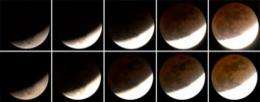
The top row of images is comprised of digital photographs taken from Troy, N.Y., of the Feb. 21, 2008 lunar eclipse. The bottom row of images is comprised of computer simulations rendered by researchers at Rensselaer Polytechnic Institute. Credit: Rensselaer/Yapo
Lunar eclipses are well-documented throughout human history. The rare and breathtaking phenomena, which occur when the moon passes into the Earth's shadow and seemingly changes shape, color, or disappears from the night sky completely, caught the attention of poets, farmers, leaders, and scientists alike.
Researchers at Rensselaer Polytechnic Institute have developed a new method for using computer graphics to simulate and render an accurate visualization of a lunar eclipse. The model uses celestial geometry of the sun, Earth, and moon, along with data for the Earth's atmosphere and the moon's peculiar optical properties to create picture-perfect images of lunar eclipses.

Researchers at Rensselaer Polytechnic Institute have developed a new method for using computer graphics to simulate and render an accurate visualization of a lunar eclipse. Image "A" is a photograph of the Feb. 21, 2008, eclipse. The other images are computer renderings of the same eclipse with b) no atmospheric dust, c) light aerosol attenuation, and d) heavy dust particulate. Credit: Rensselaer/Yapo
The computer-generated images, which are virtually indistinguishable from actual photos of eclipses, offer a chance to look back into history at famous eclipses, or peek at future eclipses scheduled to occur in the coming years and decades. The model can also be configured to show how the eclipse would appear from any geographical perspective on Earth - the same eclipse would look different depending if the viewer was in New York, Seattle, or Rome."Other researchers have rendered the night sky, the moon, and sunsets, but this is the first time anyone has rendered lunar eclipses," said Barbara Cutler, assistant professor of computer science at Rensselaer, who supervised the study. "Our models may help with investigations into historical atmospheric phenomena, and they could also be of interest to artists looking to add this special effect to their toolbox."
Graduate student Theodore C. Yapo presented the study, titled "Rendering Lunar Eclipses," in late May at the Graphics Interface 2009 conference.
The appearance of lunar eclipses can vary considerably, ranging from nearly invisible jet black to deep red, rust, to bright copper-red or orange. The appearance depends on several different factors, including how sunlight is refracted and scattered in the Earth's atmosphere. Yapo and Cutler combined and configured models for sunlight, the solar system, as well as the different layers and different effects of the Earth's atmosphere, to develop their lunar eclipse models.
For the study, Yapo and Cutler compared digital photos of the Feb. 21, 2008, total lunar eclipse with computer-rendered models of the same eclipse. The rendered images were nearly indistinguishable from the photos.
Another model they created was a rendering of the expected 2010 lunar eclipse. Yapo said he looks forward to taking photographs of the event and comparing them to the renderings. One potential hiccup, he said, is the April eruption of Mt. Redoubt in Alaska - volcanic dust in the Earth's stratosphere can make a lunar eclipse noticeably darker and more brown. Yapo and Cutler's models can account for this dust, but they performed their simulation prior to the eruption, and assumed a low-dust atmosphere.
-
Get Ready For Total Lunar Eclipse Wednesday Night
Feb 19, 2008 |
not rated yet |
0
-
Total Lunar Eclipse
Feb 14, 2008 |
not rated yet |
0
-
A Solar Eclipse on the Moon
Apr 21, 2005 |
not rated yet |
0
-
Lunar Eclipse
Feb 13, 2007 |
not rated yet |
0
-
Passage graves from an astronomical perspective
Dec 18, 2008 |
not rated yet |
0
-
Engineers build first sub-10-nm carbon nanotube transistor
Feb 01, 2012 |
4.9 / 5 (33) |
30
-
Something old, something new: Evolution and the structural divergence of duplicate genes
Jan 31, 2012 |
4.6 / 5 (7) |
1
-
The hidden nanoworld of ice crystals: Revealing the dynamic behavior of quasi-liquid layers
Jan 30, 2012 |
5 / 5 (5) |
1
-
Stock market network reveals investor clustering
Jan 27, 2012 |
3.9 / 5 (23) |
8
-
Of microchemistry and molecules: Electronic microfluidic device synthesizes biocompatible probes
Jan 26, 2012 |
5 / 5 (2) |
0
-
Never ending outer space.....
Feb 11, 2012
-
Neutron Star fragments?
Feb 11, 2012
-
stationary or not?
Feb 11, 2012
-
Scale of the Universe
Feb 10, 2012
-
Titan's lack of impact craters
Feb 09, 2012
-
Real pictures of black hole eating a star?
Feb 08, 2012
- More from Physics Forums - General Astronomy
More news stories
With climate change, today's '100-year floods' may happen every three to 20 years: research
Last August, Hurricane Irene spun through the Caribbean and parts of the eastern United States, leaving widespread wreckage in its wake. The Category 3 storm whipped up water levels, generating storm surges ...
4 minutes ago |
not rated yet |
0
|
New European rocket lifts off on maiden flight
A new lightweight rocket, Vega, lifted off from Europe's space base Monday carrying nine satellites on its inaugural flight, mission control said.
Space & Earth / Space Exploration
1 hour ago |
5 / 5 (3) |
1
Climate change causes harmful algal blooms in North Atlantic: study
Warming oceans and increases in windiness could be causing of an abundance of harmful algal blooms in the North Atlantic Ocean and North Sea, according to new research.
2 hours ago |
not rated yet |
0
Salvage workers begin pumping fuel from Italian shipwreck
Salvage workers Sunday began pumping fuel from the shipwrecked Italian cruise liner Costa Concordia, a day ahead of schedule, officials said.
17 hours ago |
5 / 5 (2) |
0
NASA budget will axe Mars deal with Europe: scientists
US President Barack Obama's budget proposal to be submitted next week for 2013 will cut NASA's budget by 20 percent and eliminate a major partnership with Europe on Mars exploration, scientists said Thursday.
Space & Earth / Space Exploration
Feb 10, 2012 |
5 / 5 (4) |
59
New molecule has potential to help treat genetic diseases and HIV
(PhysOrg.com) -- Chemists at The University of Texas at Austin have created a molecule that's so good at tangling itself inside the double helix of a DNA sequence that it can stay there for up to 16 days before ...
Social psychologist: Lust makes you smarter and evidence that seven deadly sins are good for you
(Medical Xpress) -- Good news for lovers on Valentine’s Day - the seven deadly sins, including Lust, are good for you. University of Melbourne social psychologist Dr Simon Laham uses modern research to make a compelling ...
The joy of cheques
An electronic cheque which eliminates the need for costly processing by banks but preserves the simplicity and ease of a traditional cheque book has been designed by a team of academics in the UK.
Research shows promise in converting camelina oil into jet fuel
(PhysOrg.com) -- Researchers at Montana State University-Northern have developed a process to convert camelina oil to jet fuel and other high-value chemicals. MSU has applied for a U.S. patent and research is ongoing.
Couples in the same place emotionally stay together, study says
(Medical Xpress) -- Despite lifes ups and downs, couples whose feelings are in sync consistently over time are more likely to stay together, says a University of California, Davis, study.
Researchers make breakthrough in stem cell research
(Medical Xpress) -- University of Queensland scientists have developed a world-first method for producing adult stem cells that will substantially impact patients who have a range of serious diseases.
