Three times farther away in outer space than previously possible -- a new way to measure cosmic distances
Ohio State University researchers have found a way to measure distances to objects three times farther away in outer space than previously possible, by extending a common measurement technique.
They discovered that a rare type of giant star, often overlooked by astronomers, could make an excellent signpost for distances up to 300 million light years -- and beyond.
Along the way, they also learned something new about how these stars evolve.
Cepheid variables -- giant stars that pulse in brightness -- have long been used as reference points for measuring distances in the nearby universe, said Jonathan Bird, doctoral student in astronomy at Ohio State. Classical cepheids are bright, but beyond 100 million light years from Earth, their signal gets lost among other bright stars.
In a press briefing at the American Astronomical Society meeting in Pasadena, CA, Bird revealed that a rare and even brighter class of cepheid -- one that pulses very slowly -- can potentially be used as a beacon to measure distances three times farther than their classical counterparts.
This project is the latest in principal investigator Krzysztof Stanek's effort to gauge the size and age of the universe with greater precision.
There are several methods for calculating the distance to stars, and astronomers often have to combine methods to indirectly measure a distance. The usual analogy is a ladder, with each new method a higher rung above another. At each new rung of the cosmic distance ladder, the errors add up, reducing the precision of the overall measurement. So any single method that can skip the rungs of the ladder is a prized tool for probing the universe.
Stanek, professor of astronomy at Ohio State, applied a direct measurement technique in 2006, when he used the light emerging from a binary star system in the galaxy M33 to measure the distance to that galaxy for the first time. M33 is 3 million light years from Earth.
This new technique using so-called "ultra long period cepheids" (ULP cepheids) is different. It's an indirect method, but this initial study suggests that the method would work for galaxies that are much farther away than M33.
"We found ultra long period cepheids to be a potentially powerful distance indicator. We believe they could provide the first direct stellar distance measurements to galaxies in the range of 50-100 megaparsecs (150 million - 326 million light years) and well beyond that," Stanek said.
Because researchers generally don't take note of ultra long period cepheids, there are few of them in the astronomical record. For this study, Stanek, Bird and Ohio State doctoral student Jose Prieto uncovered 18 ULP cepheids from the literature.
Each was located in a nearby galaxy, such as the Small Magellanic Cloud. The distances to these nearby galaxies are well known, so the astronomers used that knowledge to calibrate the distance to the ULP cepheids.
They found that they could use ULP cepheids to determine distance with a 10-20 percent error -- a rate typical of other methods that make up the cosmic distance ladder.
"We hope to reduce that error as more people take note of ULP cepheids in their stellar surveys," Bird said. "What we've shown so far is that the method works in principle, and the results are encouraging."
Bird explained why astronomers have ignored ULP cepheids in the past.
Short period cepheids, those that brighten and dim every few days, make good distance markers in space because their period is directly related to their brightness -- and astronomers can use that brightness information to calculate the distance. Polaris, the North Star, is a well known and classical cepheid.
But astronomers have always thought that ULP cepheids, which brighten and dim over the course of a few months or longer, don't obey this relation. They are larger and brighter than the typical cepheid. In fact, they are larger and brighter than most stars; in this study, for example, the 18 ULP cepheids ranged in size from 12-20 times the mass of our sun.
The brightness makes them good distance markers, Stanek said. Typical cepheids are harder to spot in distant galaxies, as their light blends in with other stars. ULP cepheids are bright enough to stand out.
Astronomers have also long suspected that ULP cepheids don't evolve the same way as other cepheids. In this study, however, the Ohio State team found the first evidence of a ULP cepheid evolving as a more classical cepheid does.
A classical cepheid will grow hotter and cooler many times over its lifetime. In-between, the outer layers of the star become unstable, which causes the changes in brightness. ULP cepheids are thought to go through this period of instability only once, and going in only one direction -- from hotter to cooler.
But as the astronomers pieced together data from different parts of the literature for this study, they discovered that one of the ULP cepheids -- a star in the Small Magellanic Cloud dubbed HV829 -- is clearly moving in the opposite direction.
Forty years ago, HV829 pulsed every 87.6 days. Now it pulses every 84.4 days. Two other measurements found in the literature confirm that the period has been shrinking steadily in the decades in between, which indicates that the star itself is shrinking, and getting hotter.
The astronomers concluded that ULP cepheids may help astronomers not only measure the universe, but also learn more about how very massive stars evolve.
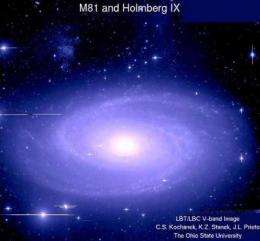
Some of these results were reported in the Astrophysical Journal in April 2009. Since that paper was written, the Ohio State astronomers have started using the Large Binocular Telescope in Tucson, Arizona to look for more ULP cepheids. Stanek says that they've found a few good candidates in the galaxy M81, but those results have yet to be confirmed.
Source: The Ohio State University (news : web)


