Fire mitigation work in western US misplaced, says new study
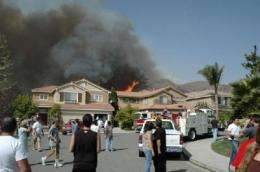
Only 11 percent of wildfire mitigation efforts undertaken as a result of a long-term federal fuels-reduction program to cut down catastrophic wildfire risk to communities have been undertaken near people's homes or offices in the past five years, says a new study led by the University of Colorado at Boulder.
The analysis of the U.S. National Fire Plan shows that as more Americans live in or near fire-prone forests and more wildfires burn, most federally funded activities to reduce fuels and wildfire hazard have occurred far from the "wildland-urban interface," the area prioritized by federal wildfire policies. The result suggests that federal wildfire treatments are minimally effective at mitigating the threat of wildfire to homes and people in the western United States.
The study also suggests that future fire mitigation strategies should emphasize constructing and maintaining "firewise" homes, restricting the abundance and configuration of residential housing units near wildlands susceptible to fire, and improving cooperation among private and public landowners in implementing fire mitigation treatments and in paying for fire suppression.
"Our comprehensive analysis suggests that fire mitigation treatments do not effectively target the wildland-urban interface," said Tania Schoennagel, a research scientist in CU-Boulder's geography department.
Schoennagel led a team of researchers who examined 44,000 federally funded wildfire mitigation projects in 11 western states between 2004 and 2008.
Schoennagel's team is the first to evaluate the U.S. National Fire Plan's management activities across the West, and to compare the location of fire-mitigation treatments to the wildland-urban interface and its nearby surroundings. The team's findings will be published in the June 8 edition of the Proceedings of the National Academy of Sciences.
Co-authors on the study included CU-Boulder graduate student Teresa Chapman, the University of Montana's Cara Nelson and Gunner Carnwath and Colorado State University's David Theobald. The study was funded by the National Science Foundation and the Wilburforce Foundation.
The team found that only 11 percent of fuel-reduction activities took place within about 1.5 miles of the wildland-urban interface, where fires pose the greatest risk to homes and people. At the same time, most of the treated land was more than 6 miles from this high-risk zone.
There are reasons that more land near the wildland-urban interface might not have been treated, said Schoennagel. The study found that 70 percent of the wildland-urban interface plus a 1.5-mile community-protection zone surrounding it is privately owned, which limits the federal government's ability to treat the high-risk zone.
The results underscore the research team's call for a "significant shift in fire policy emphasis from federal to private lands" if protecting people and homes remains a primary goal. For example, reducing ignitable fuels and structures within around 100 feet of private homes has been shown to most effectively protect a home from burning.
Federal agencies treated more than 29 million fire-prone acres between 2001 and 2008.
The cost of treatments is substantial. Congress allocated $2.7 billion for fuels treatment between 2001 and 2006. The cost of fire suppression is also substantial, exceeding $1 billion per year recently, largely for protection of private property in the wildland-urban interface. Because costs are high, it is important to track whether fire mitigation is being targeted near where people live, said Schoennagel.
The risk of wildfire to people has increased for two primary reasons, and is expected to continue rising, she said.
One cause is the recent influx of people living in or near scenic wildlands. In the western United States, the area of wildland-urban interface grew by 61 percent between 1970 and 2000. Between 1990 and 2000, the number of housing units in the wildland-urban interface rose by 68 percent, according to research cited by the study.
The other reason is a recent increase in wildfires. Schoennagel and her colleagues cite other research that has shown that the area of forest burned between 1987 and 2003 was six times greater than that which burned in the previous 16 years. That research also shows that this same time period was characterized by increased spring and summer temperatures, longer fire seasons and earlier snowmelt, the Schoennagel paper states.
Between 2002 and 2006, wildfires claimed 10,000 U.S. homes. In four of the last five years, wildfires have consumed more than 8 million acres annually, and the total area burned in each of those four years was greater than that of any year between 1960 and 2004, according to the National Interagency Fire Center.
Climate models predict rising temperatures and declining snowpack this century. The combination of more people in the wildland-urban interface and hotter, drier weather could be incendiary.
Schoennagel and her colleagues also cited research indicating that much of the wildland-urban interface in the West is in forests and shrublands subject to hard-to-control, high-severity fires, where fuels are abundant but fires are driven by severe weather events.
"These forests do not burn often because they generally are cooler and moister than lower-elevation forests, but when they do, they burn hot and fast," Schoennagel said.
The authors acknowledged that fuels treatments located far from the wildland-urban interface may play an important role in protecting timber resources and rare or threatened species or ecosystems from high-severity fire. But their effectiveness in direct protection of human communities is questionable given that the potential for a home to burn is relatively independent of distant wildland fire behavior.
"Treatments implemented far from the wildland-urban interface should be conducted primarily where substantial benefits to watershed protection, biodiversity, or restoration of degraded ecosystems can be demonstrated," said Nelson, an assistant professor of restoration ecology at the University of Montana.
Source: University of Colorado at Boulder (news : web)


