Snakes use friction and redistribution of their weight to slither on flat terrain
June 8, 2009
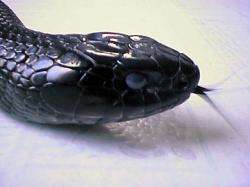
Eastern indigo snake

Snakes use both friction generated by their scales and redistribution of their weight to slither along flat surfaces, researchers at New York University and the Georgia Institute of Technology have found. Their findings, which appear in the latest issue of the Proceedings of the National Academy of Sciences, run counter to previous studies that have shown snakes move by pushing laterally against rocks and branches.

"We found that snakes' belly scales are oriented so that snakes resist sliding toward their tails and flanks," said the paper's lead author, David Hu, a former post-doctoral researcher at NYU's Courant Institute of Mathematical Sciences and now an assistant professor of mechanical engineering at Georgia Tech's George W. Woodruff School of Mechanical Engineering. "These scales give the snakes a preferred direction of motion, which makes snake movement a lot like that of wheels, cross-country skis, or ice skates. In all these examples, sliding forward takes less work than does sliding sideways."

The study's other co-authors were Jasmine Nirody and Terri Scott, both undergraduate researchers at NYU, Michael Shelley, a professor of mathematics and neural science and the Lilian and George Lyttle Professor of Applied Mathematics at Courant.

The study centered on the frictional anisotropy—or resistance to sliding in certain directions—of a snake's belly scales. While previous investigators had suggested that the frictional anisotropy of these scales might play a role in locomotion over flat surfaces, the details of this process had not been understood.

To explore this matter, the researchers first developed a theoretical of a snake's movement. The model determined the speed of a snake's center of mass as a function of the speed and size of its body waves, taking into account the laws of friction and the scales' frictional anisotropy. The model suggested that a snake's motion arises by the interaction of surface friction and its internal body forces.

To confirm movement as predicted by the model, the researchers then measured the sliding resistance of snake scales and monitored the movement of through a series of experiments on flat and inclined surfaces. They employed video and time-lapse photography to gauge their movements.

The results showed a close relationship between what the model predicted and the snakes' actual movements. The theoretical predictions of the model were generally consistent with the snakes' actual body speeds on both flat and inclined surfaces.

Source: New York University (news : web)

4.3 /5 (4 votes)  

Filter


Move the slider to adjust rank threshold, so that you can hide some of the comments.


Display comments: newest first

GrayMouser
Jun 08, 2009

Rank: not rated yet
WTF? This is old hat. Anybody that has ever watched a snake moving and handled one knows this.
At lease they tested their model against reality through well defined experimentation.
Skepticus
Jun 08, 2009

Rank: not rated yet
WTF? This is old hat. Anybody that has ever watched a snake moving and handled one knows this.

At lease they tested their model against reality through well defined experimentation.


You should know better by now. Anything even if that is true and well known is considered crap unless there are peer-reviewed papers about it.
weirmeir
Jun 08, 2009

Rank: not rated yet
the snakes can't read but they knew!
Rank 4.3 /5 (4 votes)
Related Stories
Relevant PhysicsForums posts
  • Factors affecting beet root cell membrane
    created22 hours ago
  • Stem cell question.
    createdFeb 10, 2012
  • Protease cleavage
    createdFeb 10, 2012
  • Pertubance in a model
    createdFeb 10, 2012
  • Cancer drugs and Alzheimer's, Oh my!
    createdFeb 09, 2012
  • Squishing cells
    createdFeb 09, 2012
  • More from Physics Forums - Biology

More news stories

Germination of Bacillus species which can lead to food poisoning

Some bacteria can form spores (survival capsules) that are particularly resistant to heat. Since sporogenous bacteria can also cause food poisoning and a reduction in food quality, they constitute a significant ...

Biology / Cell & Microbiology

created 15 minutes ago | popularity not rated yet | comments 0

New molecule has potential to help treat genetic diseases and HIV

(PhysOrg.com) -- Chemists at The University of Texas at Austin have created a molecule that's so good at tangling itself inside the double helix of a DNA sequence that it can stay there for up to 16 days before ...

Biology / Plants & Animals

created 1 hour ago | popularity 5 / 5 (2) | comments 0 | with audio podcast

Integrated pest management recommendations for the southern pine beetle

The southern pine beetle, Dendroctonus frontalis Zimmermann, is a chronic insect pest within pine forests in the southeastern United States. Under favorable environmental and host conditions, it is an agg ...

Biology / Ecology

created 4 hours ago | popularity not rated yet | comments 0

A mitosis mystery solved: How chromosomes align perfectly in a dividing cell

Although the process of mitotic cell division has been studied intensely for more than 50 years, Whitehead Institute researchers have only now solved the mystery of how cells correctly align their chromosomes during symmetric ...

Biology / Cell & Microbiology

created 18 hours ago | popularity 4.5 / 5 (22) | comments 0 | with audio podcast

Researchers find extensive RNA editing in human transcriptome

In a new study published online in Nature Biotechnology, researchers from BGI, the world's largest genomics organization, reported the evidence of extensive RNA editing in a human cell line by analysis of RNA-seq data, demons ...

Biology / Biotechnology

created 18 hours ago | popularity 5 / 5 (4) | comments 0 | with audio podcast


With climate change, today's '100-year floods' may happen every three to 20 years: research

Last August, Hurricane Irene spun through the Caribbean and parts of the eastern United States, leaving widespread wreckage in its wake. The Category 3 storm whipped up water levels, generating storm surges ...

Researchers make better heat sensor based on butterfly wings

(PhysOrg.com) -- Scientists have long known that butterfly wings produce their iridescent colors by bouncing light around and between tiny ridges in structures made of chitin. More recently they’ve discovered ...

Manipulating genes with hidden TALENs

(PhysOrg.com) -- A better understanding of gene function in model plant and animal systems could be used to develop useful traits in livestock and crop plants, and might someday lead to developments in stem ...

Alien matter in the solar system: A galactic mismatch

This just in: The Solar System is different from the space just outside it.

The joy of cheques

An electronic cheque which eliminates the need for costly processing by banks but preserves the simplicity and ease of a traditional cheque book has been designed by a team of academics in the UK.

Research shows promise in converting camelina oil into jet fuel

(PhysOrg.com) -- Researchers at Montana State University-Northern have developed a process to convert camelina oil to jet fuel and other high-value chemicals. MSU has applied for a U.S. patent and research is ongoing.