University of Texas 'Picosatellite' to be launched from space shuttle to begin milestone mission
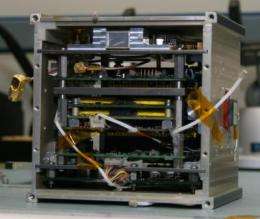
In an initial step toward the first successful rendezvous and docking of very small satellites without human control, a pair of miniature "picosatellites" built by University of Texas at Austin and Texas A&M University engineering students will be launched into orbit this month from Space Shuttle Endeavour.
In the process, the students will try to accomplish what only multi-million-dollar space missions have attempted: the autonomous docking and rendezvous of satellites. In this case, they'll be using picosatellites, named for being very compact and lightweight.
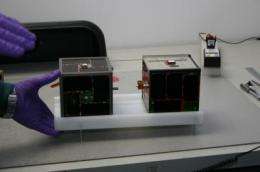
The satellites, five-inch cubes weighing seven pounds, will be jettisoned into low-Earth orbit from Space Shuttle Endeavour during the STS-127 mission scheduled for launch June 13. The mission, dubbed LONESTAR, is a collaboration among NASA's Johnson Space Center and the two universities.
"Having this complicated process performed without human control is a great challenge for any spacecraft but more so for picosatellites," said Robert Bishop, chairman of the Department of Aerospace Engineering and Engineering Mechanics and principal investigator of the project.
It's the first of four missions planned over eight years that include a gradual build-up to the goal of rendezvous and docking: having the two satellites, or spacecraft, meeting at a desired point in space starting from different locations (the rendezvous portion) and connecting to become a single vehicle (the docking sequence) - all without human control.
The goal for the June mission will be to demonstrate undocking from the Space Shuttle and separation of the two picosatellites, which launch as one unit. Then, they will collect several orbits of position data from both hemispheres by testing a new NASA Global Positioning System receiver (DRAGON) aboard the satellites, and then downlink the data to a ground station at the university.
"This is a simple starting point," said Henri Kjellberg, an aerospace engineering graduate student who worked on the project. "Our satellite will determine where it is and send mission data down to a ground station. It does this autonomously, and that's pretty cool because it took a lot of computer programming to make it work."
The university's satellite is aptly named BEVO-1, and the A&M satellite is called AggieSat2. Each school built their satellites independently but to a common interface and worked with an annual budget of $75,000, which is remarkably inexpensive for spacecraft attempting such a task.
Bishop said several multi-million-dollar missions using much larger spacecraft have attempted autonomous rendezvous and docking. He said if the picosatellite project is successful, the design could be used as a platform for less expensive missions in the future.
"What is so special here is that these spacecraft are tiny, so the technology is packed into a small volume. And it's cheap," Bishop said. "Many strategic thinkers are looking towards picospacecraft as the next revolution in space."
The satellites will operate about 185 miles above the Earth's surface but below the altitude of the International Space Station. Kjellberg said its operational lifetime is between three to six months. However, it could remain in orbit for up to a year before falling to earth and burning up harmlessly in the atmosphere.
"We're not adding to the space debris," said Travis Imken, a team member and aerospace engineering junior.
The university's satellite was built under the program called PARADIGM, which stands for Platform for Autonomous Rendezvous And Docking with Innovative GN&C Methods. Future missions of the picosatellites will include the tasks of pointing the satellites in a particular direction, the rendezvous process and the actual docking sequence.
Associate Professor Glenn Lightsey is the co-investigator of the PARADIGM project. Other university students who worked on the picosatellite include: Jahshan Bhatti, who will be an aerospace graduate student in the fall; Kit Kennedy, an aerospace senior; Ron Maglothin, aerospace graduate student; aerospace junior Peter Schulte; and Serena Zhang, an electrical engineering senior.
In December, two more University of Texas at Austin satellites are scheduled to be launched into orbit from Kodiak Island, Alaska aboard a U.S. Air Force Minotaur IV rocket. The student-built nanosatellites (larger than picosatellites but still substantially smaller than traditional ones) are part of the Formation Autonomy Spacecraft with Thrust, Relnay, Attitude, and Crosslink (FASTRAC) program, which uses twin satellites to demonstrate navigation relative to each other.
Source: University of Texas at Austin (news : web)


