Supernova remnant is an unusual suspect
June 9, 2009 Supernova remnant is an unusual suspect

Enlarge

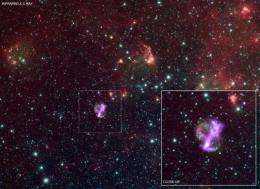
The main graphic shows the area around SNR 0104 in infrared light from Spitzer (red and green) and X-rays from Chandra (purple). The inset shows a close-up of SNR 0104. Credit: X-ray: NASA/CXC/PSU/S. Park and J. Lee; IR: NASA/JPL-Caltech

A new image from NASA's Chandra X-ray Observatory shows a supernova remnant with a different look. This object, known as SNR 0104-72.3 (SNR 0104 for short), is in the Small Magellanic Cloud, a small neighboring galaxy to the Milky Way. Astronomers think that SNR 0104 is the remains of a so-called Type Ia supernova caused by the thermonuclear explosion of a white dwarf.

In this composite made of X-rays from Chandra shown in purple and infrared data from Spitzer shown in green and red, SNR 0104 looks unlike other likely Type Ia remnants found in our own Galaxy. While objects such as the Kepler and Tycho supernova remnants appear circular, the shape of SNR 0104 in X-rays is not. Instead, the image is dominated by two bright lobes of emission (seen to the upper right and lower left). The large amount of iron in these lobes indicates that SNR 0104 was likely formed by a Type Ia supernova.

One possible explanation for this structure is that the explosion of the white dwarf itself was strongly asymmetrical and produced two jets of iron. Another possibility is that the complicated environment seen in the image is responsible. The green shells on the left and right side of SNR 0104 correspond to surrounding material that has been swept up by the explosion. So, the unusual shape of the remnant might be caused by a lack of material to the north and south of the star to interrupt the outward path of the stellar debris. This explanation, however, is still in question and scientists hope more data from Chandra and other telescopes will help settle the debate.

The presence of a nearby massive star and the shells of gas and dust seen in the wide-field view from Spitzer shows that SNR 0104 might be located within a star-forming region. This suggests that SNR 0104 may belong to a little-studied class of so-called "prompt" Type Ia supernovas caused by the demise of younger, more than average. Again, more data will be needed to test this theory.

This research was led by Sangwook Park and Jae-Joon Lee of Penn State University and was presented at the 214th meeting of the American Astronomical Society in Pasadena, California. NASA's Marshall Space Flight Center in Huntsville, Ala., manages the Chandra program for NASA's Science Mission Directorate in Washington. The Smithsonian Astrophysical Observatory controls Chandra's science and flight operations from Cambridge, Mass.

Source: Center (news : web)


print this article email this article download pdf blog this article bookmark this article     Stumble it Digg this share on Facebook retweet share on Reddit add to delicious
Rate this story - 4.5 /5 (6 votes)

Rank Filter

Move the slider to adjust rank threshold, so that you can hide some of the comments.


Display comments: newest first

  • omatumr - Jun 09, 2009
    • Rank: 1 / 5 (2)
    NEUTRON REPULSION PRODUCES COSMIC EXPLOSIONS, EJECTS IRON

    ". . . the explosion of the white dwarf itself was strongly asymmetrical and produced two jets of iron."

    Iron is the most stable form of nuclear matter.

    Neutron stars are the most unstable form of nuclear matter.

    The transition powers the Sun, ordinary stars and cosmic explosions. http://tinyurl.com/mw7mhu

    With kind regards,
    Oliver K. Manuel
    http://myprofile....anuelo09

June 9, 2009 all stories

Comments: 1

4.5 /5 (6 votes)
  • Stumble this up

  • Digg this

  • share this

  • hide
  • Related Stories

  • Chandra Spies Cosmic Fireworks
    created Jul 14, 2006 | popularity not rated yet | comments 0
  • X-ray Evidence Supports Possible New Class Of Supernova
    created Jan 04, 2007 | popularity not rated yet | comments 0
  • An Oxygen Factory in a Nearby Galaxy
    created Mar 17, 2008 | popularity not rated yet | comments 0
  • Action replay of powerful stellar explosion
    created Mar 20, 2008 | popularity not rated yet | comments 0
  • W28: A Mixed Bag of Supernova Remnant
    created Jun 04, 2008 | popularity not rated yet | comments 0


  • hide
  • Relevant PhysicsForums posts

  • The shape of our solar system's orbits.
    created 3 hours ago
  • Above or Below the Line of Nodes
    created 7 hours ago
  • Supernova vs. Nova?
    created 14 hours ago
  • Supernova's Gamma Rays and Comets
    created Nov 06, 2009
  • More from Physics Forums - General Astronomy

Other News

Seattle team wins $900,000 in Space Elevator Games (AP)

Seattle team wins $900,000 in Space Elevator Games

Space & Earth / Space Exploration

created 16 hours ago | popularity 5 / 5 (6) | comments 4

(AP) -- A Seattle team has collected a $900,000 prize in a NASA-backed competition to develop the concept of an elevator to space - an idea spurred by science fiction novels.


Russian rocket to launch from French Guiana in 2010

Space & Earth / Space Exploration

created 16 hours ago | popularity 5 / 5 (2) | comments 0

A Russian rocket will next year for the first time blast off from a European launch pad in South America, officials said Saturday, as the first rockets headed for the site on board a ship.


Success in 'space elevator' competition (AP)

Success in 'space elevator' competition (Update 3)

Space & Earth / Space Exploration

created Nov 05, 2009 | popularity 4.3 / 5 (32) | comments 50

(AP) -- A robot powered by a ground-based laser beam climbed a long cable dangling from a helicopter on Wednesday to qualify for prize money in a $2 million competition to test the potential reality of the ...


Space hotel taking bookings for 2012 opening

Space hotel taking bookings for 2012 opening

Space & Earth / Space Exploration

created Nov 05, 2009 | popularity 4.3 / 5 (19) | comments 11

(PhysOrg.com) -- The first orbiting space hotel is on track to open for its first customers in 2012, but hurry, as bookings are filling fast.


'Dropouts' pinpoint earliest galaxies

'Dropouts' pinpoint earliest galaxies

Space & Earth / Astronomy

created Nov 06, 2009 | popularity 4.1 / 5 (9) | comments 11

Astronomers, conducting the broadest survey to date of galaxies from about 800 million years after the Big Bang, have found 22 early galaxies and confirmed the age of one by its characteristic hydrogen signature ...