Wildlife Conservation Society supports world's first study of egg-laying mammal
June 9, 2009
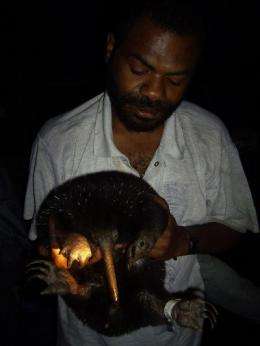
As a research intern for the Wildlife Conservation Society, Muse Opiang (now of the Papua New Guinea Institute of Biological Research) completed a study on one of the world's most elusive, egg-laying mammals: the long beaked echidna. Credit: WCS Papua New Guinea
A Wildlife Conservation Society research intern working in the wilds of Papua New Guinea has successfully completed what many other field biologists considered "mission impossible"—the first study of a rare egg-laying mammal called the long-beaked echidna.
The WCS-supported study—which consisted of thousands of hours of grueling field work in Papua New Guinea's Crater Mountain Wildlife Management Area—took Muse D. Opiang, now of the Papua New Guinea Institute of Biological Research, several years of remotely tracking the porcupine-sized mammals and recording their dens and other signs.
The study, published in a recent of the Journal of Mammalogy, chronicles the first solid data on the animal's nocturnal foraging behaviors, movement patterns, and home-range sizes for the species.
The long-beaked echidna is found only in New Guinea and is a member of the monotremes, a primitive order of mammals that forced zoologists to change their very definitions of what a mammal is. Unlike all other mammals, monotremes like the echidna (also called the spiny anteater) and the better known platypus lay eggs.
"All of the time and effort invested in the study has paid off with new insights into the natural history of this seldom seen and unusual mammal," said Opiang. "These findings will help inform conservation strategies for the species, which is threatened by hunting and habitat loss."
The nocturnal, subterranean lifestyle of the species represented a real challenge for field research, with some experts declaring the species impossible to study. And it did take some time - nearly 6,000 man-hours of field work between 2001-2005. Opiang spent 500 hours in the field before locating his first animal.
In the end, Opiang managed to capture 22 individual echidnas (15 adults and 7 juveniles), and affixed radio transmitters to 9 adults and 3 juveniles. Because this was the first study of the unusual species, Opiang had to develop methods by trial and error. Initially, transmitters were attached to spines, but the constant burrowing and digging of the echidnas resulted in transmitters falling off. The ankle proved to be a more reliable placement point. Home ranges for the tracked echidnas averaged 39 hectares (96 acres).
The study located over 200 den sites, most of which were underground, while others were found in cliff faces and in thick vegetation. One lactating female was found. Other signs recorded in the study were nose-pokes (when the echidna pokes its tube-like snout in the soil in search of invertebrate prey) and digs (deeper holes excavated with the echidna's long claws).
"The limited information on the long-beaked echidna's biology, feeding behavior and ecology has prevented conservationists from formulating plans for protecting this elusive and threatened animal," said Dr. Ross Sinclair, Director of WCS's Papua New Guinea program. "The research methods developed by Opiang and the data he gathered can now help us to manage and protect this rare and species."
About long-beaked echidnas
- Echidnas are members of the monotremes, an order of mammals that lay leathery eggs, as opposed to placental and marsupial mammals, both groups of which give birth to live young.
- Echidnas resemble anteaters with long course hairs and spines. They are powerful diggers and possess short legs with long claws.
- The snout of the echidna ends in a tiny mouth with no teeth.
- Long-beaked echidnas feed on insect larvae, worms, and other invertebrates (whereas short-beaked echidnas prefer ants and termites).
- Echidnas and platypuses are more reptile-like than other mammals, with features such as: a more sprawling gait; and a single opening for depositing waste and facilitating reproduction (known as a cloaca, as in both birds and reptiles).
- Echidnas (both long- and short-beaked) lay a single egg, which the female holds in a sticky pouch. The hatchling (known as a "puggle") resides in the pouch for between 40-50 days and receives milk from two mammary patches (echidnas have no teats).
- Once the puggle develops spines, the mother digs a nursery den that becomes the puggle's new home; the mother returns every five days to nurse the puggle. The baby is weaned in seven months.
-
Uni leads study on echidna sex life
Aug 22, 2007 |
not rated yet |
0
-
Small furry animal lived with dinosaurs
Jan 12, 2006 |
not rated yet |
0
-
Loss of egg yolk genes in mammals and the origin of lactation and placentation
Mar 18, 2008 |
not rated yet |
0
-
Study Finds Beaked Whales' Tusks Evolved Through Sexual Selection Process
Dec 12, 2008 |
not rated yet |
0
-
Beaked Whales Perform Extreme Dives to Hunt Deepwater Prey
Oct 20, 2006 |
not rated yet |
0
-
Engineers build first sub-10-nm carbon nanotube transistor
Feb 01, 2012 |
4.9 / 5 (31) |
30
-
Something old, something new: Evolution and the structural divergence of duplicate genes
Jan 31, 2012 |
4.6 / 5 (7) |
1
-
The hidden nanoworld of ice crystals: Revealing the dynamic behavior of quasi-liquid layers
Jan 30, 2012 |
5 / 5 (3) |
1
-
Stock market network reveals investor clustering
Jan 27, 2012 |
3.9 / 5 (23) |
8
-
Of microchemistry and molecules: Electronic microfluidic device synthesizes biocompatible probes
Jan 26, 2012 |
5 / 5 (1) |
0
-
Stem cell question.
Feb 10, 2012
-
Protease cleavage
Feb 10, 2012
-
Pertubance in a model
Feb 10, 2012
-
Cancer drugs and Alzheimer's, Oh my!
Feb 09, 2012
-
Squishing cells
Feb 09, 2012
-
Any books/articles for evolutionary stable strategy models in humans?
Feb 09, 2012
- More from Physics Forums - Biology
More news stories
Entire genome of extinct human decoded from fossil
(PhysOrg.com) -- In 2010, Svante Pääbo and his colleagues presented a draft version of the genome from a small fragment of a human finger bone discovered in Denisova Cave in southern Siberia. The ...
Feb 07, 2012 |
4.7 / 5 (58) |
44
|
Why are there so few fish in the Earth's oceans?
(PhysOrg.com) -- A Stony Brook University researcher has found that, contrary to popular belief, there are not plenty of fish in the sea.
Feb 08, 2012 |
4.3 / 5 (17) |
26
|
Miami battling invasion of giant African snails
No one knows how they got there. But an invasion of African giant snails has southern Florida in a panic over potential crop damage, disease and general yuckiness surrounding the slimy gastropods.
Feb 10, 2012 |
4.5 / 5 (2) |
5
Deciding to go left or right: Researchers use device to determine that lower animals can navigate too
For decades, scientists have associated binary decision making opting to go left or right with higher-ranking animals, including humans. A team of Harvard researchers, however, is rewriting that ...
Feb 09, 2012 |
4 / 5 (1) |
4
|
Study shows chimps able to understand needs of others
(PhysOrg.com) -- By setting up a unique experiment, a small team of researchers has found that chimpanzees are able to understand need in other chimps, despite their general disinclination to offer aid when ...
Latin America mining boom clashes with conservation
Latin America is experiencing a mining boom as prices rise fuelled by a hike in global demand, but the region is also being hit by a wave of violent protests, strikes and rallies by environmentalists.
Love a click away in Indonesia's Twitter Republic
He was a geeky kid from Yogyakarta, she a glamorous city girl in Jakarta. In a country with one of the world's most vibrant social networking scenes they fell in love on Twitter.
Walney offshore wind farm is world's biggest (for now)
(PhysOrg.com) -- The Walney wind farm on the Irish Sea--characterized by high tides, waves and windy weather--officially opened this week. The farm is treated in the press as a very big deal as the Walney ...
GPS court ruling leaves US phone tracking unclear
A US Supreme Court decision requiring a warrant to place a GPS device on the car of a criminal suspect leaves unresolved the bigger issue of police tracking using mobile phones, legal experts say.
Europeans protest controversial Internet pact
Tens of thousands of people marched in protests in more than a dozen European cities Saturday against a controversial anti-online piracy pact that critics say could curtail Internet freedom.
Europe stakes billion-dollar bet on new rocket
A pencil-slim rocket is scheduled to lift into space from South America on Monday, carrying a billion-dollar bet that Europe can grab a juicy slice of the market to place satellites in low orbit.