Biologist discovers pink-winged moth in Chiracahua Mountains
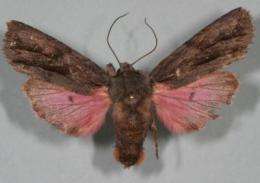
University of Arizona biologist Bruce Walsh has identified a new species of moth in southern Arizona. Normally, this is not a big deal. The region is one of the most biologically rich areas in the country and collectors have been finding hundreds of new species for decades. This one, however, is different.
Walsh is a professor of ecology and evolutionary biology and a member of the UA's BIO5 Institute. He is best known in the science community as an authority on plant and animal breeding, having written one of the leading textbooks on the subject.
His work also spans several departments and programs, including statistics, applied math, insect science and genetics. He also teaching biostatistics in the UA Zuckerman College of Public Health and has worked with trial attorneys on interpreting DNA evidence. Collecting moths is a hobby.
His new discovery is Lithophane leeae. Walsh found it in the Chiracahua mountains east of Tucson, and reported it in the journal Zoo Keys.
Lithophane moths are members of the noctuid family, which often are dull colored. Walsh's moth, in contrast, is bright pink. He also named it after his wife, Lee, who has an affinity for the color.
Walsh discovered L. leeae while collecting one evening at Onion Saddle, at about 7,700 feet in the Chiracahuas. Collecting involves illuminating a sheet with mercury vapor lamps. Moths are attracted by the lights and will land on the sheet.
"This large moth flew in and we didn't think much of it because there is a silk moth very much like it, a Doris silk moth that feeds on pines that has dark wings with pink on the hind wings. It's fairly common there."
On closer inspection, though, the moth, a female, appeared to be an entirely different species from an entirely different family. Walsh said it currently is the only known individual.
Scientists are generally reluctant to identify a new species based on one individual, but L. leeae appears so distinct from others that Walsh said it is highly unlikely that it is an aberration of an existing species. A DNA barcode later confirmed it as a distinct species.
Walsh said he is confident there are bound to be more. "If this thing is flying at the top of the Chiracahuas, it's probably pretty common," he said.
Finding it is another matter because moths like Lithophane tend to over-winter at higher elevations, hibernating when there is snow on the ground and flying off at the first signs of spring. Walsh said bats are the primary predators of moths, and so if the insects can make it through the winter, when bats hibernate, they will likely do well as the weather gets warmer.
As to why L. leeae hasn't been found before, Walsh theorized that his specimen simply emerged late from hibernation when it was caught. Another theory is that it could be a stray from another mountain range in the region. He said there are a number of species that fly early in the summer and are rare in collections and not often seen in most years.
"We can now add L. leeae to this group of large, but quite elusive, species," he said.
Source: University of Arizona (news : web)


