Red giant star Betelgeuse is mysteriously shrinking
The red supergiant star Betelgeuse, the bright reddish star in the constellation Orion, has steadily shrunk over the past 15 years, according to University of California, Berkeley, researchers.
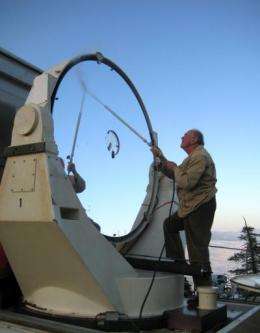
Long-term monitoring by UC Berkeley's Infrared Spatial Interferometer (ISI) on the top of Mt. Wilson in Southern California shows that Betelgeuse (bet' el juz), which is so big that in our solar system it would reach to the orbit of Jupiter, has shrunk in diameter by more than 15 percent since 1993.
Since Betelgeuse's radius is about five astronomical units, or five times the radius of Earth's orbit, that means the star's radius has shrunk by a distance equal to the orbit of Venus.
"To see this change is very striking," said Charles Townes, a UC Berkeley professor emeritus of physics who won the 1964 Nobel Prize in Physics for inventing the laser and the maser, a microwave laser. "We will be watching it carefully over the next few years to see if it will keep contracting or will go back up in size."
Townes and his colleague, Edward Wishnow, a research physicist at UC Berkeley's Space Sciences Laboratory, will discuss their findings at a 12:40 p.m. PDT press conference on Tuesday, June 9, during the Pasadena meeting of the American Astronomical Society (AAS). The results were published June 1 in The Astrophysical Journal Letters.
Despite Betelgeuse's diminished size, Wishnow pointed out that its visible brightness, or magnitude, which is monitored regularly by members of the American Association of Variable Star Observers, has shown no significant dimming over the past 15 years.
The ISI has been focusing on Betelgeuse for more than 15 years in an attempt to learn more about these giant massive stars and to discern features on the star's surface, Wishnow said. He speculated that the measurements may be affected by giant convection cells on the star's surface that are like convection granules on the sun, but so large that they bulge out of the surface. Townes and former graduate student Ken Tatebe observed a bright spot on the surface of Betelgeuse in recent years, although at the moment, the star appears spherically symmetrical.
"But we do not know why the star is shrinking," Wishnow said. "Considering all that we know about galaxies and the distant universe, there are still lots of things we don't know about stars, including what happens as red giants near the ends of their lives."
Betelgeuse was the first star ever to have its size measured, and even today is one of only a handful of stars that appears through the Hubble Space Telescope as a disk rather than a point of light. In1921, Francis G. Pease and Albert Michelson used optical interferometry to estimate its diameter was equivalent to the orbit of Mars. Last year, new measurements of the distance to Betelgeuse raised it from 430 light years to 640, which increased the star's diameter from about 3.7 to about 5.5 AU.
"Since the 1921 measurement, its size has been re-measured by many different interferometer systems over a range of wavelengths where the diameter measured varies by about 30 percent," Wishnow said. "At a given wavelength, however, the star has not varied in size much beyond the measurement uncertainties."
The measurements cannot be compared anyway, because the star's size depends on the wavelength of light used to measure it, Townes said. This is because the tenuous gas in the outer regions of the star emits light as well as absorbs it, which makes it difficult to determine the edge of the star.
The ISI that Townes and his colleagues first built in the early 1990s sidesteps these confounding emission and absorption lines by observing in the mid-infrared with a narrow bandwidth that can be tuned between spectral lines. The ISI consists of three 5.4-foot (1.65-meter) diameter mirrors separated by distances that vary from 12 to 230 feet (4-70 meters), said Townes. Using a laser as a common frequency standard, the ISI interferometer combines signals from telescope pairs in order to determine path length differences between light that originates at the star's center and light that originates at the star's edge. The technique of stellar interferometry is highlighted in the June 2009 issue of Physics Today magazine.
"We observe around 11 microns, the mid-infrared, where this long wavelength penetrates the dust and the narrow bandwidth avoids any spectral lines, and so we see the star relatively undistorted," said Townes. "We have also had the good fortune to have an instrument that has operated in a very similar manner for some 15 years, providing a long and consistent series of measurements that no one else has. The first measurements showed a size quite close to Michelson's result, but over 15 years, it has decreased in size about 15 percent, changing smoothly, but faster as the years progressed."
Townes, who turns 94 in July, plans to continue monitoring Betelgeuse in hopes of finding a pattern in the changing diameter, and to improve the ISI's capabilities by adding a spectrometer to the interferometer.
"Whenever you look at things with more precision, you are going to find some surprises and uncover very fundamental and important new things," he said.
Source: University of California - Berkeley (news : web)


