Manipulating the Brain Network Could Improve IQ
June 10, 2009 by Lisa Zyga weblog
Brain

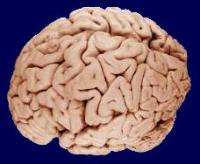
Image source: University of Wisconsin and Michigan State Comparative Mammalian Brain Collections and the National Museum of Health and Medicine.

In an attempt to investigate why some brains are more intelligent than others, researchers have found that efficient wiring between different brain regions is associated with a higher IQ. This understanding could potentially lead to the development of drugs that could improve IQ by improving the brain's network efficiency.

Martijn van den Heuvel, a neuroscientist at Utrecht University Medical Center who led the new study, explained that the concept of a networked brain is similar to a transportation grid, with the brain using its network to send information from one region to another.

In their study, the scientists scanned the brains of 19 subjects at rest using functional magnetic resonance imaging (fMRI). Because the brains were at rest, the revealed the "default" underlying connectivity between . Brain connectivity reflects how many steps are required to send information between different regions of the brain.

When comparing the connectivity networks, the researchers found a link between connectivity efficiency and the subject's IQ, with connectivity explaining about 30% of the difference between subjects. However, the researchers did not find a link between the total number of connections in the brain and IQ. "We show that more intelligent people don't have more connections, but they have more efficiently placed connections," van den Heuvel said.

In the future, the scientists hope to investigate the possibilities of manipulating the brain's connectivity efficiency in order to create more efficient brain networks, and possibly boost IQ. Previous research has found a genetic component to white matter in the , which is also related to intelligence. By understanding how these genes work, scientists may be able to figure out how to manipulate the genes, leading to improved intelligence.

More information: Journal of Neuroscience (DOI: 10.1523/JNEUROSCI.1442-09.2009)

Via: New Scientist

4.1 /5 (11 votes)  

Filter


Move the slider to adjust rank threshold, so that you can hide some of the comments.


Display comments: newest first

Myria83
Jun 10, 2009

Rank: 4 / 5 (1)
..."with connectivity explaining about 30% of the difference between subjects"...

How can they draw this kind of conclusions from a study involving 19 subjects only?
no1enter
Jun 10, 2009

Rank: not rated yet
Probably because its to expensive to bring in more people for the study, as the companies that 'rent' the use of MRI machines charge so much do to the multi-million dollar cost of each machine.
El_Nose
Jun 10, 2009

Rank: not rated yet
I remember a movie called lawnmower man by stephn king that had a similair concept. The new super genius man then takes over the world because he became too aggressive.

I wonder what effect effecient pathways have on things like aggression, passion, and decision making. Will this reworking affects the pituitary gland especially.
gmurphy
Jun 10, 2009

Rank: 5 / 5 (1)
Myria83, good point.
GlenM
Jun 10, 2009

Rank: not rated yet
I have done some research in this area. Making intraareal connections or even distant interareal ones is very difficult once the giant depolarizing potentials have stopped. Making such long range connections after the cessation of GDPs would be very disruptive.
jimbo92107
Jun 11, 2009

Rank: not rated yet
I held a magnet to my head once. It didn't make me smarter, but I felt more attractive...
PinkElephant
Jun 28, 2009

Rank: not rated yet
I'd be careful trying to boost the brain's connectivity willy-nilly. Some nasty side-effects may emerge if it isn't done just right: like grand mal seizures, for example...

There's probably a good reason why most modern brains aren't as optimal as they could theoretically be. There's got to be a cost to genius: some get lucky and don't have to pay the piper; others may end up in institutions or dead... or maybe something more prosaic, such as failing to procreate...
Rank 4.1 /5 (11 votes)
Related Stories
Relevant PhysicsForums posts

More news stories

Complex wiring of the nervous system may rely on a just a handful of genes and proteins

Researchers at the Salk Institute have discovered a startling feature of early brain development that helps to explain how complex neuron wiring patterns are programmed using just a handful of critical genes. ...

Medicine & Health / Research

created 1 hour ago | popularity 5 / 5 (2) | comments 0 | with audio podcast

Curry spice component may help slow prostate tumor growth

Curcumin, an active component of the Indian curry spice turmeric, may help slow down tumor growth in castration-resistant prostate cancer patients on androgen deprivation therapy (ADT), a study from researchers ...

Medicine & Health / Cancer

created 6 hours ago | popularity 4.5 / 5 (4) | comments 0 | with audio podcast

Both maternal and paternal age linked to autism

Older maternal and paternal age are jointly associated with having a child with autism, according to a recently published study led by researchers at The University of Texas Health Science Center at Houston (UTHealth).

Medicine & Health / Psychology & Psychiatry

created 5 hours ago | popularity not rated yet | comments 0 | with audio podcast

Team isolates nerve cells involved in storing long term memory and gene proteins associated with them

(Medical Xpress) -- A research team in Taiwan has succeeded in isolating two nerve cells in fruit fly brains that are believed to be the major players in allowing for the formation of long term memories. Furthermore, ...

Medicine & Health / Neuroscience

created 7 hours ago | popularity 5 / 5 (4) | comments 1 | with audio podcast report

Seeing colors in music, tasting flavors in shapes may happen in life's early months

Famed violinist Itzhak Perlman sees a deep forest green whenever he plays a B-flat on his Stradivarius' G string. The A on the E string is red.

Medicine & Health / Psychology & Psychiatry

created 8 hours ago | popularity 4.5 / 5 (2) | comments 1 | with audio podcast


NASA sees wide-eyed cyclone Jasmine

Cyclone Jasmine's eye has opened wider on NASA satellite imagery, as it moves through the Southern Pacific Ocean.

NASA sees Giovanna reach cyclone strength, threaten Madagascar

Tropical Storm 12S built up steam and became a cyclone on February 10, 2012 as NASA's Terra satellite passed overhead. Residents of east-central Madagascar should prepare for this cyclone to make landfall ...

CIA website offline, Anonymous takes credit

The website of the Central Intelligence Agency was unresponsive on Friday after the hacker group Anonymous claimed to have knocked it offline.

The power of estrogen -- male snakes attract other males

A new study has shown that boosting the estrogen levels of male garter snakes causes them to secrete the same pheromones that females use to attract suitors, and turned the males into just about the sexiest ...

New error-correcting codes guarantee the fastest possible rate of data transmission

Error-correcting codes are one of the triumphs of the digital age. They’re a way of encoding information so that it can be transmitted across a communication channel — such as an optical fiber o ...

Humans may have helped the decline of African rainforests 3000 years ago

(PhysOrg.com) -- Large areas of rainforests in Central Africa mysteriously disappeared over three thousand years ago, to be replaced by savannas. The prevailing theory has been that the cause was a change ...