Friday is final curtain for analog TV signals
June 10, 2009 By PETER SVENSSON , AP Technology Writer
Friday is final curtain for analog TV signals (AP)

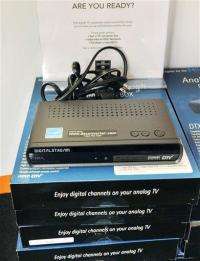
In this June 5, 2009 photo, digital television converter boxes are on display at Radio Shack in Gloucester, Mass. Remaining television stations that have not already made the switch to digital signals are scheduled to cut their analog signals on June 12. (AP Photo/Lisa Poole)

(AP) -- The last major TV stations that are still broadcasting in analog will turn those signals off Friday and go all digital. And this time, they really mean it.

The original Feb. 17 deadline for the shutdown was delayed by the Obama administration after funding ran out for $40 coupons the government offered to help people buy converter boxes for old TVs.

Now officials say the country is much better prepared than in February, though they still expect some viewers to be confused.

About 3.1 million U.S. homes were unprepared to receive as of late last month, according to the Nielsen Co. That's half the number that were unprepared in February, and the number will probably decline further by Friday, as procrastinators get around to replacing old TVs or hooking them up to converter boxes or cable or satellite service.

Some people may believe the shutdown will be put off once again. But President Barack Obama debunked that with a statement last week: "I want to be clear: There will not be another delay."

Because digital signals are more efficient than the analog TV broadcasts that have been on the air for six decades, the transition will make room in the airwaves for and emergency communications services.

Nearly half of the nation's 1,760 full-power TV stations have already cut their analog signals, though they are mostly in thinly populated areas.

Come Friday, older, non-digital TV sets will lose all major channels unless they have an antenna and a converter box that allows them to accept digital signals, or if they are hooked up to cable or satellite.

A few low-power analog stations and rural relay stations known as "translators" will still be available in some areas. And about 100 stations will keep an analog "night light" on, informing viewers of the need to switch to .

The Federal Communications Commission has given stations freedom to decide what time of day they will be shutting down analog. Many have opted to do it in the evening, meaning the full impact will not be felt until Saturday.

Groundwork for the analog shutdown has been laid with a massive public information campaign, but getting the whole country to understand what's going on has been a challenge.

Moe Shakkour, manager of an independent electronics store in a largely Hispanic area of New York City, said people have come in with converter box coupons, without knowing what they are for, or that analog TV signals are going away.

Other stores are also reporting antenna shortages, and antenna issues in general could be another problem for the transition. Digital signals travel differently than analog ones, and some viewers may need to get new antennas for optimal reception.

Antennas that produced a poor but watchable picture with an analog broadcast may get nothing at all on digital, or a picture that freezes now and then.

Early public information efforts were focused on getting people to understand the need for a converter box. Thanks to lessons learned from areas where stations shut down analog early, the latest ads also stress the need for a suitable antenna that receives both the UHF and VHF bands.

The ads also point out that viewers need to force converter boxes and digital TV sets to "re-scan" the airwaves to find channels that will move to new frequencies Friday.

Even if a set is correctly hooked up to a converter box and a good antenna, many stations that are already being received digitally will disappear when they move to new channels.

To confuse matters further, many stations will not be broadcasting very strong digital signals on Friday, because those signals are coming from secondary antennas.

The primary antennas, at the top of the broadcast tower, have been used for analog. Until those are taken down and replaced with digital antennas, which can take weeks, outlying areas may get poor or no digital signals.

Where stations have already cut off analog, the shutdown has caused some confusion but hardly the sort of widespread resentment that was originally feared. When hundreds of broadcasters stuck to the original deadline, just 28,000 people called the FCC's help line, though an estimated 12 million households without cable or satellite were affected.

One afternoon this week, a walk-in digital TV help center operated by a Hispanic community association in New York was empty. Roberto Cuesta, who runs a nearby electronics store, said most people were comfortable with their new converter boxes and only about one in 50 customers needed extra help connecting them.

"The good news is that we're in considerably better shape now than we were four months ago," acting FCC Chairman Michael Copps said last week.

"We were nowhere near ready for a nationwide transition in February. Had we flipped the switch back then, we would have faced a debacle that would have made New Coke look like a stroke of marketing genius."

©2009 The Associated Press. All rights reserved. This material may not be published, broadcast, rewritten or redistributed.

Filter


Move the slider to adjust rank threshold, so that you can hide some of the comments.


Display comments: newest first

no1enter
Jun 10, 2009

Rank: 3 / 5 (2)
About time we are so VERY behind schedule already. The initial transition date was decided in 1998 to be scheduled for 2006... What took so long for the transition you ask? To many procrastinators... We had the technology available and the country was more financially stable then. So nearly 11 years after the FCC set a date we FINALLY switch to DTV... And to think it was as easy as start giving out the rebates as soon as the decision was made in 1998 instead of doing nearly NOTHING for 10 years...

Here is the Digital Television Consumer Information Bulletin release on 11/16/98: http://www.fcc.go...811.html
iknow
Jun 10, 2009

Rank: 1 / 5 (1)
Thats the British Colony of Virgina for ya.
david_42
Jun 10, 2009

Rank: 1 / 5 (1)
I guess I need to get the TV out of the back closet, buy a converter, an antenna and get it working.

Is there something good on?
googleplex
Jun 10, 2009

Rank: 1 / 5 (1)
TV is so passée. You can watch most things when you want on the internet. A lot less adverts too. All you have to do is connect your big screen to a PC and buy a PC remote control.
Digital_Wangateur
Jun 10, 2009

Rank: 1 / 5 (2)
8vsb ... the standard we chose has a problem with reception in the city's due to multiple path signal interference and so... we deny the people who most need the signal access... Who still has analog TV sets...lots of economically disadvantaged people in city's who will be totally cut off cause the converter boxes are not very robust in city environments unless you have direct line of site to the transmitter. I guess it isn't important that they receive PBS any more.
Rank 4 /5 (4 votes)
Related Stories
Relevant PhysicsForums posts
  • Need help reading 3-D
    created19 hours ago
  • A way to send and receive wireless data
    createdFeb 11, 2012
  • Calling function with no input argument
    createdFeb 10, 2012
  • Force free body diagram problem on gym equipment
    createdFeb 10, 2012
  • Empirical data regarding shower heads and water
    createdFeb 10, 2012
  • feed hold button on CNC lathe
    createdFeb 09, 2012
  • More from Physics Forums - General Engineering

More news stories

Iran blocks email, restricts net access: reports

Iran has further restricted access to the Internet and blocked popular email services for the past few days, in a move a top lawmaker said could "cost the regime dearly," media reports said on Sunday.

Technology / Internet

created 1 hour ago | popularity 5 / 5 (1) | comments 2

Google might launch Drive for cloud storage soon

(PhysOrg.com) -- Google's next big move, according to the Wall Street Journal, is a cloud storage service called Drive. Hardly first to the plate, Google is simply catching up to introducing its cloud reposi ...

Technology / Internet

created 8 hours ago | popularity 4.8 / 5 (4) | comments 4 | with audio podcast report

Love a click away in Indonesia's Twitter Republic

He was a geeky kid from Yogyakarta, she a glamorous city girl in Jakarta. In a country with one of the world's most vibrant social networking scenes they fell in love on Twitter.

Technology / Internet

created 9 hours ago | popularity 4 / 5 (1) | comments 0

Walney offshore wind farm is world's biggest (for now)

(PhysOrg.com) -- The Walney wind farm on the Irish Sea--characterized by high tides, waves and windy weather--officially opened this week. The farm is treated in the press as a very big deal as the Walney ...

Technology / Energy & Green Tech

created Feb 11, 2012 | popularity 4 / 5 (11) | comments 35 | with audio podcast weblog

Navy to begin tests on electromagnetic railgun prototype launcher

The Office of Naval Research (ONR)'s Electromagnetic (EM) Railgun program will take an important step forward in the coming weeks when the first industry railgun prototype launcher is tested at a facility ...

Technology / Engineering

created Feb 06, 2012 | popularity 4.7 / 5 (16) | comments 93 | with audio podcast


Lab study raises questions over nano-particle impact

Tests involving chickens have raised questions about the impact on health from engineered nano-particles, the ultra-fine grains commonly used in drugs and processed foods, scientists said on Sunday.

Salvage workers begin pumping fuel from Italian shipwreck

Salvage workers Sunday began pumping fuel from the shipwrecked Italian cruise liner Costa Concordia, a day ahead of schedule, officials said.

Scientists discover molecular secrets of 2,000-year-old Chinese herbal remedy

For roughly two thousand years, Chinese herbalists have treated Malaria using a root extract, commonly known as Chang Shan, from a type of hydrangea that grows in Tibet and Nepal. More recent studies suggest that halofuginone, ...

New method to examine batteries -- MRI from the inside

There is an ever-increasing need for advanced batteries for portable electronics, such as phones, cameras, and music players, but also to power electric vehicles and to facilitate the distribution and storage of energy derived ...

A mitosis mystery solved: How chromosomes align perfectly in a dividing cell

Although the process of mitotic cell division has been studied intensely for more than 50 years, Whitehead Institute researchers have only now solved the mystery of how cells correctly align their chromosomes during symmetric ...

Starve a virus, feed a cure? Findings show how some cells protect themselves against HIV

A protein that protects some of our immune cells from the most common and virulent form of HIV works by starving the virus of the molecular building blocks that it needs to replicate, according to research published online ...