Climate change could drive vast human migrations
June 10, 2009 Climate change could drive vast human migrations

Enlarge

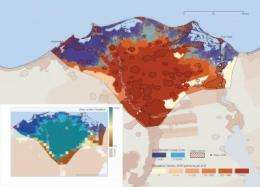
This is the Nile delta, with sea level rises of 1 meter (dark blue) and 2 meters (light blue), along with population density (lighter to darker browns) and urban areas (hatching). Of the 40.2 million people here in 2000, 10.7 million would be inundated by a 2-meter rise. The inset shows the distribution of farmlands. Credit: Center for International Earth Science Information Network, Columbia University

By mid-century, people may be fleeing rising seas, droughts, floods and other effects of changing climate, in migrations that could vastly exceed the scope of anything before, says a major new report. The document, authored by researchers at Columbia University's Center for International Earth Science Information Network (CIESIN), the United Nations University and CARE International, was released at a news conference in Bonn.

The researchers say that the effects of climate are hard to sort from connected factors including political and economic conflicts, extreme weather events, population growth, human destruction of ecosystems and overuse of farmland. However, they say, climate change will eventually play a dominant role by exacerbating all of these problems, and is already having detectable effects. While the report does not attempt to put numbers to those potentially uprooted, estimates from other reports it cites range from 25 million to 50 million by 2010, to almost 700 million by 2050.

"Climate is the envelope in which all of us lead our daily lives. This report sounds warning bells," said coauthor Alexander de Sherbinin, a geographer at CIESIN. "We usually categorize the poor as the ones who will suffer most—but richer societies will potentially lose as well."

The report, In Search of Shelter: Mapping the Effects of Climate Change on and Displacement, is based on a first-time global survey of environmental change and migration. It is illustrated with a series of detailed maps, generated by CIESIN, that show how and where significant displacements may occur. Among its findings:


  • Breakdown of ecosystem-based economies including subsistence herding, farming and fishing will be the dominant driver of forced migration.
  • Climate change will increase the frequency and intensity of natural hazards such as cyclones, floods and droughts. Rains in parts of Mexico and Central America, for instance, are projected to drop as much as 50% by 2080. Farmers in parts of Mexico and north Africa's Sahel region may already be moving in part due to changing rains.
  • Sea level rise directly threatens the existence of some 40 countries. Saltwater intrusion, flooding and erosion could destroy agriculture in the densely populated Mekong, Nile and Ganges deltas. A rise of two meters, or six feet--well within some projections for this century-- would inundate nearly half the Mekong's 3 million hectares (7.5 million acres) of farmland. Some Pacific island nations including the Maldives (pop. 300,000) are already considering prospects for total relocation.
  • Ongoing melting of alpine glaciers in the Himalayas will devastate the heavily irrigated farmlands of Asia by increasing floods and decreasing long-term water supplies. The glacier-fed basins of the Ganges, Brahmaputra, Irawaddy, Salween, Mekong, Yangtze and Yellow rivers now support over 1.4 billion people.
  • Most migrants will probably move within their own countries, or to countries next door. Many will be poor, and many will be unable to move far enough to improve their lots. Ripples from resulting conflicts and collapses will hit richer countries.

Coauthor Charles Ehrhart, CARE's climate-change coordinator, called the potential impacts "startling."

"Societies affected by climate change may find themselves locked into a downward spiral of ecological degradation, towards the bottom of which social safety nets collapse, while tensions and violence rise," said a statement from CARE. "In this all-too plausible scenario, large populations would be forced to migrate as a matter of immediate survival."

De Sherbinin pointed out that human population is projected to grow from 6.8 billion today, to 9 billion by 2050. "Countries are running out of places to put people productively," he said. "You can't just stockpile people."

The report says it is vital that countries reach an agreement to stem greenhouse gases during this December's United Nations Framework Convention on Climate Change. But even if this deadline is met, most scientists say some amount of is now inevitable. To mitigate resulting migrations, the report recommends that nations prioritize the most vulnerable populations and invest there in defensive measures, including irrigation technology that uses less water; low-till agriculture; economic diversification; and official systems to manage natural disasters. It says nations must agree on how to resettle populations of low-lying areas, and strengthen the ability of emigrants to send remittances to those left in affected regions.

"New thinking and practical approaches are needed to address the threats that climate-related migration poses to human security and well-being," said coauthor Koko Warner, head of the UN University's Institute for Environment and Human Security.

Source: The Earth Institute at Columbia University (news : web)


print this article email this article download pdf blog this article bookmark this article     Stumble it Digg this share on Facebook retweet share on Reddit add to delicious
Rate this story - 4.5 /5 (42 votes)

Rank Filter

Move the slider to adjust rank threshold, so that you can hide some of the comments.


Display comments: newest first

  • Doschx - Jun 10, 2009
    • Rank: 3.4 / 5 (7)
    Seems like yet another "end of the world" climate change report. I think overpopulation is more inhumane than global warming, honestly, and all of this reinforces my belief that we need to get off this planet ASAP.
  • fleem - Jun 10, 2009
    • Rank: 3.4 / 5 (5)
    Don't worry, the government will save us.
  • Bob_Kob - Jun 10, 2009
    • Rank: 2.5 / 5 (4)
    Yeah like rising sea levels are anything to worry about. Do they really expect us to scratch our heads and move to higher ground because there is absolutely nothing we can do? We are HUMANS. We don't live in every part of the world for no reason. We can adapt and global warming will be at most nothing but a hindrance rather than a catastrophe.
  • ArtflDgr - Jun 10, 2009
    • Rank: 2.6 / 5 (5)
    Ever notice that these climate change article titles can always be written %u201C, then again, maybe not%u201D.

    %u201CClimate change could drive vast human migrations, then again, maybe not%u201D.

    the formulea works for any inane title.

    "Small green and purple people may cause the earth to stop rotating, then again maybe not"
  • otto1923 - Jun 10, 2009
    • Rank: 2.8 / 5 (4)
    Migrations began decades ago. Best and brightest third-worlders invited north leaving dregs to fight and suffer. Old old equation. Ambitious immigrants make America great, revitalize Europe.
  • Mayday - Jun 10, 2009
    • Rank: 3.4 / 5 (5)
    Why not just make huge rafts out of bundles of freshly printed money for everyone to float on? It seems to be working for everything else.
  • 3432682 - Jun 10, 2009
    • Rank: 3 / 5 (4)
    Mass migration. Or not. I think not.
  • lengould100 - Jun 10, 2009
    • Rank: 3.7 / 5 (6)
    A river takes many centuries develop its delta farmland and that rich farmland is essentially irreplaceable. To risk taking actions which threaten to flood it with saltwater is the stupidest (or least sane) act a society could take.

    But then, from reading above comments, appears that sanity is the thing humans have least of.
  • Truth - Jun 10, 2009
    • Rank: 5 / 5 (1)
    Man, am I glad I didn't sell my canoe...!

June 10, 2009 all stories

Comments: 9

4.5 /5 (42 votes)
  • Stumble this up

  • Digg this

  • share this

  • hide
  • Related Stories

  • Environmental exodus
    created Nov 26, 2007 | popularity not rated yet | comments 0
  • Study: SE Asia will be hit hard by climate change
    created Apr 27, 2009 | popularity not rated yet | comments 0
  • Climate change to hit poorest hardest
    created Apr 06, 2007 | popularity not rated yet | comments 0
  • Lower increases in global temps could lead to greater impacts than previously thought, study finds
    created Feb 23, 2009 | popularity not rated yet | comments 0
  • Researchers Assess Risks Associated with Living in Low-Lying Coastal Areas
    created May 17, 2006 | popularity not rated yet | comments 0


  • hide
  • Relevant PhysicsForums posts

  • Climate Science Update
    created 14 hours ago
  • The IPCC and the term "most"
    created Nov 23, 2009
  • Is global warming a fact?
    created Nov 23, 2009
  • Random variability of wind patterns
    created Nov 23, 2009
  • Record precipitation in the UK
    created Nov 22, 2009
  • How to move cloud from one time to another..
    created Nov 22, 2009
  • More from Physics Forums - Earth

Other News

Fermi Telescope Peers Deep into Microquasar

Fermi Telescope Peers Deep into Microquasar (w/ Video)

Space & Earth / Astronomy

created 10 hours ago | popularity 4.5 / 5 (6) | comments 0

(PhysOrg.com) -- NASA's Fermi Gamma-ray Space Telescope has made the first unambiguous detection of high-energy gamma-rays from an enigmatic binary system known as Cygnus X-3. The system pairs a hot, massive ...


The Energy Sources of Ultraluminous Galaxies

The Energy Sources of Ultraluminous Galaxies

Space & Earth / Astronomy

created 11 hours ago | popularity 4.3 / 5 (9) | comments 0

(PhysOrg.com) -- Ultraluminous infrared galaxies ((ULIRGs) are galaxies whose luminosity exceeds that of a trillion suns; for comparison, the Milky Way galaxy has a typical (and much more modest) luminosity ...


Space shuttle Atlantis, 7 astronauts back on Earth (AP)

Space shuttle Atlantis, 7 astronauts back on Earth

Space & Earth / Space Exploration

created 12 hours ago | popularity not rated yet | comments 0

(AP) -- Space shuttle Atlantis and its seven astronauts returned to Earth with a smooth touchdown Friday to end an 11-day flight that resupplied the International Space Station.


China is set to launch its second moon orbiter next October, state media have reported

China to launch second lunar probe: state media

Space & Earth / Space Exploration

created 16 hours ago | popularity 5 / 5 (4) | comments 0

China will launch its second moon orbiter next October, state media reported Friday, as it powers ahead with a space programme that has sparked concerns abroad.


Herschel takes a peek at the ingredients of the galaxies

Herschel takes a peek at the ingredients of the galaxies

Space & Earth / Astronomy

created 9 hours ago | popularity 4.3 / 5 (3) | comments 0

(PhysOrg.com) -- The European Space Agency has today released spectacular new observations from the Herschel Space Observatory, including the UK-led SPIRE instrument. Spectrometers on board all three Hershel ...