Cancer: The cost of being smarter than chimps?
June 10, 2009 Cancer: The cost of being smarter than chimps?

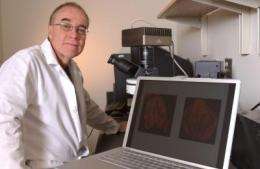
John McDonald, chair of the School of Biology and chief research scientist at the Ovarian Cancer Institute, is testing whether the cognitive superiority of human's brains over chimps has lead to an increased propensity for cancer. Credit: Nicole Cappello/Georgia Tech

Are the cognitively superior brains of humans, in part, responsible for our higher rates of cancer? That's a question that has nagged at John McDonald, chair of Georgia Tech's School of Biology and chief research scientist at the Ovarian Cancer Institute, for a while. Now, after an initial study, it seems that McDonald is on to something. The new study is available online in the journal Medical Hypothesis and will appear in the forthcoming issue of the journal.

"I was always intrigued by the fact that chimpanzees appear to have lower rates of than humans," said McDonald. "So we went back and reanalyzed some previously reported gene expression studies including data that were not used in the original analyses."

McDonald and his graduate students, Gaurav Arora and Nalini Polivarapu, compared chimp-human gene expression patterns in five tissues: brain, testes, liver, kidneys and heart. They found distinct differences in the way apoptosis — or programmed cell death — operates, suggesting that humans do not "self-destroy" cells as effectively as chimpanzees do. Apoptosis is one of the primary mechanisms by which our bodies destroy .

"The results from our analysis suggest that humans aren't as efficient as chimpanzees in carrying out programmed cell death. We believe this difference may have evolved as a way to increase and associated cognitive ability in humans, but the cost could be an increased propensity for cancer," said McDonald.

Like all evolutionary hypotheses, this can't be proven absolutely, according to McDonald. However, his lab has recently obtained additional direct experimental evidence consistent with the hypothesis that apoptotic function is more efficient in chimps than in humans.

Source: Georgia Institute of Technology


print this article email this article download pdf blog this article bookmark this article     Stumble it Digg this share on Facebook retweet share on Reddit add to delicious
Rate this story - 3.7 /5 (7 votes)

Rank Filter

Move the slider to adjust rank threshold, so that you can hide some of the comments.


Display comments: newest first

  • codesuidae - Jun 10, 2009
    • Rank: not rated yet
    How do they show that ineffective apoptotic function contributes directly to increased brain size? If it does, does it contribute to increased size of other aspects of the body as well?

    Do they have plans to show how ether increased apoptotic function in humans results in smaller brain size or decreased function in chimps results in larger brain size (and more cancer)?
  • Olson - Jun 10, 2009
    • Rank: not rated yet
    There's probably a huge amount of factors influencing rates of apoptosis that are not controlled for in this kind of interspecies comparison experiment.

    About the evolution of the brain, seems like less apoptosis would likely not be selected for since it is required for proper structuring of brain by pruning out excess neurons that are not integrated in functioning networks.
  • El_Nose - Jun 10, 2009
    • Rank: not rated yet
    In realility aren't we really talking about chemical pathways and processes. I think what is being suggested merely by the article is that the chemical signatures are harder to come by in humans to trigger cell death. That the basic pathway is less complex in chimps and that the added complexity seems to allow for other chemical pathways to exists that allow for larger brain mass and complexity.

    -- Now whether they are right , or this is true will be in the science -- when biologists can lay down a close approximation of the full path of apoptosis (which i believe is close to complete outside of recognizing which genes code for the protien bindind) but then we need to fully understand all the chemical process that go into growing a brain. We may observe but never really know.
  • mo411 - Jun 10, 2009
    • Rank: not rated yet
    One of the fundamental keys to cancer is becoming how cells communicate with one another. What if the aforementioned is an artifact of humanities improved internal cell to cell communications? We are more adaptable because of cell to cell communication which one might conclude is an elevated anatomy for the cell and groups of cells. This intern might lead to communication breakdown in the request for cells to self-destruct... once we find this key will we use it for growth or as a new weapon to manipulate the populous and to the finder of the key do you pause and contemplate the ramifications of your discovery?
  • mongander - Jun 10, 2009
    • Rank: not rated yet
    Do dolphins have higher rates of cancer because of their large brains?
  • E_L_Earnhardt - Jun 11, 2009
    • Rank: not rated yet
    The ape's coarse hair radiates more HEAT ENERGY!
    His bone mass CONDUCTS more inner heat outward!
    His RESPERATION far exceeds the human!
    COOKED food is a rarity! He consumes lots of water!

June 10, 2009 all stories

Comments: 6

3.7 /5 (7 votes)
  • Stumble this up

  • Digg this

  • share this

  • hide
  • Related Stories

  • Evolution Study Tightens Human-Chimp Connection
    created Jan 24, 2006 | popularity not rated yet | comments 0
  • Using magnetic nanoparticles to combat cancer
    created Jul 16, 2008 | popularity not rated yet | comments 0
  • Humans and chimps register faces by using similar brain regions
    created Dec 18, 2008 | popularity not rated yet | comments 0
  • Do you want fries with that, Mickey?
    created Jan 30, 2008 | popularity not rated yet | comments 0
  • Researchers turn cancer friend into cancer foe
    created Oct 07, 2008 | popularity not rated yet | comments 0


  • hide
  • Relevant PhysicsForums posts

  • Multiple Sclerosis & CCSVI
    created 20 hours ago
  • 23 Years in a Vegetative State....or not?
    created Nov 25, 2009
  • Has the H1N1 vaccine been scientifically proven to work?
    created Nov 24, 2009
  • nesfatin
    created Nov 22, 2009
  • More from Physics Forums - Medical Sciences

Other News

What a grind: Bruxism at night likely a sign of stress by day

Medicine & Health / Health

created 59 minutes ago | popularity not rated yet | comments 0

You can practically track Steve Barkley's stress by the level of activity in his temporomandibular joint, or TMJ, the hinge joint that connects the lower jaw to the temporal bone of the skull and helps one chew, talk and ...


Overeating can set stage for obesity, researchers say

Medicine & Health / Health

created 6 hours ago | popularity not rated yet | comments 0

It doesn't seem like a fair fight. In one corner loomed the Thanksgiving table, groaning with poultry, pie and mashed potatoes.


eye

Over-the-counter eye drops raise concern over antibiotic resistance

Medicine & Health / Medications

created 13 hours ago | popularity 3.5 / 5 (2) | comments 1

(PhysOrg.com) -- The use of antibiotic eye drops for conjunctivitis has increased by almost half since they became available over the counter at chemists in 2005, data obtained by Oxford University researchers ...


New tools for prediction of disease progression in acute childhood leukemia

Medicine & Health / Cancer

created 7 hours ago | popularity not rated yet | comments 0

(PhysOrg.com) -- Researchers at Uppsala University and University Children’s Hospital in Uppsala have devised powerful new tools for typing cells from children with acute lymphatic leukemia and for prediction of how children ...


Nuclear science to fight sleeping sickness

Medicine & Health / Diseases

created 9 hours ago | popularity not rated yet | comments 0

The International Atomic Energy Agency on Friday announced an agreement to help African nations battle the tsetse fly, the main carrier of parasites that causes sleeping sickness with its bites.