No more geeky glasses to watch 3D (w/Video)
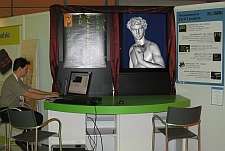
Most people’s experience with 3D involves wearing tinted glasses in a cinema. But a new technology, which does not require glasses and may enable 3DTV, is being developed by European researchers.
While the first applications of the new technology are likely to be the fields of industry and science, there are also very major implications for the future of entertainment, both at the cinema and on television, as well as in video gaming.
The most important aspect of the new system from the user perspective is that nothing is required of the viewer - no need for the special glasses in cinemas or having to adjust your head into specific positions to get the 3D effect, as with a holographic image. It provides the closest video 3D viewing experience compared to the well-known static holography, where the user can freely move to change viewing angle.
The breakthrough has been thanks to two EU-funded projects, firstly HOLOVISION, which ended in April last year, and then its successor OSIRIS, which is still going and runs until the end of 2009.
Resolution 10x that of HDTV
Ákos Demeter of Holografika, a partner in both projects, explains that in the first one the primary aim was to develop technologies capable of producing a very high-resolution 3D image.
“We basically organised projection engines in a special way and used holographic imaging film for the display screen. The combination of these, with the projection engines being driven by a cluster of nine high-end PCs, and new sophisticated software, allowed us to achieve our aims,” he notes.
A prototype system was produced with a resolution of 100Mpixel - or around 10 times that of HDTV - at 25 frames a second in six colours, rather than the standard RGB (red, green, blue). The researchers were able to increase the resolution three fold to virtually 300Mpixel by using greyscales instead of colours.
Although nothing commercial has come out of the HOLOVISION project as yet, it provided a major stepping-stone for the much larger OSIRIS project. An early prototype of an OSIRIS system was demonstrated at the ICT 2008 exhibition in Lyon, and impressed enough to win the Best Exhibit Award silver prize
Big-screen 3D for cinemas
A major aim of OSIRIS is to develop high-resolution, big screen, reflective projection 3D cinema. The prototype under development has a wall-mounted 1.7m x 3m screen, with the projector on the ceiling. In HOLOVISION, the images were back-projected which meant a very unwieldy display system that was 35 inches deep.
In OSIRIS, using a complex system of mirrors and light sources to provide the re-projected images, the screen display will only have a depth of between 15 and 20 inches to give a much less bulky and more modern look.
The glassless technology presents the 3D image in a way very similar to light coming from a normal object, so putting a lot less strain on the brain than current 3D projections. Demeter likens the experience to looking through a window. And as with looking though a window, it is possible for the viewer to walk around in front of the display and still see the same view, albeit from a changing perspective.
Although the technology is still under development, the commercial prospects are many and varied.
Many potential applications
“Military combat training is one potential application, replacing the current 2D projection technology with 3D projections for a much more lifelike experience,” says Zsuzsa Dobranyi, Sales Director at Holografika.
“Another application will be gaming, where we can imagine people walking into a small gaming room and freely moving around and seeing 3D images and playing 3D games with 3D objects without quickly tiring their brains out,” she continues.
This type of application may not be too far off commercialisation and the OSIRIS partners are already in discussions with a market-leading company to develop a 3D golf gaming system. This may be available in about a year.
Industrial and professional applications, such as computer-aided design (CAD), advertising, control rooms, and medicine could be just a few months off, with project members able to custom-build 3D systems according to customers’ requirements, Dobranyi says.
The work that has been done and is still underway, means that the projection and display technology will not be what delays the introduction of this type of 3D in cinemas. Content is more likely to be a stumbling block.
According to Demeter, “When filmmakers are ready to shoot with higher numbers of cameras to create 3D images, or broadcasters are prepared to combine images from all the cameras filming a live event to build 3D images, then we will be ready to show it.”
Electronics giant Thomson, co-coordinators of OSIRIS, are currently working on a better solution to capture and display real-life 3D video, replacing existing 3D acquisition systems which are clumsy or limited.
A 3D camera system is being developed using plenoptic camera technology. The system uses multiple cameras to capture sufficiently large field-of-view (FOV) 3D content for OSIRIS’ 3D displays, offering better 3D visibility and freedom than the existing stereo cameras.
How long before 3DTV, then?
Dobranyi believes 3DTV will happen, but can’t say exactly when. There are already dozens of HDTV broadcasters out there who would be interested in the next step to 3D. But better compression technologies are needed to deliver on this promise.
Research in the OSIRIS project is addressing this challenge. She confirms that 3D-IPTV wide-band networks even beyond 100Mbit/sec are on the horizon.
Despite this progress, broadcasting OSIRIS quantities of data at 100Mpixel and 50 frames a second will have to wait a bit longer, she suggests.
“But it is only a matter of time!” she concludes.
Source: ICT results cordis.europa.eu/ictresults


