Tracking down the causes of multiple sclerosis
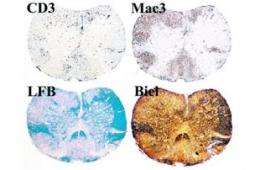
Over 100,000 people suffer from multiple sclerosis in Germany alone. Despite intensive research, the factors that trigger the disease and influence its progress remain unclear. Scientists from the Max Planck Institute of Neurobiology in Martinsried and an international research team have succeeded in attaining three important new insights into the disease.
It would appear that B cells play an unexpected role in the spontaneous development of multiple sclerosis and that particularly aggressive T cells are activated by different proteins. Furthermore, a new animal model is helping the scientists to understand the emergence of the most common form of the disease in Germany.
Multiple Sclerosis (MS) poses enormous problems for both patients and doctors: it is the most common inflammatory disease of the central nervous system in our part of the world and often strikes patients at a relatively young age. In some patients it leads to severe disability. Moreover, despite decades of research on MS, the causes and course of the disease are still largely unclear.
There is much evidence to support the fact that MS is triggered by an autoimmune reaction: immune cells that should actually protect the body against threats like viruses, bacteria and tumours, attack the body's own brain tissue. New treatments now available can attenuate the harmful immune reaction and thus delay the progress of the disease. However, the more effective the treatment, the more serious its side effects. Therefore, it is a matter of extreme urgency that new forms of treatment be developed which can differentiate in a targeted way between the immune cells that cause the disease and those that should be protected. A better understanding of the disease is required in order to achieve this.
Entirely new possibilities
The research of multiple sclerosis has proven particularly difficult. This is due, not least, to the fact that the focus of the disease is embedded in the sensitive brain tissue and is, therefore, inaccessible. More than other branches of medicine, MS research is dependent, therefore, on animal models in its study of the disease. Working in collaboration with an international team, scientists at the Max Planck Institute of Neurobiology have succeeded in developing a very effective animal model. The specially bred mice spontaneously develop a disease pattern that is practically identical to the course of the human form of MS most common in our part of the world. Because the disease also develops spontaneously in humans, the new model is superior to all of the previous models which only develop MS symptoms following injection with brain tissue. Moreover, the research using the new model has already prompted a rather sensational discovery: the emergence of the disease requires significantly more immune cells than previously assumed.
Unrecognised significance
Up to now, MS research has worked on the assumption that the disease mainly arises as a result of attacks on a group of white blood cells known as T cells. These immune-system cells provide a kind of 'immediate response' to pathogens - they recognise the pathogens, activate the immune response and thus trigger the destruction of the harmful cells. In addition to T cells, the immune system also has B cells. These also react to the presence of a pathogen, are activated and start to divide rapidly. Thousands of cells are created which produce a pathogen-specific antibody. An invasion of pathogens can be overcome quickly and effectively through the targeted interaction of T and B cells.
Unlike the T cells, the B cells have hitherto only been assigned a subordinate role in the emergence of multiple sclerosis - erroneously, as the new model now shows. Previous experimentally-generated models of the disease had simply failed to reveal the true role of the B cells.
In the new mouse model, T cells also attack the body's own brain tissue. However, this is not sufficient to trigger the disease, as when the scientists remove the B cells, the animals remain healthy. "This observation surprised us all because it contradicted the prevailing doctrine," notes Gurumoorthy Krishnamoorthy. The new model shows that there most be some kind of interaction between the T and B cells, that the resulting army of B cells triggers the full-blown form disease through its antibody attacks.
More aggressive than others
Even if B cells play a far more significant role than was previously believed, the fact remains that T cells can cause extensive damage to nerve cells in the context of multiple sclerosis. Basically, they can misinterpret any component of the nervous system as a foreign body and launch an attack. However, it is well known that some of the autoreactive T cells are significantly more aggressive than others. One group of these 'special' T cells recognises and attacks the protein MOG, which is found on the surface of brain cells. To the amazement of the neuroimmunologists, however, these cells also attack mice that lack MOG. "This finding was completely unexpected, since the T cells should not really attack anything in the absence of MOG", says Krishnamoorthy. The solution to this puzzle was provided by a broad-based biochemical study: T cells that identify MOG as a foreign body also react to a second, completely different protein in the brain.
New understanding - possible treatments
"Such doubly or even triply activated T cells could be the reason for the significantly greater aggressiveness of these cells", suggests Hartmut Wekerle, the head of the study. And, of course, he is already thinking one step ahead: "We must now find a way of identifying these special T cells in the patient." Based on this, treatments could be developed that specifically suppress the activity of these particularly aggressive T cells or remove them from the tissue. Such a treatment should have considerably fewer side effects than the previous, rather unspecific approaches.
The new animal model, which provides a far better simulation of the human form of the disease, has prompted surprising insights into the role of the B cells in the spontaneous development of MS. This and the astonishing finding that particularly aggressive T cells are activated by different proteins both represent considerable advances in the research of multiple sclerosis. All of these insights could provide the basis for the development of new approaches to the treatment of the disease.
Citation:
"Myelin-specific T cells also recognize neuronal autoantigen in a transgenic mouse model of multiple sclerosis," Gurumoorthy Krishnamoorthy, Amit Saxena, Lennart T. Mars, Helena S. Domingues, Reinhard Mentele, Avraham Ben-Nun, Hans Lassmann, Klaus Dornmair, Florian C. Kurschus, Roland Liblau & Hartmut Wekerle, Nature Medicine, May 31st, 2009
Source: Max-Planck-Gesellschaft


