Baby Stars Finally Found in Jumbled Galactic Center
June 10, 2009 Baby Stars Finally Found in Jumbled Galactic Center

Enlarge

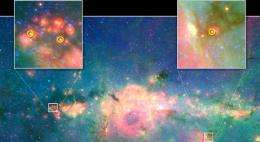
This infrared image from NASA's Spitzer Space Telescope shows three baby stars in the bustling center of our Milky Way galaxy. Image credit: NASA/JPL-Caltech

Astronomers have at last uncovered newborn stars at the frenzied center of our Milky Way galaxy. The discovery was made using the infrared vision of NASA's Spitzer Space Telescope.

The heart of our spiral galaxy is cluttered with stars, dust and gas, and at its very center, a supermassive black hole. Conditions there are harsh, with fierce stellar winds, powerful shock waves and other factors that make it difficult for stars to form. Astronomers have known that stars can form in this chaotic place, but they're baffled as to how this occurs. Confounding the problem is all the dust standing between us and the center of our galaxy. Until now, nobody had been able to definitively locate any baby stars.

"These stars are like needles in a haystack," said Solange Ramirez, the principal investigator of the research program at NASA's Exoplanet Science Institute at the California Institute of Technology, Pasadena. "There's no way to find them using optical light, because dust gets in the way. We needed Spitzer's infrared instruments to cut through the dust and narrow in on the objects."

The team plans to look for additional baby stars in the future, and ultimately to piece together what types of conditions allow stars to form in such an inhospitable environment as our galaxy's core.

"By studying individual stars in the galactic center, we can better understand how stars are formed in different interstellar environments," said Deokkeun An of the Infrared Processing and Analysis Center at Caltech, lead author of a paper submitted for publication in the Astrophysical Journal. "The Milky Way galaxy is just one of more than hundreds of billions of galaxies in the visible universe. However, our galaxy is so special because we can take a closer look at its individual stellar components." An started working on this program while a graduate student at Ohio State University, Columbus, under the leadership of Ohio State astronomer Kris Sellgren, the co-investigator on the project.

The core of the Milky Way is a mysterious place about 600 light-years across (light would take 600 years to travel from one end to the other). While this is just a fraction of the size of the entire Milky Way, which is about 100,000 light-years across, the core is stuffed with 10 percent of all the gas in the galaxy -- and loads and loads of stars.

Before now, there were only a few clues that stars can form in the galaxy's core. Astronomers had found clusters of massive adolescent stars, in addition to clouds of charged gas -- a sign that new stars are beginning to ignite and ionize surrounding gas. Past attempts had been unsuccessful in finding newborn stars, or as astronomers call them, young stellar objects.

Ramirez and colleagues began their search by scanning large Spitzer mosaics of our galactic center. They narrowed in on more than 100 candidates, but needed more detailed data to confirm the stars' identities. Young stellar objects, when viewed from far away, can look a lot like much older stars. Both types of stars are very dusty, and the dust lying between us and them obscures the view even further.

To sort through the confusion, the astronomers looked at their candidate stars with Spitzer's spectrograph - an instrument that breaks light apart to reveal its rainbow-like array of infrared colors. Molecules around stars leave imprints in their light, which the spectrograph can detect.

The results revealed three stars with clear signs of youth, for example, certain warm, dense gases. These youthful features are found in other places in the galaxy where stars are being formed.

"It is amazing to me that we have found these stars," said Ramirez. "The is a very interesting place. It has young stars, old stars, black holes, everything. We started mining a catalog of about 1 million sources and managed to find three young stars -- that will help reveal the secrets at the core of the Milky Way."

The young stellar objects are all less than about 1 million years old. They are embedded in cocoons of gas and dust, which will eventually flatten to disks that, according to theory, later lump together to form planets.

Source: NASA/JPL


print this article email this article download pdf blog this article bookmark this article     Stumble it Digg this share on Facebook retweet share on Reddit add to delicious
Rate this story - 4.4 /5 (7 votes)

Rank Filter

Move the slider to adjust rank threshold, so that you can hide some of the comments.


Display comments: newest first

  • omatumr - Jun 12, 2009
    • Rank: 1 / 5 (1)
    GREAT REASONING

    "However, our galaxy is so special because we can take a closer look at its individual stellar components."

    Now apply that same reasoning to the star next door, the only one that is close enough for detailed measurements.

    For example, the Sun discards 50,000 billion metric tons of Hydrogen in the solar wind each year.

    Is the Hydrogen fuel for the H-fusion reactor furnace that powers the Sun?

    Or is the Hydrogen smoke (a neutron-decay product) from the furnace that powers the Sun? See: http://arxiv.org/.../0411255

    With kind regards,
    Oliver K. Manuel
    http://www.omatumr.com/


  • barakn - Jun 12, 2009
    • Rank: 1 / 5 (2)
    Oliver Manuel's recent efforts to plaster Physorg.com and other public news sites with his theories and personal URLs are a bit puzzling, as scientists have a variety of publications available to communicate directly to each other in. My best guess is that he is desperately trying to prop up his legacy in light of his arrest in his university office on 7 charges of rape and sodomy based on allegations by 4 of his own children. The charges have been reduced to one count of felony attempted sodomy, not necessarily because of his innocence, but because of the statute of limitations. One can only guess how the recent charges and decades of family strife have affected his ability to reason rationally and to remain objective while defending his unpopular theories.

    http://www.connec...id=10140
    http://www.komu.c...816.page
    http://blogs.colu...assault/
  • Ethelred - Aug 08, 2009
    • Rank: not rated yet
    Barakn:

    What did you do that has Earls giving you a one for every post he can find? And I thought he was mad at me.

    Not a PM so Earls in hopes that Earls sees this.

    If you want I have just found more information regarding your links.

    I wonder I Oliver will look at this. He doesn't seem to have noticed your post at all.

    Ethelred

June 10, 2009 all stories

Comments: 3

4.4 /5 (7 votes)
  • Stumble this up

  • Digg this

  • share this

  • hide
  • Related Stories

  • Amazing Andromeda Galaxy
    created Oct 03, 2006 | popularity not rated yet | comments 0
  • Stars Forming Just Beyond Black Hole’s Grasp at Galactic Center
    created Jan 05, 2009 | popularity not rated yet | comments 0
  • Smoking galaxy revealed
    created Mar 17, 2006 | popularity not rated yet | comments 0
  • Milky Way's infrared portrait gives new view of galaxy
    created Jun 03, 2008 | popularity not rated yet | comments 0
  • With computers, astronomers show predicted present day distribution of elusive first stars
    created Dec 12, 2006 | popularity not rated yet | comments 0


  • hide
  • Relevant PhysicsForums posts

  • Sideral question
    created 18 hours ago
  • Doppler shifted blackbody spectrum
    created 21 hours ago
  • Earth v. Moon
    created 23 hours ago
  • help me with coordinates and orbits
    created 23 hours ago
  • basic 'our universe' question..
    created Nov 20, 2009
  • deriving keplers law
    created Nov 19, 2009
  • More from Physics Forums - General Astronomy

Other News

Astronauts finish another spacewalk, still no baby (AP)

Astronauts finish another spacewalk, still no baby

Space & Earth / Space Exploration

created 10 hours ago | popularity 3 / 5 (2) | comments 0

(AP) -- A spacewalking astronaut put aside the impending birth of his daughter and blazed through his first-ever venture outside the International Space Station on Saturday.


Unseasonably hot and dry weather combined with strong winds to fan scores of blazes in the country's southeastern states

Australia issues 'catastrophic' alerts as fires rage

Space & Earth / Environment

created 16 hours ago | popularity 4 / 5 (3) | comments 0

Australia has issued "catastrophic" alerts after record-breaking temperatures and wild lightning storms sparked more than 100 fires across the country, officials said Saturday.


Commuters wait on the platform shrouded by fog in London

Climate change not man-made, say majority of Britons: poll

Space & Earth / Environment

created Nov 15, 2009 | popularity 3.3 / 5 (15) | comments 46

Less than half of Britons believes that human activity is to blame for global warming, according to a poll carried out for The Times newspaper and published on Saturday.


Mysteriously warm times in Antarctica

Mysteriously warm times in Antarctica

Space & Earth / Earth Sciences

created Nov 18, 2009 | popularity 4.2 / 5 (21) | comments 28

(PhysOrg.com) -- A new study of Antarctica's past climate reveals that temperatures during the warm periods between ice ages (interglacials) may have been higher than previously thought. The latest analysis ...


UN: Fight climate change with free condoms (AP)

UN: Fight climate change with free condoms

Space & Earth / Environment

created Nov 18, 2009 | popularity 3.1 / 5 (11) | comments 24

(AP) -- The battle against global warming could be helped if the world slowed population growth by making free condoms and family planning advice more widely available, the U.N. Population Fund said Wednesday.