Evolution can occur in less than 10 years
June 11, 2009
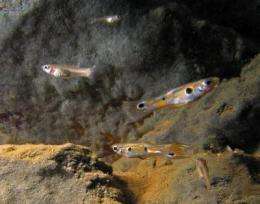
Guppies are small fresh-water fish that biologists have studied for long. Credit: Paul Bentzen.
How fast can evolution take place? In just a few years, according to a new study on guppies led by UC Riverside's Swanne Gordon, a graduate student in biology.
Gordon and her colleagues studied guppies — small fresh-water fish biologists have studied for long — from the Yarra River, Trinidad. They introduced the guppies into the nearby Damier River, in a section above a barrier waterfall that excluded all predators. The guppies and their descendents also colonized the lower portion of the stream, below the barrier waterfall, that contained natural predators.
Eight years later (less than 30 guppy generations), the researchers found that the guppies in the low-predation environment above the barrier waterfall had adapted to their new environment by producing larger and fewer offspring with each reproductive cycle. No such adaptation was seen in the guppies that colonized the high-predation environment below the barrier waterfall.
"High-predation females invest more resources into current reproduction because a high rate of mortality, driven by predators, means these females may not get another chance to reproduce," explained Gordon, who works in the lab of David Reznick, a professor of biology. "Low-predation females, on the other hand, produce larger embryos because the larger babies are more competitive in the resource-limited environments typical of low-predation sites. Moreover, low-predation females produce fewer embryos not only because they have larger embryos but also because they invest fewer resources in current reproduction."
Study results appear in the July issue of The American Naturalist.
Natural guppy populations can be divided into two basic types. High-predation populations are usually found in the downstream reaches of rivers, where they coexist with predatory fishes that have strong effects on guppy demographics. Low-predation populations are typically found in upstream tributaries above barrier waterfalls, where strong predatory fishes are absent. Researchers have found that this broad contrast in predation regime has driven the evolution of many adaptive differences between the two guppy types in color, morphology, behavior, and life history.
Gordon's research team performed a second experiment to measure how well adapted to survival the new population of guppies were. To this end, they introduced two new sets of guppies, one from a portion of the Yarra River that contained predators and one from a predator-free tributary to the Yarra River into the high-and low-predation environments in the Damier River.
They found that the resident, locally adapted guppies were significantly more likely to survive a four-week time period than the guppies from the two sites on the Yarra River. This was especially true for juveniles. The adapted population of juveniles showed a 54-59 percent increase in survival rate compared to their counterparts from the newly introduced group.
"This shows that adaptive change can improve survival rates after fewer than ten years in a new environment," Gordon said. "It shows, too, that evolution might sometimes influence population dynamics in the face of environmental change."
Source: University of California - Riverside (news : web)


Are we adapting to our environment? Is there new genetic information present in Americans because we have been forced to adapt to cheeseburgers?
My point is simple, adapting to the environment and evolution are two different things.
But evolution means whatever the person promoting it wants it to mean. ;-)
Now it is possible to check this. Simply take some young guppies from above the falls transfer SOME to below the falls and see what the females do in the new environment in comparison to the control group that is left behind.
Instead they did something did something that was totally irrelevant to the initial study. They took guppies from the original source population and tested their survival rate. Surprise surprise they died faster after being dumped in a new environment with no real chance to acclimate.
Perhaps the article is missing something important. Some relevant fact that would make the experimenter's work seem meaningful.
It is likely that the guppies in the Damier had undergone some genetic changes to adapt to the new environment which certainly would qualify as evolution. However the experiment simply fails to do the right kind of tests.
There is nothing stopping them from doing further tests that show change. They just haven't done it yet. The second test they did would be a waste time to do over. Guppies have live birth and would need to be born in the Damier for the test to be relevant, dumping in juveniles was a guaranteed way to get dead guppies whether above or below the falls.
Ethelred
Ethelred
Oh, and gmurphy: I second your question :)
Its that simple. I even showed how they could show heritable selection. Its called constructive criticism.
Only DNA change results in heritable change. Anything else isn't inherited.
No, really. I didn't know that. No wonder I can't find in my copy of Origins. I really got to finish that thing but its hard to read something that old after the dozens of other books on evolution that I have read.
Please give me a clue as to where something showing that is in the article. I saw no evidence in the article that could lead to that conclusion. Just because someone claims to have shown something it doesn't mean they have. And the evidence didn't support the conclusion. They need at least one more step. They have to show that changes in phenotype were due to changes in the genotype.
Fittest is a poor term. Evolution does not select the fittest. It selects OUT the least fit for conditions at hand. The change comes from mutation the selection is from the environment.
Since the definition of fittest is that which reproduces successfully, Creationist use this poor choice of words to claim its circular reasoning. So avoid it. Stick with natural selection, just like Darwin did.
Read the article more carefully.
They introduced the guppies ABOVE the falls. The guppies then went over the falls and survived. Going up the falls is considerably more difficult. How difficult depends on the height of the falls. Even salmon and steelhead have their limits.
Ethelred
How does it not? Direct quotes from the article:
"Eight years later (less than 30 guppy generations), the researchers found that the guppies in the low-predation environment above the barrier waterfall had adapted to their new environment by producing larger and fewer offspring with each reproductive cycle."
and then:
"This was especially true for juveniles. The adapted population of juveniles showed a 54-59 percent increase in survival rate compared to their counterparts from the newly introduced group."
With respect to the latter, note particularly the reference to "juveniles": fresh hatchlings whose differences in phenotype can only be attributed to genetics.
Not quite. RNA is inerited. Cellular organelles are inherited (consider mitochondria, for example.) Cytoplasm is inherited, with its cocktail of proteins and various epigenetic promoters/inhibitors of gene expression.
They showed it effectively enough, in the second experiment. Both times, guppies were taken form Yarra, and introduced into Damier. In the second case, locally-adapted Damier guppies derived from Yarra, outperformed freshly-introduced Yarra guppies, particularly among juveniles. That is an adaptive phenotype change, deriving from change in genotype.
Two idempotent formulations of the same predicate: 2 plus 2 = 4, vs. 2 - (-2) = 4. Except your way is unnecessarily convoluted, since it employs double-negation.
Follow your own advice. Quote from article:
"Low-predation populations are typically found in upstream tributaries above barrier waterfalls, where strong predatory fishes are absent."
They're talking about natural populations now, not the experimental ones. So the quirky thing about that is, how do the small guppies naturally make it up stream to end up above waterfalls, when stronger/larger predatory fishes are incapable of following them there? Inquiring minds want to know!
They have to show that is not a normal response by guppies to a low predator environment. I pointed that out already.
Which was predictable without any need to claim evolution was involved. Dump a bunch of humans in a new a difficult environment competing with experience locals and they too will have a depressed survival rate. There was nothing in the article that gave any indication that experience was not the cause of the result.
There was no mention of differences in phenotype. Only in survival. Juveniles would have the wrong experiences for the new environment.
I covered that already. It had nothing to do with phenotype.
You, and they, need to distinguish between genetics and experience. Guppies have at least some ability to learn from experience. They did nothing to show that experience was the cause of the different survival rates.
Perhaps there is sufficient information about how guppies respond to changes in environment already but the article does nothing to show that.
]
My way avoids the appearance of circular reasoning. And there is no double negative. Now this phrase that I created does have a double negative.
"Evolution is a process that cannot, not happen."
The comma is needed to emphasize the situation. In speech there should be a strong emphasis on CANNOT. Don't use can't either. It will decrease the emphasis. Double negatives must be used with care.
Its a pretty effective double negative. Don't let the Grammar Nazis get in the way of effective writing. Long experience in arguing with Creationists has taught me how to overcome their favorite objections.
Evolution should be treated as a process and not some kind of path to higher species. No ladders. No Great Chain of Being. Not a theory but an inevitable process inherent in the way life functions.
Yes. I saw that. Its exactly my point in regard to the question asked about why the predators weren't above the falls. Its a frequent occurrence in the Sierra Nevada. Brown trout below the falls and brooks above. Of course both were planted fish as rainbows are the native trout in California.
That's two times you didn't really read carefully enough. Even after I explained. So now I will do it in more detail.
The guppies, you can see there, were NOT a natural population. They were planted ABOVE the falls which excluded the predators. They did NOT move upstream. They did move downstream. Going over the falls downstream is not exactly hard, though in really extreme cases the fish going over the falls are all killed or stunned and then eaten. Going up is difficult.
Inquiring minds need to read more carefully. And stay away from the supermarket checkout rags. They rot the mind.
Ethelred
If that were so, it would not have taken 30 generations to manifest such a "normal response". The "normal response" would have occured within 1 generation, or at most within 2 generations.
Dude... they were talking about imported JUVENILES vs. adapted JUVENILES. What "experienced locals" are you talking about??? Juveniles are just-hatched; they have no "experience" other than their [epi]genetic endowment!
Again, quote (emphasis added):
"The adapted population of JUVENILES showed a 54-59 percent increase in survival rate compared to their counterparts from the newly introduced group."
What the hell do you think determines survival, in JUVENILES -- their recalled experience from prior lives??
Saying that the fittest are selected has no implication for "higher species" or "ladders". The definition of fitness is very simple: rate of survival and reproduction. Every species in existence today is equall fit, regardless of whether we consider it a "higher" or "lower" form of life. If it wasn't sufficiently fit for its niche, it would have been replaced by competing species with higher fitness.
That, in fact, is a key insight into why rapid proliferation of new species can only follow a mass-extinction catastrophe (as repeatedly documented in the fossil record): mutants typically have lower fitness and have little chance of succeeding against established competitors, particularly when entering a new niche (for the species), but when the playing board is cleared by a mass extinction, mutants suddenly have more breathing room and less survival pressure on them, which allows for a burst of rapid evolutionary change (until all niches are once again occupied by highly-optimized lifeforms.)
In the name of all that's unholy... Talk about reading comprehension:
"Low-predation populations are TYPICALLY FOUND in upstream tributaries above barrier waterfalls, where strong predatory fishes are absent."
What the heck do you think that means? How do you honestly read that as "Low-predation populations are all unnatural and are always the result of artificial planting..."
True, you have a point. However I can't be sure that it took 30 generations. That is I don't know how often they checked what was going on, nor do I know what was happening when they did check, except for the end. Perhaps there is enough information in the actual paper to tell.
Previously I did say this:
If the article has change over time per generation then I would have to say that is significant.
Dude?
The adapted juveniles of course. If that does mean just hatched then you are right. Sorry, but juvenile doesn't mean just hatched to me. If the article had said just hatched I wouldn't have disagreed.
Of course guppies don't hatch. So perhaps I was looking for a term that wouldn't be used in regards to guppies.
The time since they hatched or rather were born. Also in the case of mice they have behavioral changes based on the season they were born in. Mice don't live long enough for them to need to be able to handle both summer and winter. It was a bit surprising when I first ran accross that.
Found something about sardines regarding juvenile:
http://www.scienc...ticleURL]http://www.scienc...ticleURL[/url]&_udi=B6T6N-40VT0S5-1&_user=10&_rdoc=1&_fmt=&_orig=search&_sort=d&view=c&_acct=C000050221&_version=1&_urlVersion=0&_userid=10&md5=d8c4dbbc7ac25db53287e2f85f051183
I hope the URL doesn't break the page. My thats a long one.
In this one they call 10 to 50 day old guppies juveniles:
http://www.scienc...ticleURL]http://www.scienc...ticleURL[/url]&_udi=B6T2J-4PYYTS3-2&_user=10&_rdoc=1&_fmt=&_orig=search&_sort=d&view=c&_acct=C000050221&_version=1&_urlVersion=0&_userid=10&md5=b34b8c5d33e6d3017a89ff3554189e95
Here is something interesting about juveniles and predators:
http://beheco.oxf...arm111v1
That's enough of that. If juveniles are defined as start from birth with guppies then you are right.
Not too most. Which is why I avoid the use of the term.
Actually that isn't true. Any species that has had a recent change in environment is less fit that one has stabilized. Otherwise there would be little or no change in any species. Your next paragraph shows that you knew that also, at least in regard to mass extinctions.
Well all the tests I have took show its high. Very high. Its my math that sucks. Frankly I don't have any idea what you are complaining about here. Above yes but here no.
Who the hell are you quoting? I never said that. I can't even find on the page with Control-F except for your alleged quote. Talking about reading comprehension problems. You have quote problem.
To go back a bit:
You:
gmurphy:
I was answering that question for the second time. Rather thoroughly I might add both times. The information was there in the article. And by the way I skipped on over the part I quoted when I was reading the article on the first pass since I already understood what the falls were doing in regards to the predators. When the question was asked I thought they might have left it out but they didn't.
Its not my fault you assumed I was some sort of Creationist in the beginning and its not my fault that you have yet to adapt to the reality that I am no such thing. I have simply suggested that you exercise care in the way you say things as Creationists have become very adept at exploiting sloppy language. Survival of the fittest is sloppy. Its not in Darwin either until the fifth edition. My copy, which was under my alarm clock, is the first edition.
You might have a look at this:
http://en.wikiped..._fittest
As you can see there I am not the only person that avoids that phrase.
Ethelred