Japan's first lunar probe ends mission
June 11, 2009 By SHINO YUASA , Associated Press Writer Japan's first lunar probe ends mission (AP)

Enlarge

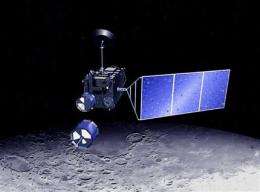
In this artist rendition released by Japan Aerospace Exploration Agency (JAXA), Japan's first lunar prob Kaguya orbits the moon in space. Kaguya made a controlled crash-landing on the moon Thursday, June 11, 2009, successfully completing a 19-month mission studying Earth's nearest neighbor, JAXA said. (AP Photo/Japan Aerospace Exploration Agency, HO)

(AP) -- Japan's first lunar probe made a controlled crash landing on the moon Thursday, successfully completing a 19-month mission to study the Earth's nearest neighbor, Japan's space agency said.

The remotely controlled satellite, named after the folklore princess Kaguya, had been orbiting the moon to map its surface and study its mineral distribution and gravity levels. It was dropped onto the surface of the moon at 3:25 am. (1825 GMT), the Japan Aerospace Exploration Agency, or JAXA, said in a statement.

"The mission was a success. Thanks to Kaguya, we will have a very detailed map of the ," said JAXA spokesman Shinichi Sobue. The Japanese space agency will analyze data sent by Kaguya and plans to publish the results online in November.

The 55 billion yen ($560 million) lunar mission launched in September 2007 is the largest in scope and ambition since the U.S. Apollo program of the 1960s and 70s, Sobue said.

"With data from Kaguya, we hope to shed light on the evolution of the moon," Sobue said.

During the Kaguya project, Japan launched two other orbiters to relay data. One landed on the moon in February, while the other has been measuring gravity around the moon and is still in orbit. Japan launched a probe in 1990, but that was a flyby mission.

Japan launched its first satellite in 1970 and has achieved several major scientific coups in space, including the launch of a probe that made a rendezvous with an asteroid. The Japanese-produced H-2A rocket is one of the world's most advanced and consistent.

In January, Japan launched the first satellite to monitor greenhouse gases, a tool to help scientists better judge where global warming emissions are coming from, and how much is being absorbed by the oceans and forests.

But its space program has also been beset by delays and mishaps.

In 2007, one of its four spy satellites became unresponsive due to apparent electrical problems. The other three satellites were functioning normally, but the failure left its multibillion dollar, long-awaited spy network with a significant hole.

A mission to Mars had to be abandoned in 2003 after a probe moved off course.

©2009 The Associated Press. All rights reserved. This material may not be published, broadcast, rewritten or redistributed.


print this article email this article download pdf blog this article bookmark this article     Stumble it Digg this share on Facebook retweet share on Reddit add to delicious
Rate this story - not rated yet


June 11, 2009 all stories

Comments: 0

not rated yet
  • Stumble this up

  • Digg this

  • share this

  • hide
  • Related Stories

  • Japan lunar orbiter frees mini-satellite
    created Oct 10, 2007 | popularity not rated yet | comments 0
  • India Plans for Lunar Mission in 2007
    created Jan 26, 2005 | popularity not rated yet | comments 0
  • China Expected To Launch Lunar Probe Satellite In 2007
    created Aug 10, 2005 | popularity not rated yet | comments 0
  • First Chinese Unmanned Lunar Mission Set For 2007
    created Aug 17, 2005 | popularity not rated yet | comments 0
  • Japanese probe lands on asteroid again and apparently takes samples
    created Nov 26, 2005 | popularity not rated yet | comments 0


  • hide
  • Relevant PhysicsForums posts

  • Question about 2-body gravity
    created 23 hours ago
  • life on Mars
    created Nov 24, 2009
  • Semi-major axis from cartesian co-ordinates
    created Nov 23, 2009
  • Primary Mirror grinding
    created Nov 23, 2009
  • More from Physics Forums - General Astronomy

Other News

Mars Reconnaissance Orbite

Mars Reconnaissance Orbite Team Plans Uplink of Protective Files

Space & Earth / Space Exploration

created 1hour ago | popularity not rated yet | comments 0

(PhysOrg.com) -- The team operating NASA's Mars Reconnaissance Orbiter plans to uplink protective files to the spacecraft next week as one step toward resuming the orbiter's research and relay activities.


America's increasing food waste is laying waste to the environment

Space & Earth / Environment

created 3 hours ago | popularity not rated yet | comments 0

Food waste contributes to excess consumption of freshwater and fossil fuels which, along with methane and carbon dioxide emissions from decomposing food, impacts global climate change. In a new paper published in the open-access, ...


Shuttle Atlantis leaves space station, headed home (AP)

Shuttle Atlantis leaves space station, headed home

Space & Earth / Space Exploration

created 3 hours ago | popularity not rated yet | comments 0

(AP) -- Atlantis and its seven astronauts have left the International Space Station.


First black holes may have incubated in giant, starlike cocoons, says CU-Boulder study

First black holes may have incubated in giant, starlike cocoons

Space & Earth / Astronomy

created 19 hours ago | popularity 4.4 / 5 (10) | comments 15

(PhysOrg.com) -- The first large black holes in the universe likely formed and grew deep inside gigantic, starlike cocoons that smothered their powerful x-ray radiation and prevented surrounding gases from ...


Cassini Captures Ghostly Dance of Saturn's Northern Lights

Cassini Captures Ghostly Dance of Saturn's Northern Lights (w/ Video)

Space & Earth / Space Exploration

created 16 hours ago | popularity 5 / 5 (7) | comments 1

(PhysOrg.com) -- In the first video showing the auroras above the northern latitudes of Saturn, Cassini has spotted the tallest known "northern lights" in the solar system, flickering in shape and brightness ...