Sunlight Trap Could Lead to New Generation of Solar Devices
June 11, 2009 by Lisa Zyga
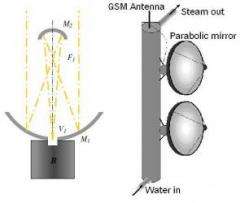
(Left) The design for trapping sunlight using two elliptical mirrors, with M1 collecting sunlight and M2 (the zozzaroid) focusing sunlight back to the vertex of M1 and into the blackbody. (Right) The mirrors used in a scheme for steam generation. Image credit: De Luca and Fedullo.
In the Greek legend of Dionysius' ear, Dionysius made a cave shaped like an ellipse in order to hear the words whispered by a prisoner in one of the foci of the cave. Some science museums today feature a similar exhibit, where two people at opposite ends of a room can whisper into giant ellipses and distinctly hear each others' words. This sort of cave, called Dionysius' ear, has also inspired the design of a new sunlight trap proposed by physicists Roberto De Luca and Aniello Fedullo, both of the University of Salerno in Italy.
As the scientists explain in a study to be published in the European Journal of Physics, their sunlight trapping system is the optical equivalent of acoustical Dionysius' ear. The design consists of two parabolic mirrors arranged face-to-face. Sunlight first hits the larger mirror and reflects to the smaller mirror placed a short distance away. Then the light from the smaller mirror reflects back, this time being focused into the vertex of the larger mirror. By confining sunlight into this small region, scientists can ideally trap solar radiation. The sunlight is stored in a blackbody, which consists of a cavity with perfectly reflecting inner walls.
"Through a sunlight trap system, solar radiation is first concentrated in a small region of space and then sent into a blackbody, where it can be stored (not for an arbitrary long time, though) for a variety of uses," De Luca told PhysOrg.com. "For example, after having trapped sunlight in a cavity with perfectly reflecting inner walls, what we call a blackbody, one can think of heating water enclosed in a container placed inside the cavity itself. Other uses of this concept are also conceivable."
In their study, De Luca and Fedullo investigated the feasibility of such a perfect sunlight trapping system, which was first envisioned by Paolantonio Zozzaro, a high school physics professor from the Province of Salerno. Zozzaro, who is involved in alternative energy research, wondered what the shape of the smaller mirror should be in order to reflect all incident light rays to the vertex of the larger mirror. Through their calculations, De Luca and Fedullo found that the smaller mirror should have a specific elliptic or hyperbolic profile, similar to Dionysius' ear. They call this secondary mirror a "zozzaroid." They've shown that, theoretically, the design focuses sunlight very effectively, so that it can be transferred to a blackbody with a rather small hole.
The scientists hope that the new sunlight collector could be useful for a variety of alternative energy applications. In a follow-up study, De Luca has investigated the possibility of using the device to generate steam without the need for a convection fluid. In the hollow cavity of the blackbody, he added a metal container into which water is pumped. Through conduction, heat is transferred from the metal container to the water, which is transformed into superheated steam. The steam can then be used for applications such as power generation. In addition to steam generation, such a system might be able to transform sea water into drinking water using only solar energy.
"Let us consider the problem of drinking water on the coasts of hot regions of the globe," De Luca said. "In these places, salt water and sunlight are available in great quantity. Well! It is now not difficult to show that one can use a sunlight trap to heat one side of a metal surface dividing a cylindrical blackbody in two parts. On the other side of the metal surface (which attains a temperature very close to that of the opposite side), one can spray sea water. The generated vapor will then rise in the second chamber of the blackbody and salt will drop down due to gravity. By condensation of the generated vapor, one finally obtains drinkable water."
De Luca and Fedullo predict that constructing a prototype of this system will involve technical challenges due to the highly idealized scheme. However, they hope that a close approximation to the ideal system could lead to many exciting possibilities.
"There can be more applications indeed," De Luca said. "If one can generate overheated steam, one is able to produce electricity, as one does in ordinary thermoelectric power plants. In our case, however, one does not need to burn fossil fuel to generate heat. On the other hand, owing to the periodic availability of sunlight, one has to experiment with new types of controlled power generation systems. This new type of technology may be implemented, on a rather large scale, in a region of the world where the local social and economical development is not yet strictly linked to the availability of fossil fuel and where solar radiation is a rather ample resource.
"A group of developed countries can then make an agreement with the country having such characteristics: We shall invest in testing a model of sustainable industrial development based on alternative energies in your [undeveloped] country, using our technologies and our funds. In return, you will inherit the new developed technology (comprising the possibility of having a public transportation system based on hydrogen vehicles) in the near future, solve some occupational problems and, probably, have a better production of drinking water. Most of all, your country will not contribute to the greenhouse effect, being the first example of a fully developed region whose industrial production and human activity do not emit carbon dioxide into the atmosphere."
More information: R De Luca and A Fedullo. "Focusing light rays back to the vertex of a reflecting parabolic collector: the equivalent of Dionysius ear effect in optical systems." European Journal of Physics. (to be published).


Exactly so... See the small GSM antenna for solar tracking...
Big expensive smith-cassgrain telescopes with dual axis tracking for minute amounts of unreliable heat? Even first graders should be able to do the math and reject the idea as preposterous.
Very good... does anyone know that the power delivered by solar radiation on Earth could be, by itself, more than enough to satisfy the energy needs of Mankind? This is just a way to use it more effectively.
I am very much surprised about negative comments. However, I shall repeat: good science should be judged by good scientists.
Ciao.
Vito Carlomagno
Adding a second mirror still requires mounting hardware that does little to improve upon the existing parabolic troughs. Moving the blackbody behind the focusing mechanism is the same as fresnel CPV. And finally, the mechanism, tracker and drive motors are all expenses that require maintenance just as many existing approaches.
If the true point of the article was to describe a new blackbody storage device then it should have talked about that. But the technology, as described, appears to have no improvements when looked at on a feature and benefit basis--it is identical to existing solutions. Further more, the argument could be made that requireing two optical surfaces AND the drive mechanism would cost more and be more difficult to manufacture than would a single mirror trough (and single altitude drive) or a FLAT mirror array (and alt-az drive) focusing on a tower.
Year average of ~250 Wth/m^2 in exceptional areas, 50 Wth/m^2 or so in Sweden, where I live.
With 10-20% efficiency you get 5-50 We/m^2. That's utterly abysmal.
Who cares? You're not going to be able to cover even a billionth of the Earths surface with dual-axis tracking, schmidt-cassegrain telescopes, maintain and clean them, build the associated electrical energy storage and transmission. The reason is quite simple; each unit you make is hideously unprofitable, making more of them just gets you increasingly into debt.
What are you going to do? Take a loss on each unit and make it up on volume?
Vacuous crap tends to draw out negative comments.
R. De Luca, F. Romeo, P. Zozzaro, "Capturing sunlight" Eur. J. Phys. 27 (2006) 1233
There is no better answer to your angry comments than this wonderful work
hey!!! let me save them LOTS of money....
rather than use a second curved mirror, if they moved the top curved mirror down in focal length, they then could use a mirrored flat instead of an expensive second curved mirror.
and dont tell them.. but more than 10 years ago i figured out that you could take a wire, make a circle. put a mass made CD on it, then take a tube and make cuts on the end to bend it out like a flower. threat it. then use that in the center to make the cd have a curve (you can also put them on a metal bowl and heat them in the oven till they are soft and curve).
with that, you only need now to take another CD, and put it in the right space of the focal length.
however, even better is to make a large array of throwaway cds, and have that track the sun to a cast iron radiator painted black. put the radiator in a glass case, and voila, junkyard solar power of a pretty hige degree. all thats needed is to eather use steam power, or run it to peltier.
the point is that the guys that go do this are not good engineers, and not that conversant. if they were they wouldnt go and do this!!!!
they would realize that the costs of production in what they are desinging are so high that its not worth doing. as a personal hobby project that pans out by putting junk together, its GREAT!! because thats how some choose to spend their time, and time is needed to collect and put the junk together.
but if they cant see that they are just making a telescope, and cant see that there are better designs that make it easier to make by using flats, then their proposals are too expensive.
i ahve lots of workable designs that are NOT too expensive. but in a sea of cranks like this, i cant be noticed.
what they ahve is the right connections to do something and have some capital, that is waht i dont have.
funny thing is that there ARE designs that one can make that are relatively cheap that would funnel light and would not need any equipment to track!!!
i have lots of designs for energy. they are a chew block for good engineers. but as you can see almost no one takes them to market as they are not competitive.
I also have lots of other designs in other areas that ARE more competitive and solve specific market problems. but my baliwick is the tech, not the business gritty areas (though i do know business. but dealing is gritty, and dealing is not what i do).
ah well..
if there was some cash in it, i would take the time to put up some of the more economical ideas for people to do.
most of them confuse do it yourself projects with innovating. thats sad.
but at least they are not doing other things.
The reason you want to concentrate sunlight is to produce high-grade heat, so you can perform physical work with at least a modicum of efficiency.
This abomination uses not only two curved mirrors and dual axis-tracking for the collector, but a cavity composed of a spherical mirror(two half spheres bolted toghether probably) with a spherical black-body inside to produce low-grade heat that's useless for anything but residential heating.
Simple flat-panel or evacuated tube collectors beats the snot out of this system. No tracking, simple parts, light weight, can be installed on almost any roof without having your neighbours complain.
I suspected as much.
Since your response was pathetic and there is no better response by your own admission, it follows that this idea is an unworkable piece of crap.
Q.E.D.
The possible uses proposed in the article for salt water heating and steam generation are intriguing and worthwhile subjects for intense study and funding.
However, the difficulty of achieving the internal structure of the black body seems to make this project very complex.
I'm not sure why the author felt the need to promote alternative energy politics for the third world. It seems to go without saying and only infuriates and increases the level of invective in the comments here.
But a complex arrangement of mirrors (when one flat one would work) AND a SATELLITE ANTENNA (OMG) to track the sun!?!?! when a simple photodiode arrangement would work.
I like the idea of an array of old CD's! now THAT's workable and innovative.
The point is that whoever wrote this paper probably is a grad student trying to make their mark. Hopefully their advisers would point out the "Rube Goldberg"-esque quality of this design.
The article makes the claim of perfectly reflecting surfaces. It also says that all the energy will not be permanently contained. Badly written article. Paper still has promise.
How does a flat mirror funnel the light into the small hole more effectively than the proposed design?
A solar array would provide enough power for the tracking system to run permanently.
I agree that the article was badly presented with unnecessary details included and more important details missed.