Simulation helps students learn dental implant procedures
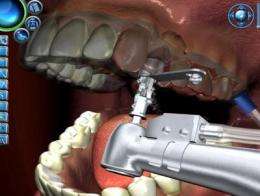
A realistic computer game will soon be used to help dental students worldwide learn and reinforce dental implant procedures.
The Virtual Dental Implant Training Simulation Program is designed to help students in diagnostics, decision making and treatment protocols. It was designed by Medical College of Georgia School of Dentistry faculty and students and BreakAway, Ltd., a developer of game-based technology for training, experimentation and decision-making analysis.
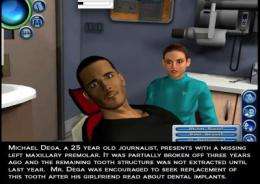
"There's a lot of enthusiasm in the global dental and medical communities to use virtual reality and simulation as a tool to convey and reinforce information and ensure competency levels," says Dr. Roman Cibirka, MCG vice president for instruction and enrollment management and the program's project director. He presented the game and its 18-month development process today at the fifth annual Games for Health Conference in Boston.
Dental implants are tiny screws surgically placed in the jaw to act as artificial roots for prosthetic teeth. About 25 percent of adults 60 and older no longer have any natural teeth, according to the Centers for Disease Control and Prevention, and the need for this procedure could increase with the country's aging population.
"The program was an opportunity to align the defined need to enhance the depth and penetration of implant therapy knowledge in undergraduate dental education with my vision of using gaming to reach the millennial student," Dr. Cibirka says.
His highest priorities were instructional effectiveness, patient safety and a fun learning environment for the students.
Research shows that health care providers who practice clinical skills via simulation have better patient outcomes than those who don't.
The implant simulation game uses multiple patients and clinical scenarios that can be randomly selected, letting students interact with virtual patients by asking about their medical history, examining them and arriving at a diagnosis. Like humans, the virtual patients have different personalities, and students must tailor treatment based on the mental, physical and emotional needs of the individual.
If the virtual patient is a candidate for implant therapy, the simulation then ventures into a virtual clinical treatment area, where students decide the type, location and orientation of the implants, type and location of anesthesia and tools for surgery.
"It's realistic. If the student doesn't place anesthesia in the right spot, the patient screams," Dr. Cibirka says.
The game uses Pulse!! Virtual Learning Lab, developed by BreakAway in partnership with Texas A&M University-Corpus Christi through funding from the Office of Naval Research.
As effective as the learning tool is, it is intended to supplement - not replace - actual clinical training.
"It's anytime, anywhere education; a classroom without walls," Dr. Cibirka says. "I think it really fortifies the entire educational experience and capitalizes on the needs of this generation."
To ensure the game reaches the millennial generation, Dr. Cibirka brought students into the design process. Sarah Padolsky, a second-year MCG dental student, served as the student project manager. Student reviews have been overwhelmingly positive and added great value to the final product, says Dr. Cibirka, noting he also worked with a team of faculty subject matter experts to ensure educational accuracy.
The program was funded as part of a $6.2 million contract between MCG and Nobel Biocare, a leading manufacturer of implants and equipment, which also established the School of Dentistry as a Nobel Biocare Center for Excellence.
The program is now being evaluated for functionality and instructional usefulness by more than 20 dental schools in the Nobel Biocare University Partnership Program. This summer it will be launched at 25 universities worldwide, potentially reaching 15,000 dental students, Dr. Cibirka says.
In most instances, the program will be used during the third and fourth years of dental education, depending on the curricula of each institution. Dr. Cibirka hopes it will be part of MCG's dental curriculum soon.
"We want the students that we graduate to be the best dentists they can be because they have learned better and feel more confident in the techniques they've learned, and this is another tool to do so," Dr. Cibirka says.
Source: Medical College of Georgia


