Electric aircraft take to the air
June 11, 2009 Electric aircraft take to the air

Enlarge

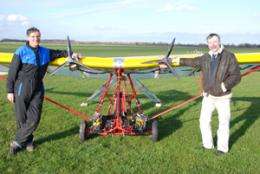
Test pilot Paul Dewhurst (left) with Dr Paul Robertson, who designed and built the electric propulsion system for the Lazair microlight. Photo credit David Bremner, editor of Microlight Flying magazine

On the 1st of March 2009, a pair of electric aircraft had simultaneous maiden flights at Sywell Aerodrome near Northampton. These are the first electric aircraft to fly in the UK under the recently introduced sub-115 kg regime, which allows single seat, lightweight aircraft to be developed and flown without the administrative burden of the airworthiness approvals process applied to larger aircraft. This class was introduced to encourage innovation in light aviation in the UK.

The electric propulsion system for the twin-engine, fixed-wing Lazair airframe of Canadian origin was designed and built by Dr Paul Robertson of the Engineering Department, in collaboration with Paul Dewhurst of Flylight Airsports Ltd, a Midlands based manufacturer and importer of microlight aircraft. The hang-glider (flex-wing) based Dragonfly trike unit, made by Flylight, was powered by an electric motor system being developed in Germany. The electric aircraft have flown for around 30 minutes on a single charge, reaching an altitude of 1700 ft.

The E-Lazair propulsion system comprises a pair of 10 kW peak, brushless electric motors, weighing less than 2 kg each, with direct drive to carbon fibre propellers. The motors are each powered by a stack of 12 large capacity (40 Ah) Lithium Polymer (LiPo) cells, giving a total stored energy capacity of 3.2 kWh. A bespoke Battery Management System (BMS), charger unit and avionics were developed by Dr Paul Robertson to monitor the energy capacity and temperature of the LiPo cells, control the motor power and temperature and provide the pilot with a 'fuel gauge' to indicate remaining capacity. Each of the 24 LiPo cells are individually monitored and charge balanced to maintain optimum capacity and cell lifetime.

These developments are the first steps towards a new class of leisure aircraft offering low operating costs, high reliability and low environmental impact - on both carbon footprint and noise issues. Observers on the ground commented on the very low noise levels and the pilots noticed a significant decrease in both noise and vibration, when compared to petrol engine alternatives.

Flight tests using the existing Lazair airframe will continue, to characterise and develop the electric propulsion system, although substantial increases in the flight duration and range can only be achieved through a custom-built airframe, encompassing the new design opportunities available through electric propulsion. These will include such factors as being able to distribute the mass of the propulsion units and energy storage around the airframe - there is no longer a need for a relatively large, heavy engine in one location, with its attendant structural bracing adding yet more weight. The potential of hybrid fuel options are also being considered. A flight duration of 2 hours and a range of 100 miles are being targeted and sponsorship is being sought to help achieve these objectives.

Source: University of Cambridge (news : web)


Rate this story - 3.3 /5 (12 votes)

Rank Filter

Move the slider to adjust rank threshold, so that you can hide some of the comments.


Display comments: newest first

  • ormondotvos - Jun 11, 2009
    • Rank: not rated yet
    I've seen electric powered hang gliders for two years. Why is this newsworthy?

    http://www.electraflyer.com/
  • nkalanaga - Jun 11, 2009
    • Rank: 5 / 5 (1)
    Because these aren't hang gliders, but fixed wing aircraft, a different type of flying machine.
  • dan42day - Jun 12, 2009
    • Rank: 5 / 5 (2)
    Cool! Now just get Dmitri Talapin's laboratory at the University of Chicago to cover your wings with inexpensive ultralight solar cells fabricated with their new "electronic glue" (see previous article).
  • LuckyBrandon - Jun 12, 2009
    • Rank: not rated yet
    how much will they cost? how long do they take to charge? what is the top air speed, and how long will a charge hold at that top speed?

    etc etc etc

June 11, 2009 all stories

Comments: 4

3.3 /5 (12 votes)

  • hide
  • Related Stories

  • Superconducting Turbojet
    created Jun 18, 2007 | popularity not rated yet | comments 0
  • EU project to develop first fuel-cell aircraft
    created Jun 01, 2007 | popularity not rated yet | comments 0
  • Silent aircraft readies for take-off
    created Nov 06, 2006 | popularity not rated yet | comments 0
  • Full speed ahead: High-temperature superconductors ensure efficient propulsion in all-electric ships
    created Apr 11, 2007 | popularity not rated yet | comments 0
  • Working Towards The Novel 'Silent' Aircraft Engine
    created Jul 22, 2004 | popularity not rated yet | comments 0


  • hide
  • Relevant PhysicsForums posts

  • How to measure recoil force?
    created 1hour ago
  • How to obtain time constant of servo motor
    created 4 hours ago
  • How to calculate section constants for rectangular tubes?
    created 8 hours ago
  • how to welding thin SS foil (0.002")?
    created Feb 08, 2010
  • More from Physics Forums - General Engineering

Other News

Opera logo

Opera Software announces iPhone browser

Technology / Software

created 1hour ago | popularity 5 / 5 (1) | comments 0

(AP) -- Opera Software ASA announced Wednesday that it will unveil an iPhone version of its Opera Mini mobile phone browser at an international tech conference next week despite not having approached iPhone ...


Star chef points the way

Star chef points the way

Technology / Engineering

created 27 minutes ago | popularity not rated yet | comments 0

Master chef Johann Lafer is a virtuoso in the kitchen -- and with modern technology too. At his cookery school the TV celebrity adopts a high-tech approach to make things easier in the kitchen with the touchless ...


AT&T picks Alcatel-Lucent, Ericsson for network

Technology / Telecom

created 1hour ago | popularity not rated yet | comments 0

(AP) -- AT&T says it has picked Alcatel-Lucent and Ericsson to supply the equipment for its next wireless network, which will provide faster data speeds starting next year.


Students find ?lost? office gear with tiny sensors

Students find 'lost' office gear with tiny sensors

Technology / Engineering

created 3 hours ago | popularity 3 / 5 (2) | comments 1 | with audio podcast

(PhysOrg.com) -- Miniature sensors being developed by CSIRO promise to provide the answers to questions which seem to arise regularly in modern office workplaces like: "Where's my pen?" and; "Who nicked my ...


Toshiba to spend billions on new chip factory: report

Technology / Semiconductors

created 5 hours ago | popularity not rated yet | comments 0

Japan's Toshiba plans to spend almost nine billion dollars to build a new factory producing memory chips for mobile telephones, cameras and other electronics, a report said Wednesday.