A red-wine polyphenol demonstrates significant health benefits
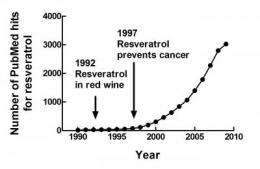
The benefits of alcohol are all about moderation. Low to moderate drinking - especially of red wine - appears to reduce all causes of mortality, while too much drinking causes multiple organ damage. A mini-review of recent findings on red wine's polyphenols, particularly one called resveratrol, will be published in the September issue of Alcoholism: Clinical & Experimental Research; the review is also available at Early View.
"Reports on the benefits of red wine are almost two centuries old," said Lindsay Brown, associate professor in the School of Biomedical Sciences at The University of Queensland and corresponding author for the study. "The media developed the more recent story of the French paradox in the early 1990s. However, studies on the actions of resveratrol, one of the active non-alcoholic ingredients, were uncommon until research around 1997 showed prevention of cancers. This led to a dramatic interest in this compound."
Red wine contains a complex mixture of bioactive compounds, including flavonols, monomeric and polymeric flavan-3-ols, highly colored anthocyanins, as well as phenolic acids and the stilbene polyphenol, resveratrol. Brown said that some of these compounds, particularly resveratrol, appear to have health benefits.
"The breadth of benefits is remarkable - cancer prevention, protection of the heart and brain from damage, reducing age-related diseases such as inflammation, reversing diabetes and obesity, and many more," said Brown. "It has long been a question as to how such a simple compound could have these effects but now the puzzle is becoming clearer with the discovery of the pathways, especially the sirtuins, a family of enzymes that regulate the production of cellular components by the nucleus. 'Is resveratrol the only compound with these properties?' This would seem unlikely, with similar effects reported for other components of wine and for other natural products such as curcumin. However, we know much more about resveratrol relative to these other compounds."
Stephen Taylor, professor of pharmacology at the University of Queensland, agreed that resveratrol is the "compound du jour."
"I think that red wine has both some mystique and some historical symbolism in the west," said Taylor, "and of course, some various pleasures attached to its ingestion, all of which give it a psychological advantage edge, food-wise. Not many of us can or will eat a couple of cups of blueberries a day for years on end, but if we could do a population study for a decade or so on such a group, you might actually see similar results."
Key points of the review include:
- Resveratrol exhibits therapeutic potential for cancer chemoprevention as well as cardioprotection.
"It sounds contradictory that a single compound can benefit the heart by preventing damage to cells, yet prevent cancer by causing cell death, said Brown. "The most likely explanation for this, still to be rigorously proved in many organs, is that low concentrations activate survival mechanisms of cells while high concentrations turn on the in-built death signals in these cells."
- Resveratrol may aid in the prevention of age-related disorders, such as neurodegenerative diseases, inflammation, diabetes, and cardiovascular disease.
"The simplest explanation is that resveratrol turns on the cell's own survival pathways, preventing damage to individual cells," said Brown. "Further mechanisms help, including removing very reactive oxidants in the body and improving blood supply to cells."
- Low doses of resveratrol improve cell survival as a mechanism of cardio- and neuro-protection, while high doses increase cell death.
"The key difference is probably the result of activation of the sirtuins in the nucleus," said Brown. "Low activation reverses age-associated changes, while high activation increases the process of apoptosis or programmed cell death to remove cellular debris. Similar changes are seen with low-dose versus high-dose resveratrol: low-dose resveratrol produces cellular protection and reduces damage, while high-dose resveratrol prevents cancers."
In summary, noted Brown, current scientific research is starting to explain reports from the last 200 years that drinking red wine improves health. "It is a cliché that 'nature is a treasure trove of compounds,' but studies with resveratrol show that this is correct! We need to understand better the vast array of compounds that exist in nature, and determine their potential benefits to health."
"There is one particular point that deserves fleshing out," added Taylor. "Resveratrol is largely inactivated by the gut or liver before it reaches the blood stream, where it exerts its effects - whatever they may be - good, bad, or indifferent. Thus, most of the reseveratrol in imbibed red wine does not reach the circulation. Interestingly, absorption via the mucous membanes in the mouth can result in up to around 100 times the blood levels, if done slowly rather than simply gulping it down. Of course, we don't know if these things matter yet, but issues like this are real and generally ignored by all."
Source: University of Queensland (news : web)


