Fingerprints do not improve grip friction
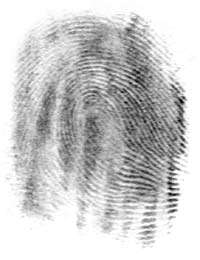
June 12, 2009 fingerprint

Image credit: Wikimedia.

Fingerprints mark us out as individuals and leave telltale signs of our presence on every object that we touch, but what are fingerprints really for? According to Roland Ennos, from the University of Manchester, other primates and tree-climbing koalas have fingerprints and some South American monkeys have ridged pads on their tree-gripping tails, so everyone presumed that fingerprints are there to help us hang onto objects that we grasp.

This theory that increase between the skin and whatever we grab onto has been around for over 100 years, but no one had directly tested the idea. Having already figured out why we have fingernails, Ennos was keen to find out whether fingerprints improve our grip, so he recruited Manchester undergraduate Peter Warman to test out fingerprint friction and publishes his results in the Journal of Experimental Biology.

Because the friction between two solid materials is usually related to the force of one of the materials pressing against the other, Ennos and Warman had to find a way of pushing a piece of acrylic glass (Perspex) against Warman's finger before pulling the Perspex along the student's finger to measure the amount of friction between the two. Ennos designed a system that could produce forces ranging from a gentle touch to a tight grip, and then Warman strapped his index finger into the machine to begin measuring his fingerprint's friction.

But after days of dragging the Perspex along Warman's fingers and thumbs, it was clear that something wasn't quite right. Instead of the friction between each finger and the Perspex increasing in proportion to the amount that the Perspex® pushed against Warman's fingers, it increased by a smaller fraction than Ennos had expected. Ennos realised that instead of behaving like a normal solid, the skin was behaving like rubber, where the friction is proportional to the contact area between the two surfaces.

To check that skin behaves more like rubber than a normal solid, the duo varied the area of each fingerpad that came into contact with the surface by dragging narrow and wide strips of Perspex along Warman's fingerpads. They found that the friction did increase as more of the fingerprint came in contact with the surface, so the skin was behaving just like rubber.

Finally, the friction issue was clinched when Warman measured his fingerprints' surface area. The area of skin in contact with the Perspex was always 33% less than if the fingerpads were smooth resulting in the maximum contact area. Fingerprints definitely don't improve a grip's friction because they reduce our skin's contact with objects that we hold, and even seem to loosen our grip in some circumstances.

So if fingerprints don't tighten our grasp on smooth surfaces, what are they for? Ennos explains that our fingerprints may function in other ways. They might have evolved to grip onto rough surfaces, like tree bark; the ridges may allow our skin to stretch and deform more easily, protecting it from damage; or they may allow water trapped between our finger pads and the surface to drain away and improve surface contact in wet conditions. Other researchers have suggested that the ridges could increase our fingerpads' touch sensitivity. Whatever our fingerprints are for, it seems that the idea that they provide friction for grip is just another urban myth.

Source: The Company of Biologists (news : web)


Rate this story - 2.4 /5 (11 votes)

Rank Filter

Move the slider to adjust rank threshold, so that you can hide some of the comments.


Display comments: newest first

  • alexxx - Jun 12, 2009
    • Rank: 3 / 5 (2)
    it's funny. see links to related articles on physorg - they state the opposite.
  • M_N - Jun 12, 2009
    • Rank: 3 / 5 (2)
    They tested grip on only ONE material (smooth perspex) and come to these conclusions? That's hardly representative of the average material that people pick up with their hands.

    I've read plently of material that says the direct OPPOSITE, including from people who have temporarily lost their fingerprints due to abrasion etc.
  • Vlasev - Jun 12, 2009
    • Rank: not rated yet

    It might be related to the moisture in the skin. The fingerprint might be helping the skin to hold some extra moisture, which makes the skin behave more like rubber, increasing the friction.


    I've read plently of material that says the direct OPPOSITE, including from people who have temporarily lost their fingerprints due to abrasion etc.


    No fingerprints, less moisture, harder skin, less friction.
  • no1enter - Jun 12, 2009
    • Rank: not rated yet
    I have read articles that say your fingerprints act as amplifiers for your touch sense increasing your ability to feel different textures.
  • ArtflDgr - Jun 12, 2009
    • Rank: not rated yet
    actually, it may not be to grip objects in general, but may be to grip a certain type of object.

    skin to skin

    skin is a protective thing, that is its evolved to not be maximally easily grippable. in fact thats the purpose of all animals surface interfaces.

    but social animals that climb, need to be able to grip their skins without negating the surval qualities of them. skin has oil on it. and what you have is to oily objects and one has to grip the other.

    i will bet that the study above was hand to dry objects, and such like that. that would of course maximize the grip and that grip quotient wont change much.

    but let someone without fingerprints try to hold a greased cylinder by squeezing it. and nother person do it with fingerprints you will see a remarkable result.

    like the tires that prevent hyrdoplaning, the fingerprints will move the grease into grooves and away from the surface of the ridges. the ridges will then be free to maiximize the grip they can have. (it can never be zero, but it can reduce it to too small to efficiently lubricate and then give grip).

    this also would apply to waxy vines, greasy fingers, and water in teh mix.

    they are not there for average situations, they are there in critical situations. darwin flakes out on average. :)

June 12, 2009 all stories

Comments: 5

2.4 /5 (11 votes)

  • hide
  • Related Stories

  • Get a grip! Blistering new evidence on why we have fingerprints
    created May 29, 2009 | popularity not rated yet | comments 0
  • Models present new view of nanoscale friction
    created Feb 25, 2009 | popularity not rated yet | comments 0
  • Why Do We Have Fingerprints?
    created Apr 04, 2009 | popularity not rated yet | comments 0
  • Shaking Reduces Friction
    created Jul 08, 2005 | popularity not rated yet | comments 0
  • Using 'Minutiae' to Match Fingerprints Can Be Accurate
    created Mar 17, 2006 | popularity not rated yet | comments 0


  • hide
  • Relevant PhysicsForums posts

Other News

Researchers reveal 3-D structure of bullet-shaped virus with potential to fight cancer, HIV

Researchers reveal 3-D structure of bullet-shaped virus with potential to fight cancer, HIV

Biology / Cell & Microbiology

created 5 hours ago | popularity 5 / 5 (4) | comments 0 | with audio podcast

(PhysOrg.com) -- Using cryo-electron microscopy and advanced image-processing methods, UCLA researchers have developed a model of how the potentially therapeutic vesicular stomatitis virus assembles.


Engineering bacterial cells

Biology / Cell & Microbiology

created 5 hours ago | popularity 5 / 5 (1) | comments 0

(PhysOrg.com) -- Two teams of Oxford University researchers led by Professors Judith Armitage and David Stuart have made the first steps towards being able to engineer a bacterial cell that can sense and respond to novel ...


Will earlier springs throw nature out of step?

Biology / Ecology

created 7 hours ago | popularity 1 / 5 (1) | comments 1

The recent trend towards earlier UK springs and summers has been accelerating, according to a study published today (9 February 2010) in the scientific journal Global Change Biology.


Resistant wheat goes for the gut to protect against Hessian flies

Biology / Biotechnology

created 18 hours ago | popularity not rated yet | comments 4 | with audio podcast

(PhysOrg.com) -- Resistant wheat plants stave off attacks by Hessian fly larvae by essentially destroying the fly's midgut and its ability to absorb nutrients, according to a study by Purdue University and the U.S. Department ...


Biologist solves mystery of tropical grasses' origin

Biology / Plants & Animals

created 22 hours ago | popularity 4.6 / 5 (5) | comments 1 | with audio podcast

Around 30 to 40 million years ago, grasses on Earth underwent an epic evolutionary upheaval. An assemblage capitalized on falling levels of atmospheric carbon dioxide by engineering an internal mechanism to concentrate the ...