Greenland ice sheet larger contributor to sea-level rise
June 12, 2009 Study: Greenland ice sheet larger contributor to sea-level rise

Enlarge

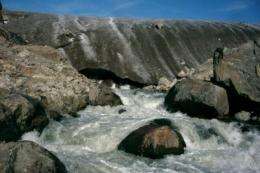
Melting water from a glacier in Greenland runs into the ocean. Credit: Photo by Sebastian Mernild

The Greenland ice sheet is melting faster than expected according to a new study led by a University of Alaska Fairbanks researcher and published in the journal Hydrological Processes.

Study results indicate that the may be responsible for nearly 25 percent of global sea rise in the past 13 years. The study also shows that seas now are rising by more than 3 millimeters a year—more than 50 percent faster than the average for the 20th century.

UAF researcher Sebastian H. Mernild and colleagues from the United States, United Kingdom and Denmark discovered that from 1995 to 2007, overall precipitation on the ice sheet decreased while surface ablation—the combination of evaporation, melting and calving of the ice sheet—increased. According to Mernild's new data, since 1995 the ice sheet lost an average of 265 cubic kilometers per year, which has contributed to about 0.7 millimeters per year in global rise. These figures do not include thermal expansion—the expansion of the ice volume in response to heat—so the contribution could be up to twice that.

The Greenland ice sheet has been of considerable interest to researchers over the last few years as one of the major indicators of . In late 2000/early 2001 and in 2007, major glacier calving events sent up to 44 square miles of ice into the sea at a time. Researchers are studying these major events as well as the less dramatic ongoing melting of the ice sheet through runoff and surface processes.

Ice melt from a warming Arctic has two major effects on the ocean. First, increased water contributes to global sea-level rise, which in turn affects coastlines across the globe. Second, fresh water from melting ice changes the salinity of the world's oceans, which can affect ocean ecosystems and deep water mixing.

"Increasing sea level rise will be a problem in the future for people living in coastal regions around the globe," said Mernild. "Even a small sea level rise can be a problem for these communities. It is our hope that this research can provide people with accurate information needed to plan for protecting people and communities."

Source: University of Alaska Fairbanks (news : web)


print this article email this article download pdf blog this article bookmark this article     Stumble it Digg this share on Facebook retweet share on Reddit add to delicious
Rate this story - 4.4 /5 (52 votes)

Rank Filter

Move the slider to adjust rank threshold, so that you can hide some of the comments.


Display comments: newest first

  • Velanarris - Jun 12, 2009
    • Rank: 4.6 / 5 (9)
    These figures do not include thermal expansion%u2014the expansion of the ice volume in response to heat%u2014so the contribution could be up to twice that.
    Ice doesn't expand under heat. What the hell is wrong with these people?
  • Ropnes - Jun 12, 2009
    • Rank: 2.7 / 5 (3)
    Coefficient of thermal expansion of ice:
    alpha= 50*10e-6 deg-1
  • Billybaroo - Jun 12, 2009
    • Rank: 3.8 / 5 (4)
    "Study results indicate that the ice sheet may be responsible for nearly 25 percent of global sea rise in the past 13 years. The study also shows that seas now are rising by more than 3 millimeters a year%u2014more than 50 percent faster than the average for the 20th century."

    Uh, wrong! See Section 4.5 of:

    Craig Idso and S. Fred Singer, Climate Change Reconsidered: 2009 Report of the Nongovernmental Panel on Climate Change (NIPCC), Chicago, IL: The Heartland Institute, 2009.
  • Velanarris - Jun 12, 2009
    • Rank: 4 / 5 (4)
    Coefficient of thermal expansion of ice:


    alpha= 50*10e-6 deg-1

    No it's 50*10^-6 deg^-1

    The second carat is rather important to not exclude as it changes the resultant outcome significantly.

  • El_Nose - Jun 12, 2009
    • Rank: 1 / 5 (1)
    yeah might be true Ropnes but what are we really talking about

    .000051 per degree in terms of linear expansion and .0051 in terms of volume but we are talking about what maybe a 1 degree change. The figure is .78 - .18 degrees celcius increase over the last century. the thermal expansion of all the ice in antartica and greenland isn't that much in absolute terms.

    I say look to the fact that the artic thaws almost completely now. That is a bigger amount of water being displaced back into the ocean that ice expanding. --- Wait maybe not --- IF all the ice in the artic ocean melted then wouldn't the sea levels actually lower a little. Ice takes up more volume that liquid water so as you local freeze water in a spot in a closed system the effect is that the overall volume will increase raising the water level -- and the inverse is true as well if you thaw that ice back out the water will decrease. Now this is only true when the temp is close to 39.2 degree Farenhiet the higher the temp the more the water expands and you are on the same island with rising water.
  • thermodynamics - Jun 13, 2009
    • Rank: 5 / 5 (4)
    Vel is right. Remember that ice floats (because it is less dense than water). If you are talking about the ice sheet itself, then it can expand as it warms but that does not matter because it is supported by Greenland. It is what happens when it melts that is important. When it melts it expands until it melts and then it contracts (increases in density) until it reaches 3.98C. It then starts expanding again. So, the comment that "These figures do not include thermal expansion the expansion of the ice volume in response to heat so the contribution could be up to twice that." is nonsense as Vel correctly pointed out.


    El Nose seems to be a bit confused. This is not floating ice they are talking about in the article. It is the ice sheet that covers Greenland (a land mass). When it melts it flows into the ocean and causes the sea levels to rise.

  • timefighter - Jun 13, 2009
    • Rank: 2.3 / 5 (3)
    Global warming and Thermal expansion will increase the sea level over the coming century and longer periods. It is stated in one of the studies that the sea level would rise up to 9 to 88cm, which will lead to distict danger in communities living near the shore, for e.g. many major cities like London already have storm surge defences and would need more in the furute, though they would also experience sinking lands.
  • Velanarris - Jun 13, 2009
    • Rank: 5 / 5 (1)
    Global warming and Thermal expansion will increase the sea level over the coming century and longer periods. It is stated in one of the studies that the sea level would rise up to 9 to 88cm, which will lead to distict danger in communities living near the shore, for e.g. many major cities like London already have storm surge defences and would need more in the furute, though they would also experience sinking lands.

    Where are you accounting for tectonic plate rebound post ice volume loss?

    Exactly, no one is. If a mass of ice the size of Greenland was to melt the resultant tectonic rebound would cause greater catastrophy than any sea level rise. Problem is the glacial condition has very little to do with the warmth of the atmosphere and a lot more to do with the absence of precipitation, which has subsequently reversed in the past 3 years.

June 12, 2009 all stories

Comments: 8

4.4 /5 (52 votes)
  • Stumble this up

  • Digg this

  • share this

  • hide
  • Related Stories


  • hide
  • Relevant PhysicsForums posts

  • The Origin of the term 'fossil' fuels
    created Nov 05, 2009
  • co2
    created Nov 03, 2009
  • Early Earths Sulfidic Ocean Conditions
    created Oct 30, 2009
  • vegetation
    created Oct 29, 2009
  • More from Physics Forums - Earth

Other News

Seattle team wins $900,000 in Space Elevator Games (AP)

Seattle team wins $900,000 in Space Elevator Games

Space & Earth / Space Exploration

created 22 hours ago | popularity 5 / 5 (8) | comments 4

(AP) -- A Seattle team has collected a $900,000 prize in a NASA-backed competition to develop the concept of an elevator to space - an idea spurred by science fiction novels.


Russian rocket to launch from French Guiana in 2010

Space & Earth / Space Exploration

created 21 hours ago | popularity 5 / 5 (3) | comments 0

A Russian rocket will next year for the first time blast off from a European launch pad in South America, officials said Saturday, as the first rockets headed for the site on board a ship.


Success in 'space elevator' competition (AP)

Success in 'space elevator' competition (Update 3)

Space & Earth / Space Exploration

created Nov 05, 2009 | popularity 4.3 / 5 (33) | comments 50

(AP) -- A robot powered by a ground-based laser beam climbed a long cable dangling from a helicopter on Wednesday to qualify for prize money in a $2 million competition to test the potential reality of the ...


Space hotel taking bookings for 2012 opening

Space hotel taking bookings for 2012 opening

Space & Earth / Space Exploration

created Nov 05, 2009 | popularity 4.3 / 5 (19) | comments 11

(PhysOrg.com) -- The first orbiting space hotel is on track to open for its first customers in 2012, but hurry, as bookings are filling fast.


'Dropouts' pinpoint earliest galaxies

'Dropouts' pinpoint earliest galaxies

Space & Earth / Astronomy

created Nov 06, 2009 | popularity 4.1 / 5 (9) | comments 11

Astronomers, conducting the broadest survey to date of galaxies from about 800 million years after the Big Bang, have found 22 early galaxies and confirmed the age of one by its characteristic hydrogen signature ...