Using nanoparticles to increase the effiiciency of thin film solar cells
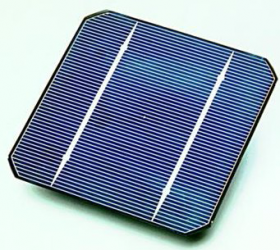
June 12, 2009 Solar Cell

Germany is one of the leading countries when it comes to efforts related to renewable energy sources. Therefore, it is no surprise that the Institute of Condensed Matter and Solid State Optics at Friedrich-Schiller-Universität in Jena, Germany, is a place where scientists are hard at work looking for ways to improve current solar cell technology.

“There is a great desire to make regenerative energies more attractive,” Carsten Rockstuhl, one of the physicists at the Institute, tells PhysOrg.com. “In solar cell technology, it is becoming a matter of interest to improve efficiency without increasing the thickness of the active layer of a solar cell.” Rockstuhl and his colleague at the Institute, Falk Lederer, believe that they may have found a way to increase the absorption of light by . Their work focuses on using metallic nanodiscs that sustain plasmonic resonances to manage photons, and is explained in Applied Physics Letters: “Photon management by metallic nanodiscs in thin film solar cells.”

Using a simulation, Rockstuhl and Lederer analyzed different scenarios exploring how metallic nanoparticles could be distributed over the surface of a thin film solar cell. The nanoparticles in the simulation increased absorption in the solar cell, and improved the efficiency of the cell integrated over the entire spectral domain by up to 50 percent. “It may not sound like that much,” Rockstuhl says, “but in the world of solar technology, that is a pretty big difference.”

Part of the reason that the simulation shows such promise is that Rockstuhl and Lederer propose matching the absorption spectra of the used nanodiscs to the absorption edge of the silicon solar cell. “Instead of using randomly distributed nanoparticles with different sizes, one may figure out precisely the size and distribution that enhances the absorption in the solar cell the strongest,” Rockstuhl explains. “Controlling the way you spread the nanoparticle over the top of the solar cell can make a difference.”

So far, the setup proposed at the Institute has not been experimentally tested. However, Rockstuhl thinks it might be soon. “Our process should not be too expensive to test and, later, to fabricate. All you have to do is use present technology to create these nanodiscs and apply it to the surface of the solar cell.” For mass production, it would be subsequently possible to use nano-imprint technology to create a kind of stamp to fabricate nanodiscs of a specific size. “It is kind of a breakthrough, in that few people from the solar cell community have thought of improving efficiency by integrating a supplementary structure.”

This practical application is not the only thing that might come out of the model produced by Rockstuhl and Lederer. “This is also attractive in the way it could lead to new research directions, in where different fields of science can learn from each other for the mutual benefit,” Rockstuhl says. “Using our simulation as a kind of blueprint for an experiment could help researchers to advance in the areas of optics and photonics, since they may find a field of application within photovoltaics where their fundamental science oriented research turns out to do some something useful, where it is moreover strongly desired. To increase the solar cell efficiency has to be understood as a major contribution to slow down or even eventually reverse the global warming.”

Rockstuhl continues with his hopes for what their work, which has been supported by the German research council, can accomplish: “And with this work we are certain to put photon management using optical micro- and nano-structures on the agenda, hope that the added value photonics can provide to solar cells is recognized and that it will find its way in commercial solar cells.”

More information: Carsten Rockstuhl and Falk Lederer, “Photon management by metallic nanodiscs in thin film solar cells.” Applied Physics Letters (2009). Available online: http://link.aip.org/link/?APPLAB/94/213102/1.

Copyright 2009 PhysOrg.com.
All rights reserved. This material may not be published, broadcast, rewritten or redistributed in whole or part without the express written permission of PhysOrg.com.


print this article email this article download pdf blog this article bookmark this article     Stumble it Digg this share on Facebook retweet share on Reddit add to delicious
Rate this story - 4.4 /5 (19 votes)

Rank Filter

Move the slider to adjust rank threshold, so that you can hide some of the comments.


Display comments: newest first

  • timefighter - Jun 13, 2009
    • Rank: 3 / 5 (2)
    I think using solar cells rather than other energy sources is better to face the technological world with its risks to the globe.
    "Pretty soon", a scientist stated, "Cars would be designed to work by solar cells"
    For, although, solar cells are expensive to buy, they will later be a benefit for the user, whether he is using them for his car, lights, or A.c's.
  • greenoptimistic - Jun 13, 2009
    • Rank: not rated yet
    This idea is not new; it was also brought into attention last year, when some Dutch scientists discovered the effect of surface plasmons on solar cell efficiency. Read more here: http://www.greeno...-to-30/.
  • holoman - Jun 13, 2009
    • Rank: 2.3 / 5 (3)
    So the 10-15% percent efficient already,,,, means a
    whopping new 15-22.5% efficiency, big whoop !
  • vika_Tae - Jun 14, 2009
    • Rank: 5 / 5 (1)
    Its a slow process, holoman, but, every little helps. We are seeing 3-4 such gradual improvements in solar cell technology per month at the moment, and it all adds up.
  • mongander - Jun 14, 2009
    • Rank: 3 / 5 (2)
    I've been reading this nano-thinfilm blabla for years. When will we see products that make dollars and sense?
  • N_O_M - Jun 14, 2009
    • Rank: 5 / 5 (3)
    Hey wow! Here's a physorg nano/solar news item that hasn't been spammed by Neil Farbstein.
  • vika_Tae - Jun 17, 2009
    • Rank: not rated yet
    Mongander, I would imagine we will see products that make 'sense' as you put it, when the efficiency rivals other electrical power producing methods, and the cost per unit is lower than the alternative.

    Most likely, another five years away. Research is worth it in the meantime of course, to edge us closer to that point.
  • PinkElephant - Jun 17, 2009
    • Rank: not rated yet
    Monglader, check out the products made by First Solar Inc. They have _already_ managed to reduce the cost of their product to below $1/watt (and further reductions are in the pipeline.) Let's say they sell it at 50% mark-up; and you buy 1 KW worth of solar capacity for $1,500. To simplify calculations, let's say that on average per day you get only 4 hours worth of full-nameplate production (assuming you aren't in California or Arizona, but more like somewhere in the Arctic Circle...) Then in the course of 1 year, you get 4 x 365.25 = 1,461 KWHr of energy. At a typical cost of $.07/KWHr, you get $102.27 worth of energy each year (and you avoid belching tons of pollutants into the environment, in the process.) That means, in about 15 years you've made all your money back. That's without any government subsidies, assuming energy stays as cheap as it is today for the next 15 years, and assuming that there will be absolutely no inflation whatsoever (so a dollar today is worth the same as a dollar 15 years later.) If any of the above assumptions is violated (including the assumption of a poor site for solar power production), then your return on investment gets accelerated commensurately.

    Welcome to the 21st century.

June 12, 2009 all stories

Comments: 8

4.4 /5 (19 votes)
  • Stumble this up

  • Digg this

  • share this

  • hide
  • Related Stories

  • V-shaped solar cells could lead to better efficiency
    created Dec 19, 2007 | popularity not rated yet | comments 0
  • LG Electronics to Invest in Solar Cell Production Line
    created Oct 21, 2008 | popularity not rated yet | comments 0
  • Enhancing solar cells with nanoparticles
    created Dec 23, 2008 | popularity not rated yet | comments 0
  • Silicon nanoparticles enhance performance of solar cells
    created Aug 20, 2007 | popularity not rated yet | comments 0
  • Sharp to Begin Mass-Production of Thin-Film Photovoltaic Modules
    created Jul 08, 2005 | popularity not rated yet | comments 0


  • hide
  • Relevant PhysicsForums posts

  • dynamic hardness measurements
    created Nov 21, 2009
  • May i know is structure such as bcc, fcc depends on how it process?
    created Nov 21, 2009
  • Wear patterns
    created Nov 18, 2009
  • What is meant by 'as-cast'?
    created Nov 18, 2009
  • Iron-rich spheres
    created Nov 18, 2009
  • Catalyst External and Internal Mass Transfer
    created Nov 16, 2009
  • More from Physics Forums - Materials & Chemical Engineering

Other News

Peptides control crystal growth with 'switches, throttles and brakes'

Peptides control crystal growth with 'switches, throttles and brakes'

Nanotechnology / Bio & Medicine

created 15 hours ago | popularity 5 / 5 (3) | comments 0

(PhysOrg.com) -- By producing some of the highest resolution images of peptides attaching to mineral surfaces, scientists have a deeper understanding how biomolecules manipulate the growth crystals. This research ...


Water droplets direct self-assembly process in thin-film materials

Nanotechnology / Nanomaterials

created 14 hours ago | popularity 5 / 5 (4) | comments 2

You can think of it as origami - very high-tech origami. Researchers at the University of Illinois have developed a technique for fabricating three-dimensional, single-crystalline silicon structures from thin films by coupling ...


Nanoparticles used in common household items caused genetic damage in mice

Nanotechnology / Bio & Medicine

created Nov 16, 2009 | popularity 4.8 / 5 (24) | comments 11

Titanium dioxide (TiO2) nanoparticles, found in everything from cosmetics to sunscreen to paint to vitamins, caused systemic genetic damage in mice, according to a comprehensive study conducted by researchers at UCLA's Jonsson ...


Nanotube defects equal better energy and storage systems

Nanotube defects equal better energy and storage systems

Nanotechnology / Nanomaterials

created Nov 19, 2009 | popularity 4.4 / 5 (10) | comments 2

(PhysOrg.com) -- Most people would like to be able to charge their cell phones and other personal electronics quickly and not too often. A recent discovery made by UC San Diego engineers could lead to carbon ...


Using superconducting probes to get a picture of what it's like inside CNTs

Nanotechnology / Nanophysics

created Nov 20, 2009 | popularity 4.4 / 5 (9) | comments 0

(PhysOrg.com) -- "Carbon nanotubes are exciting for fundamental physics, and for potential technological applications," Nadya Mason tells PhysOrg.com. "However, we are generally limited in the way that we can study them. ...