Scientists predict greater longevity for planets with life
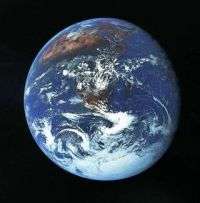
Roughly a billion years from now, the ever-increasing radiation from the sun will have heated Earth into inhabitability; the carbon dioxide in the atmosphere that serves as food for plant life will disappear, pulled out by the weathering of rocks; the oceans will evaporate; and all living things will disappear.
Or maybe not quite so soon, say researchers from the California Institute of Technology (Caltech), who have come up with a mechanism that doubles the future lifespan of the biosphere—while also increasing the chance that advanced life will be found elsewhere in the universe.
A paper describing their hypothesis was published June 1 in the early online edition of the Proceedings of the National Academy of Sciences (PNAS).
Earth maintains its surface temperatures through the greenhouse effect. Although the planet's greenhouse gases—chiefly water vapor, carbon dioxide, and methane—have become the villain in global warming scenarios, they're crucial for a habitable world, because they act as an insulating blanket in the atmosphere that absorbs and radiates thermal radiation, keeping the surface comfortably warm.
As the sun has matured over the past 4.5 billion years, it has become both brighter and hotter, increasing the amount of solar radiation received by Earth, along with surface temperatures. Earth has coped by reducing the amount of carbon dioxide in the atmosphere, thus reducing the warming effect. (Despite current concerns about rising carbon dioxide levels triggering detrimental climate change, the pressure of carbon dioxide in the atmosphere has dropped some 2,000-fold over the past 3.5 billion years; modern, man-made increases in atmospheric carbon dioxide offset a fraction of this overall decrease.)
The problem, says Joseph L. Kirschvink, the Nico and Marilyn Van Wingen Professor of Geobiology at Caltech and a coauthor of the PNAS paper, is that "we're nearing the point where there's not enough carbon dioxide left to regulate temperatures following the same procedures."
Kirschvink and his collaborators Yuk L. Yung, a Caltech professor of planetary science, and graduate students King-Fai Li and Kaveh Pahlevan, say that the solution is to reduce substantially the total pressure of the atmosphere itself, by removing massive amounts of molecular nitrogen, the largely nonreactive gas that makes up about 78 percent of the atmosphere. This would regulate the surface temperatures and allow carbon dioxide to remain in the atmosphere, to support life, and could tack an additional 1.3 billion years onto Earth's expected lifespan.
In the "blanket" analogy for greenhouse gases, carbon dioxide would be represented by the cotton fibers making up the blanket. "The cotton weave may have holes, which allow heat to leak out," explains Li, the lead author of the paper.
"The size of the holes is controlled by pressure," Yung says. "Squeeze the blanket," by increasing the atmospheric pressure, "and the holes become smaller, so less heat can escape. With less pressure, the holes become larger, and more heat can escape," he says, helping the planet to shed the extra heat generated by a more luminous sun.
Strikingly, no external influence would be necessary to take nitrogen out of the air, the scientists say. Instead, the biosphere itself would accomplish this, because nitrogen is incorporated into the cells of organisms as they grow, and is buried with them when they die.
In fact, "This reduction of nitrogen is something that may already be happening," says Pahlevan, and that has occurred over the course of Earth's history. This suggests that Earth's atmospheric pressure may be lower now than it was earlier in the planet's history.
Proof of this hypothesis may come from other research groups that are examining the gas bubbles formed in ancient lavas to determine past atmospheric pressure: the maximum size of a forming bubble is constrained by the amount of atmospheric pressure, with higher pressures producing smaller bubbles, and vice versa.
If true, the mechanism also would potentially occur on any extrasolar planet with an atmosphere and a biosphere.
"Hopefully, in the future we will not only detect Earth-like planets around other stars but learn something about their atmospheres and the ambient pressures," Pahlevan says. "And if it turns out that older planets tend to have thinner atmospheres, it would be an indication that this process has some universality."
Adds Yung: "We can't wait for the experiment to occur on Earth. It would take too long. But if we study exoplanets, maybe we will see it. Maybe the experiment has already been done."
Increasing the lifespan of our biosphere—from roughly 1 billion to 2.3 billion years—has intriguing implications for the search for life elsewhere in the universe. The length of the existence of advanced life is a variable in the Drake equation, astronomer Frank Drake's famous formula for estimating the number of intelligent extraterrestrial civilizations in the galaxy. Doubling the duration of Earth's biosphere effectively doubles the odds that intelligent life will be found elsewhere in the galaxy.
"It didn't take very long to produce life on the planet, but it takes a very long time to develop advanced life," says Yung. On Earth, this process took four billion years. "Adding an additional billion years gives us more time to develop, and more time to encounter advanced civilizations, whose own existence might be prolonged by this mechanism. It gives us a chance to meet."
Source: California Institute of Technology (news : web)


