Bumblebee re-introduced to UK
June 13, 2009 Bumblebee re-introduced to UK

Enlarge

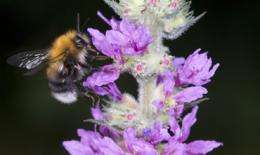
Tree bumblebee, Bombus hypnorum, on purple loosestrife. This is one of the less common bumblebee species that visits the Museum's Wildlife Garden.

This month, a campaign was launched to re-introduce the short-haired bumblebee to the UK from New Zealand.

This species, Bombus subterraneus, was last recorded in the UK in 1988. Luckily a small number of British bees were transported to New Zealand in the late 19th century to pollinate crops of red clover.

The short-haired bumblebee project is set up by Natural England, the Bumblebee Conservation Trust (BBCT), RSPB and Hymettus. It hopes to restore suitable bumblebee habitat in England, with the help of farmers, to bring back the British bees and protect them in the future.

Declining numbers
Some bumblebees are under threat worldwide and some UK species are declining in numbers. This seems to be due to habitat loss and loss of certain flower species such as the red clover.

Bees worldwide
The UK has around 20 bumblebee species and there are about 250 bumblebee species worldwide. However, there are about 20,000 different bees around the world and this includes bumblebees, and solitary bees.

Important pollinators
Many bees are extremely important for pollinating commercial crops such as cucumbers, tomatoes, strawberries and coffee. Bees account for 85% of the value of all insect pollinated crop plants in Europe.

Bumblebees in the Museum garden
It may be surprising to know that 8 of the 20 British species have been seen buzzing around in the heart of London in the Natural History Museum's Wildlife Garden.

The garden habitat is a haven for the insects and attracts all of the 6 common bumblebee species (the common carder, red-tailed, early-nesting, white-tailed, buff-tailed and garden) as well as the less common tree bumblebee, southern cuckoo bumblebee, and four-coloured cuckoo bumblebee.

New bumblebee arrival
The tree , Bombus hypnorum, was a surprise arrival into the Museum garden in 2006. Colonising southern England only recently, probably from France, it has reached Yorkshire after only 8 years.

It has a gingery front and black tail with a contrasting white tip. The males regularly visit plants such as the greater willow herb, purple loosestrife, teasel and buddleja. Tree holes and sometimes bird boxes are favourite nesting sites.

Lookalikes
A number of other insects in the Wildlife Garden look like bumblebees, such as chunky black and brown flower bees Anthophora spp., which can be seen darting from flower to flower. They are easy to spot because they fly much faster than the leisurely bumblebees.

A number of hoverflies are bee mimics, such as Eristalis intricarius. Their black, yellow and white stripes earn them some protection from predators.

Source: The Natural History Museum


print this article email this article download pdf blog this article bookmark this article     Stumble it Digg this share on Facebook retweet share on Reddit add to delicious
Rate this story - 4.7 /5 (3 votes)


June 13, 2009 all stories

Comments: 0

4.7 /5 (3 votes)
  • Stumble this up

  • Digg this

  • share this

  • hide
  • Related Stories

  • Britain boosts bumblebee battle
    created Mar 22, 2006 | popularity not rated yet | comments 0
  • Bumblebees make bee line for gardens
    created Jul 23, 2007 | popularity not rated yet | comments 0
  • Bumblebees learn the sweet smell of foraging success
    created Oct 24, 2008 | popularity not rated yet | comments 0
  • Bumblebee See, Bumblebee Do
    created Sep 01, 2005 | popularity not rated yet | comments 0
  • Bees hit a purple patch
    created Jun 20, 2007 | popularity not rated yet | comments 0


  • hide
  • Relevant PhysicsForums posts

Other News

Scientists visualize how bacteria talk to one another

Scientists visualize how bacteria talk to one another

Biology / Cell & Microbiology

created 10 hours ago | popularity 4.9 / 5 (7) | comments 1

Using imaging mass spectrometry, researchers at the University of California, San Diego have developed tools that will enable scientists to visualize how different cell populations of cells communicate. Their ...


W. Africa's last giraffes make surprising comeback (AP)

W. Africa's last giraffes make surprising comeback

Biology / Ecology

created 18 hours ago | popularity not rated yet | comments 0

(AP) -- A crisp African dawn is breaking overhead, and Zibo Mounkaila is on the back of a pickup truck bounding across a sparse landscape of rocky orange soil.


W. Africa's last giraffes make surprising comeback (AP)

China sends panda expert to Taiwan to aid breeding

Biology / Plants & Animals

created 18 hours ago | popularity not rated yet | comments 0

(AP) -- Nothing like a little time apart to rekindle the affections that could lead to a baby panda.


Laser etching safe alternative for labeling grapefruit

Laser etching safe alternative for labeling grapefruit

Biology / Other

created Nov 03, 2009 | popularity 4.4 / 5 (14) | comments 8

Laser labeling of fruit and vegetables is a new, patented technology in which a low-energy carbon dioxide laser beam is used to label, or "etch" information on produce, thereby eliminating the need for common ...


Wolves, moose and biodiversity: An unexpected connection

Wolves, moose and biodiversity: An unexpected connection

Biology / Ecology

created Nov 02, 2009 | popularity 4.9 / 5 (7) | comments 4

Moose eat plants; wolves kill moose. What difference does this classic predator-prey interaction make to biodiversity?