Sick sea critters aided by Marine Mammal Center
June 14, 2009 By JASON DEAREN , Associated Press Writer
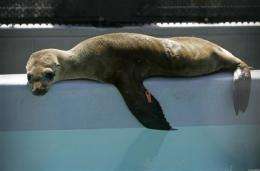
A sea lion rests at the Marine Mammal Center in Sausalito, Calif., Wednesday, June 3, 2009. A recent surge in weakened and malnourished sea lions found along the Northern California coast is mystifying scientists and keeping workers hopping at the newly expanded Marine Mammal Center here. (AP Photo/Eric Risberg)
(AP) -- A recent surge in weakened and malnourished sea lions found along the Northern California coast is mystifying scientists and keeping workers hopping at the newly expanded Marine Mammal Center here.
"We're way ahead in the numbers this year. We have twice as many animals as we should," marine veterinarian Bill Van Bonn said after examining Charcoal, a sick harbor seal.
Experts at the non-profit center, located on wind-swept Marin headlands just north of the Golden Gate Bridge, believe the perplexing spike in malnourished sea lions along several hundred miles of coast could be due to a decline in populations of smaller fish that young seals and sea lions eat while developing.
"It's likely a problem with the food web, something lower in the food chain that is affected, but we are not sure what it is yet," said Van Bonn.
For 35 years, the seaside hospital has treated and studied ailing elephant seals and other coastal mammals in bath tubs and makeshift facilities. On Monday, as more and more sick animals are needing attention, a new $32 million building will be unveiled that expands the center's capacity and technical ability at a crucial time.
On a recent afternoon, center staff decked out in rubber boots and yellow slickers busily tended to about 130 critters lolling in the center's new pens, which are shaded by solar panels and feature pools with freshly filtered water.
The center treats an average of 600 marine mammals a year, but last year more than 800 were rescued. In a recent week, staff rescued 10 more sea lions a day than usual.
"It's concerning," said Jeff Boehm, the center's executive director.
The only bright side, Boehm said, is that the center is now better equipped to help solve the riddle.
They have "a state of the art lab, a state of the art suite for performing science and doing that pathological work which helps us understand diseases," Boehm said. The center also has surgeons to repair broken flippers or remove cataracts.
Elephant seals, harbor seals and California sea lions make up the bulk of the patients, but the center also is called upon to help untangle whales caught in fishing nets, or to perform necropsies on dead animals that wash ashore.
Only about 50 percent of the animals rescued make it out alive, but all of them help in the center's scientific mission: more than 14,000 genetic and tissue samples have been stored.
The new building allows for more public access, which is free. Visitors can view the animals in their pens, watch a necropsy or attend classes.
The Marine Mammal Center has also sought to have a lighter environmental footprint in its new digs: ceiling tiles are made of seaweed and structural beams are composed of partially recycled materials. The solar panels used to shade the pens also provides about 10 percent of the electricity consumed.
These days, as the ocean's acidity rises due to climate change, much of the center's work will be focused on studying how this changing sea chemistry is affecting the mammals that live within its 600 mile-reach. Only about eight percent of the center's patients are injured by hazards like fishing nets, tackle or boats.
On a recent sunny afternoon a group of the malnourished California sea lions barked as two volunteers held one of them down so a feeding tube could be inserted.
The staff force-fed the sea lion, known as Robin, with a yellowish mash of herring, water and salmon oil, hoping to bolster Robin's strength so she can eventually return to the sea.
---
On the Net:
Marine Mammal Center: http://www.tmmc.org/
©2009 The Associated Press. All rights reserved. This material may not be published, broadcast, rewritten or redistributed.
-
Sick sea lions in L.A. have nowhere to go
May 10, 2007 |
not rated yet |
0
-
Increase in animals killed by algae toxin
Feb 17, 2006 |
not rated yet |
0
-
Domoic acid from toxic algal blooms may cause seizures in California sea lions
Jun 09, 2008 |
not rated yet |
0
-
Sea lion decline linked to climate change
Mar 19, 2007 |
not rated yet |
0
-
Answers sought in sea lion decline
Dec 08, 2006 |
not rated yet |
0
-
Fast photon control brings quantum photonic technologies closer
10 hours ago |
5 / 5 (4) |
0
-
Engineers build first sub-10-nm carbon nanotube transistor
Feb 01, 2012 |
4.9 / 5 (33) |
30
-
Something old, something new: Evolution and the structural divergence of duplicate genes
Jan 31, 2012 |
4.6 / 5 (7) |
1
-
The hidden nanoworld of ice crystals: Revealing the dynamic behavior of quasi-liquid layers
Jan 30, 2012 |
5 / 5 (5) |
1
-
Stock market network reveals investor clustering
Jan 27, 2012 |
3.9 / 5 (23) |
8
-
Looking for website on Molecular Neuroscience
46 minutes ago
-
Factors affecting beet root cell membrane
Feb 12, 2012
-
Stem cell question.
Feb 10, 2012
-
Protease cleavage
Feb 10, 2012
-
Pertubance in a model
Feb 10, 2012
-
Cancer drugs and Alzheimer's, Oh my!
Feb 09, 2012
- More from Physics Forums - Biology
More news stories
Plants use circadian rhythms to prepare for battle with insects
In a study of the molecular underpinnings of plants' pest resistance, Rice University biologists have shown that plants both anticipate daytime raids by hungry insects and make sophisticated preparations to ...
2 hours ago |
5 / 5 (2) |
0
|
Study finds fish of Antarctica threatened by climate change
A Yale-led study of the evolutionary history of Antarctic fish and their "anti-freeze" proteins illustrates how tens of millions of years ago a lineage of fish adapted to newly formed polar conditions ...
4 hours ago |
3.7 / 5 (3) |
0
|
Explosive evolution need not follow mass extinctions, says study of ancient zooplankton
Following one of Earth's five greatest mass extinctions, tiny marine organisms called graptoloids did not begin to rapidly develop new physical traits until about 2 million years after competing species became ...
4 hours ago |
5 / 5 (1) |
1
|
Writing a new code for life?
On "Star Trek, the aliens often look so human that crew members fall in love with them. But in real life, scientists in the field known as astrobiology can't be sure alien life would even be carbon-based like us, or use DNA ...
7 hours ago |
5 / 5 (5) |
1
Lens produces hours of scientific work in seconds
A new form of microscope which can produce results in seconds rather than hours dramatically speeding up the process of drug development - is being developed by researchers at the University of Strathclyde ...
8 hours ago |
4.4 / 5 (7) |
1
|
First-of-its-kind stem cell study re-grows healthy heart muscle in heart attack patients
Results from a Cedars-Sinai Heart Institute clinical trial show that treating heart attack patients with an infusion of their own heart-derived cells helps damaged hearts re-grow healthy muscle.
Discovery paves way for salmonella vaccine
(Medical Xpress) -- An international research team led by a University of California, Davis, immunologist has taken an important step toward an effective vaccine against salmonella, a group of increasingly antibiotic-resistant ...
Time of year important in projections of climate change effects on ecosystems
(PhysOrg.com) -- Does it matter whether long periods of hot weather, such as last year's heat wave that gripped the U.S. Midwest, happen in June or July, August or September?
Smoking bans lead to less, not more, smoking at home: study
Smoking bans in public/workplaces don't drive smokers to light up more at home, suggests a study of four European countries with smoke free legislation, published online in Tobacco Control.
Ovarian cancer arises in fallopian tube of knockout mice
(Medical Xpress) -- The most deadly form of "ovarian" cancer arises in the fallopian tubes not the ovaries of knockout mice that lack two genes associated with the disease, said researchers led by Baylor College ...
UK cases of progressive sight loss condition set to rise a third by 2020
New cases of the progressive sight loss condition, known as age-related macular degeneration, or AMD for short, are set to rise by a third in the UK over the next decade, reveals research published online in the British Jo ...