The Earth's magnetic field remains a charged mystery
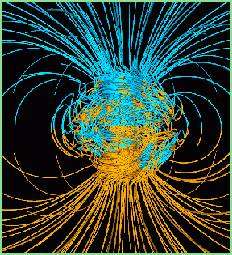
June 15, 2009 Earth Magnetic Field

400 years of discussion and we’re still not sure what creates the Earth’s magnetic field, and thus the magnetosphere, despite the importance of the latter as the only buffer between us and deadly solar wind of charged particles (made up of electrons and protons). New research raises question marks about the forces behind the magnetic field and the structure of Earth itself.

The controversial new paper published in New Journal of Physics (co-owned by the Institute of Physics and the German Physical Society), ‘Secular variation of the Earth’s magnetic field: induced by the ocean flow?’, will deflect geophysicists’ attention from postulated motion of conducting fluids in the Earth’s core, the twentieth century’s answer to the mysteries of geomagnetism and .

Professor Gregory Ryskin from the McCormick School of Engineering and Applied Science at Northwestern University in Illinois, US, has defied the long-standing convention by applying equations from magnetohydrodynamics to our oceans’ salt water (which conducts electricity) and found that the long-term changes (the secular variation) in the Earth’s main magnetic field are possibly induced by our oceans’ circulation.

With calculations thus confirming Ryskin’s suspicions, there were also time and space correlations - specific indications of the integral relationship between the oceans and our magnetospheric buffer.  For example, researchers had recorded changes in the intensity of current circulation in the North Atlantic; Ryskin shows that these appear strongly correlated with sharp changes in the rate of geomagnetic secular variation (“geomagnetic jerks”).

Tim Smith, senior publisher of the New Journal of Physics, said, "This article is controversial and will no doubt cause vigorous debate, and possibly strong opposition, from some parts of the geomagnetism community. As the author acknowledges, the results by no means constitute a proof but they do suggest the need for further research into the possibility of a direct connection between ocean flow and the secular variation of the geomagnetic field."

In the early 1920s, Einstein highlighted the large challenge that understanding our Magnetosphere poses.  It was later suggested that the Earth’s magnetic field could be a result of the flow of electrically-conducting fluid deep inside the Earth acting as a dynamo.   

In the second half of the twentieth century, the dynamo theory, describing the process through which a rotating, convecting, and electrically conducting fluid acts to maintain a magnetic field, was used to explain how hot iron in the outer core of the Earth creates a magnetosphere.

The journal paper also raises questions about the structure of our Earth’s core. 

Familiar text book images that illustrate a flow of hot and highly electrically-conducting fluid at the core of the Earth are based on conjecture and could now be rendered invalid.  As the flow of fluids at the Earth’s core cannot be measured or observed, theories about changes in the magnetosphere have been used, inversely, to infer the existence of such flow at the core of the Earth. 

While Ryskin’s research looks only at long-term changes in the Earth’s , he points out that, “If secular variation is caused by the ocean flow, the entire concept of the dynamo operating in the Earth’s core is called into question: there exists no other evidence of hydrodynamic flow in the core.”

On a practical level, it means the next time you use a compass you might need to thank the seas and oceans for influencing the force necessary to guide the way.

Dr Raymond Shaw, professor of atmospheric physics at Michigan Technological University, said, “It should be kept in mind that the idea Professor Ryskin is proposing in his paper, if valid, has the potential to deem irrelevant the ruling paradigm of geomagnetism, so it will be no surprise to find individuals who are strongly opposed or critical."

Source: Institute of Physics


print this article email this article download pdf blog this article bookmark this article     Stumble it Digg this share on Facebook retweet share on Reddit add to delicious
Rate this story - 4.7 /5 (26 votes)

Rank Filter

Move the slider to adjust rank threshold, so that you can hide some of the comments.


Display comments: newest first

  • gmurphy - Jun 15, 2009
    • Rank: 5 / 5 (1)
    interesting stuff
  • Adriab - Jun 15, 2009
    • Rank: not rated yet
    Cool stuff, the oceans are quite large and complicated, so I can buy the theory. But how does one test it?
  • yyz - Jun 15, 2009
    • Rank: not rated yet
    "In the early 1920s, Einstein highlighted the large challenge that understanding our Magnetosphere poses." Thomas Gold proposed the name 'magnetosphere' in a 1959 paper. Einstein may have been aware of earlier work by Birkeland, Breit and others but certainly had no detailed understanding of the 'magnetosphere' as we know it today. See 'Magnetosphere chronology' here: http://en.wikiped..._history .
  • earls - Jun 15, 2009
    • Rank: not rated yet
    Here's what I find odd about this suggestion...

    http://topex.ucsd...arge.gif

    http://denali.gsf.../map.jpg

    Wouldn't the magnetic field seem to be appear stronger over the oceans if this was the case?
  • AtomThick - Jun 15, 2009
    • Rank: 1 / 5 (1)
    I'm not sure if water can resist on the Earth's surface without an atmosphere (which is held in place by the magnetosphere) it will be evaporated therefore the question is how can water create the magnetosphere if it needs magnetosphere to be there in the first place?
  • Chocolate_Bacon - Jun 15, 2009
    • Rank: 5 / 5 (3)
    Gravity may help a bit with the whole atmosphere thing too.
  • omatumr - Jun 15, 2009
    • Rank: 2 / 5 (8)
    EARTH'S MAGNETIC FIELD WAS INHERITED FROM THE SUN

    Earth's core is made mostly of iron (Fe) and nickel (Ni) - elements that were made near the core of a supernova [E. M. Burbidge, G. R. Burbidge, W. A. Fowler and Fred Hoyle, "Synthesis of elements in stars," Rev. Mod. Phys. vol. 29 (1957) 547].

    Earth's metallic core formed first. This became the accretion site for stone meteorites (silicates) that formed further from the Sun and then had to cross the orbits of the metallic cores of terrestrial planets as the fell toward the Sun [See: Karl K. Turekian and S. P. Clark, Jr., "Inhomogeneous accumulation of the earth from the primitive solar nebula," Earth Planet. Sci. Lett. 6, 346-348 (1969)].

    This scenario was confirmed by the noble gas record of the terrestrial planets [See: O. K. Manuel and D. D. Sabu, "The noble gas record of the terrestrial
    planets," Geochemical Journal, vol. 15 (1981) pages 245 to 267].
    http://tinyurl.com/2k8ds3

    A few years earlier Peter Toth recognized that the Sun itself might be a pulsar [Peter Toth, "Is the Sun a pulsar?" Nature, vol. 270 (1977) pages 159 to 160].
    http://tinyurl.com/l36r6j

    Earth's magnetic field was induced by the powerful magnetic field of the nearby pulsar on which the Sun accreted.
    http://xxx.lanl.g.../0411255

    With kind regards,
    Oliver K. Manuel
    www.omatumr.com/archive/
  • Ivan2 - Jun 15, 2009
    • Rank: not rated yet
    the question is how can water create the magnetosphere if it needs magnetosphere to be there in the first place?

    Wouldn't the magnetic field seem to be appear stronger over the oceans if this was the case?

    They are correlated not because one is the cause of the other but because both are effects of a third event. Otherwise none of the data adds up to a nice pile of this-caused-that and we end up with an infinite regression!

    The mystery is that "third event". My guess: something way below the surface of the Sun.
  • smiffy - Jun 15, 2009
    • Rank: 5 / 5 (1)
    Here's what I find odd about this suggestion...


    http://topex.ucsd...arge.gif


    Wouldn't the magnetic field seem to be appear stronger over the oceans if this was the case?
    Good links earls.


    I don't know where you got the second of these links from but it certainly seems to back up what Prof. Ryskin is saying - namely that the largest variations in Earth's magnetic field are mostly confined to ocean areas.


    Of course the variation in the second jpg file are only of the order of 5% and less. It's not sufficient on its own to challenge accepted ideas about the origin and cause of Earth's Magnetosphere. Maybe the professor has stronger data.


    he points out that, "If secular variation is caused by the ocean flow, the entire concept of the dynamo operating in the Earth%u2019s core is called into question: there exists no other evidence of hydrodynamic flow in the core."
    This seems a bit of a strong claim. I would have thought that the periodic reversal of Earth's Magnetic field is pretty convincing 'other evidence' of some sort of deeply-seated fluid cause.
  • Nik_2213 - Jun 15, 2009
    • Rank: 4 / 5 (2)
    Um, does this mean we can expect a magnetic reversal if the Polar rivers' increasing outflow stall the Gulf Stream ??

    {Carefully avoiding mention of galloping glaciers, AGW etc etc ;-}

    ---
    OT: How do you accrete the Sun we see atop a neutron star without it spinning up and/or going super-nova ??
  • theophys - Jun 15, 2009
    • Rank: not rated yet
    question: how, according to this new theory, is the magnetosphere generated? Last time I checked salt water, while a magnificent conductor of electricity, does not generate a magnetic field. Perhaps I missed something?
  • PPihkala - Jun 16, 2009
    • Rank: not rated yet
    What about other planets like Mars and Venus? If I remember correctly, Mars has no water nor any magnetic field. Same seems to apply to Venus. Then what about salinity of the sea water? I think sea water salinity was earlier like 0.9% and is currently over 3%. Has this change affected the conductivity of sea water and therefore magnetic field strength? Do magnetic polarity reversals coincide with ice ages that probably alter the ocean currents?
  • earls - Jun 16, 2009
    • Rank: 1 / 5 (1)
    Last time I checked salt water, while a magnificent conductor of electricity, does not generate a magnetic field.


    Electrical currents generate magnetic fields. Magnetic fields generate electrical currents.

    If the "seawater" is conducting an electrical current...
  • earls - Jun 17, 2009
    • Rank: not rated yet
    I'm sorry, that isn't true yyz?
  • JukriS - Jun 17, 2009
    • Rank: 1 / 5 (3)
    Today physics have a wrong theory.

    Also particle emit/radiate energy all a time. particle interactive together.

    Earth just emit/radiate particle who absorbs some energy what this particle emit/radiate, who coming from Sun!

    I mean, Sune emit/radiate particle who also emit/radiate energy. Earth emit/radiate particle who can absorbs that energy. I mean that energy what this particle emit/radite, who coming from Sun.

    Sorry about terrible english.
  • JukriS - Jun 17, 2009
    • Rank: 1 / 5 (2)
    Explaination of the OneSimplePrinciple Model

    gadzometer try to explain my model with good english.

    He just found my Model and everything what he say, it is not right way.

    Check out

    http://www.youtub...Q6kLlHdE&feature=channel_page
  • earls - Jun 17, 2009
    • Rank: not rated yet
    Everyone knows that Jurkis.
  • JukriS - Jun 17, 2009
    • Rank: 1 / 5 (2)
    Uups. There is lot of thing right way ans some is not just right way. My english it is not enaf good, but i think he speak something wron way. like how star pushing themselfs far away.

    Star exploding and emit particle like neutriinos and also neutriinos exploding and emit kineticenergy for other star nucleus of atoms who also exploding all a time!
  • earls - Jun 17, 2009
    • Rank: 1 / 5 (1)
    Concepts are great, calculations are better.

    Where are you from to butcher English so bad?
  • eddy1 - Jun 17, 2009
    • Rank: not rated yet
    There would be always interaction between existing magnetic field and moving salt water ions, which explain why there are anomalies in the Earth magnetic field in the ocean.

June 15, 2009 all stories

Comments: 20

4.7 /5 (26 votes)
  • Stumble this up

  • Digg this

  • share this

  • hide
  • Related Stories

  • Surprisingly rapid changes in the Earth's core discovered
    created Jul 07, 2008 | popularity not rated yet | comments 0
  • New theory proposes Jovian magnetosphere circulates magnetic field remarkably different from that of Earth
    created Oct 23, 2007 | popularity not rated yet | comments 0
  • The Dynamo in the Cornfield
    created Jan 05, 2005 | popularity not rated yet | comments 0
  • Cluster opens a new window on 'magnetic reconnection' in the near-Earth space
    created Mar 12, 2007 | popularity not rated yet | comments 0
  • Magnetic whirlpools feed Earth's magnetosphere
    created Dec 06, 2006 | popularity not rated yet | comments 0


  • hide
  • Relevant PhysicsForums posts

  • cycles
    created 10 hours ago
  • The Origin of the term 'fossil' fuels
    created Nov 05, 2009
  • co2
    created Nov 03, 2009
  • Early Earths Sulfidic Ocean Conditions
    created Oct 30, 2009
  • More from Physics Forums - Earth

Other News

Deep creep means milder, more frequent earthquakes along Southern California's San Jacinto fault

Deep creep means milder, more frequent earthquakes along Southern California's San Jacinto fault

Space & Earth / Earth Sciences

created 10 hours ago | popularity 4.7 / 5 (3) | comments 0

With an average of four mini-earthquakes per day, Southern California's San Jacinto fault constantly adjusts to make it a less likely candidate for a major earthquake than its quiet neighbor to the east, the ...


Success in 'space elevator' competition (AP)

Success in 'space elevator' competition (Update 3)

Space & Earth / Space Exploration

created Nov 05, 2009 | popularity 4.3 / 5 (33) | comments 50

(AP) -- A robot powered by a ground-based laser beam climbed a long cable dangling from a helicopter on Wednesday to qualify for prize money in a $2 million competition to test the potential reality of the ...


In a Galaxy Far, Far Away...

In a Galaxy Far, Far Away...

Space & Earth / Astronomy

created Nov 06, 2009 | popularity 4.8 / 5 (5) | comments 15

(PhysOrg.com) -- Astronomers have published the discovery of the farthest known object in the cosmos: a star that exploded when the universe was only 630 million years old -- only 4.6% of its current age. ...


'Dropouts' pinpoint earliest galaxies

'Dropouts' pinpoint earliest galaxies

Space & Earth / Astronomy

created Nov 06, 2009 | popularity 4.2 / 5 (10) | comments 13

Astronomers, conducting the broadest survey to date of galaxies from about 800 million years after the Big Bang, have found 22 early galaxies and confirmed the age of one by its characteristic hydrogen signature ...


Space hotel taking bookings for 2012 opening

Space hotel taking bookings for 2012 opening

Space & Earth / Space Exploration

created Nov 05, 2009 | popularity 4.4 / 5 (20) | comments 11

(PhysOrg.com) -- The first orbiting space hotel is on track to open for its first customers in 2012, but hurry, as bookings are filling fast.