Lifestyle melts away with Uganda peak snow cap
June 15, 2009 by Ben Simon
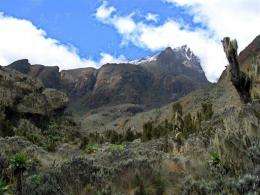
The Rwenzori mountain range in western Uganda. n 1906, Mount Speke, one the highest peaks on the range was covered with 217 hectares of ice, according to the Climate Change Unit at Uganda?s ministry of water and environment. In 2006, only 18.5 hectares remained
In 1906, Mount Speke, one the highest peaks of Uganda's Rwenzori Mountains was covered with 217 hectares (536 acres) of ice, according to the Climate Change Unit at Uganda's ministry of water and environment. In 2006, only 18.5 hectares remained.
Satellite images taken in 1987 and again in 2005 show that much of the thaw has occurred over the past two decades.
When Yasamu Maate was a younger man, he could stand in his garden on a clear, cloudless morning and stare at the ice caps on the range.
But on a recent Friday the 87-year-old lamented the loss of those ice caps, which have all but disappeared, as the world around him has gotten warmer.
"We used to use the snow and ice as our guide," he said, sitting on a roadside chair in Bundibugyo, a village in western Uganda at the base of the Rwenzoris, which run roughly 100 kilometres (60 miles) along the border with the Democratic Republic of Congo.
"We would say if there was a lot of snow on the mountains the rain was coming, but these days we are not seeing it. The coldness has disappeared."
"The ice is literally disappearing. In some cases it has disappeared, and I am more than certain that this is a result of global warming," said Philip Gagwe, who heads the Climate Change Unit.
"Man-made global warming is here. We are smelling it and we are touching it."
Uganda's National Environmental Management Authority (NEMA) believes that if melting continues at the current rate the ice will be gone by 2023.
For the people of Bundibugyo who rely on agriculture to survive, temperature increases have changed their lives dramatically.
"I used to be able to plant beans down here at around March," said Nelson Bikalwamuli, 45, referring to his garden at the base of the mountain. "But now it has changed."
Beans serve as both a food crop and a crash crop for Bikalwamuli, so he can?t afford to lose them.
He?s had to secure a plot of land part way up the mountain, where he says temperatures are still cool enough to yield a descent crop, but the trek up is hard, and competition for space is growing increasingly fierce.
"People just keep moving up, up, up," he said. "I fear soon we may be on top of each other."
Goretti Kitutu, a climate change specialist at NEMA, said people might soon be competing for water as well.
The snow cap provides a steady trickle of water to the neighbouring communities and feeds the Nile river basin, which includes Lake George and Lake Albert.
"Once this ice disappears we shall have serious problems in the hydrology of the area. We will see reduced water in the lakes and that will impact the Nile basin," Kitutu explained.
"There are plenty of countries that depend on that water," she said. "You could easily have communities that will be fighting over water," she added.
-- 'The country is punished for someone else's crime' --
But on the dusty, quiet streets of Bundibugyo, the potential impacts on the region?s hydrological system are remote concerns.
The locals are more bothered by the emergence of malaria, which they insist used to be a scarce occurrence in their cool mountain community.
"Earlier we used to not hear mosquitoes and we had no malaria here. Mosquitoes were down," Maate said, gesturing to the warmer lowlands in the distance. "But now they are here."
"When we used to slaughter goats we could leave the meat for two days and you would never see bugs flying around," Bikalwamuli told AFP. "When you slaughter a goat now, so quickly flying insects are everywhere."
Kate Kascinsky, a vector specialist at the British-funded Malaria Consortium, said that even a slight increase in temperature could affect malaria prevalence but admitted that measuring the change was difficult.
She warned that in warmer parts of the country, where mosquitoes thrive and malaria is transmitted on a regular and stable basis, people develop immunity.
"But people in a community with no history of malaria are never going to get immune," she said.
Though the melting ice caps offer the most poignant visual evidence that climate change has touched this east African nation, experts insist the impacts are being felt across the country.
Gagwe claimed that climate change was responsible for recent occurrences of severe hailstorms, prolonged drought and massive flooding as well as more erratic rain cycles.
In Karamoja, an under-developed pastoralist region in northeast Uganda, changing rainfall patterns have led to food shortages.
The Karimojong are not skilled agriculturalists and have historically led semi-nomadic lives, with greatest importance placed on cattle grazing.
The recent droughts and floods devastated their minimal agricultural production, and the Karimojong were unable to adjust, putting hundreds of thousands at risk of starvation.
"For the Karimojong it is not a question of choice," Stanlake Samkange, Uganda director for the World Food Programme, which launched a massive food distribution in January.
"Some practices that were sustainable in the past are just no longer sustainable because the climate is changing."
There is a clear sentiment among some Ugandans that the country is being punished for someone else?s crime.
"Our contribution to climate change is almost insignificant but we are being impacted heavily," Kitutu of NEMA said.
The British charity Oxfam has begun advising the government on how to negotiate compensation from industrialized nations at upcoming international climate conferences, according to Maria Tusingwire, Oxfam?s Uganda spokeswoman.
The charity has called for additional and unconditional foreign aid, to help less developed countries adapt to climate change.
(c) 2009 AFP
-
Fabled equatorial icecaps to disappear
May 15, 2006 |
not rated yet |
0
-
'Airport malaria' -- cause for concern in the US
Nov 11, 2008 |
not rated yet |
0
-
New Ice Age maps point to climate change patterns
Jan 19, 2009 |
not rated yet |
0
-
Study: Climate change alters water supply
Nov 17, 2005 |
not rated yet |
0
-
Greenland and Antarctic ice sheet melting, rate unknown
Feb 16, 2009 |
not rated yet |
0
-
Engineers build first sub-10-nm carbon nanotube transistor
Feb 01, 2012 |
4.9 / 5 (31) |
30
-
Something old, something new: Evolution and the structural divergence of duplicate genes
Jan 31, 2012 |
4.6 / 5 (7) |
1
-
The hidden nanoworld of ice crystals: Revealing the dynamic behavior of quasi-liquid layers
Jan 30, 2012 |
5 / 5 (3) |
1
-
Stock market network reveals investor clustering
Jan 27, 2012 |
3.9 / 5 (23) |
8
-
Of microchemistry and molecules: Electronic microfluidic device synthesizes biocompatible probes
Jan 26, 2012 |
5 / 5 (1) |
0
-
Discrepancy between oxygen and carbon-dioxide levels
17 hours ago
-
where gems are found in the world
20 hours ago
-
Wind Waves in Reservoir ~ Wind run-up and Wind set-up
Feb 08, 2012
-
Balance of oxygen in the atmosphere
Feb 01, 2012
-
The case for a methanol-based economy
Jan 30, 2012
-
Weather in a rotating cylinder
Jan 25, 2012
- More from Physics Forums - Earth
More news stories
Could Venus be shifting gear?
(PhysOrg.com) -- ESAs Venus Express spacecraft has discovered that our cloud-covered neighbour spins a little slower than previously measured. Peering through the dense atmosphere in the infrared, the ...
Space & Earth / Space Exploration
5 hours ago |
5 / 5 (5) |
7
|
Humans may have helped the decline of African rainforests 3000 years ago
(PhysOrg.com) -- Large areas of rainforests in Central Africa mysteriously disappeared over three thousand years ago, to be replaced by savannas. The prevailing theory has been that the cause was a change ...
Mars Science Laboratory computer issue resolved
(PhysOrg.com) -- Engineers have found the root cause of a computer reset that occurred two months ago on NASA's Mars Science Laboratory and have determined how to correct it.
Space & Earth / Space Exploration
6 hours ago |
5 / 5 (5) |
3
|
Clam fields found at deep, low-temperature Mariana vents
(PhysOrg.com) -- Scientists have marveled at the unusual life forms thriving at high temperature hydrothermal vents of the deep ocean.
Space & Earth / Earth Sciences
5 hours ago |
not rated yet |
0
|
Two new moons for Jupiter
Advances in technology have lead to the discovery of new planets outside of our Solar System, and now even new moons in our own backyard.
Space & Earth / Space Exploration
5 hours ago |
not rated yet |
2
Putting the squeeze on planets outside our solar system
(PhysOrg.com) -- Using high-powered lasers, scientists at Lawrence Livermore National Laboratory and collaborators discovered that molten magnesium silicate undergoes a phase change in the liquid state, abruptly ...
Employers feel no love for unscrupulous practice of 'service sweethearting'
A new study led by two Florida State University marketing professors finds that some frontline service employees who are rewarded for hikes in customer loyalty and satisfaction also may engage in "service ...
US issues guidelines to avoid heparin contamination
Four years after US drug-maker Baxter International's blood thinner heparin was contaminated in China, causing dozens of deaths, US regulators on Friday issued draft guidelines for safe production.
Expat French get Internet vote for first time
French citizens will for the first time this year be able to vote in a parliamentary election over the Internet, an experiment that could be extended to other elections if successful.
"Twisted Metal" gamers get shot at real gunplay
Fans of "Twisted Metal" will get to welcome a long-awaited sequel of the car-battle videogame with a real-world bang by blasting an ice cream truck to bits with a machine gun.
The power of estrogen -- male snakes attract other males
A new study has shown that boosting the estrogen levels of male garter snakes causes them to secrete the same pheromones that females use to attract suitors, and turned the males into just about the sexiest ...
Jun 15, 2009
Rank: 3.8 / 5 (4)
Jun 15, 2009
Rank: 3.7 / 5 (3)
Shame they couldn't tell us how much was covered in 1806 or 1706....
Dunno what's so scary about ice caps melting the further we get from the last ice age, I would guess that was normal for climate change.
Instead of greeting about it, why don't the locals adapt and build themselves a 200hectare reservoir?
Jun 15, 2009
Rank: 4 / 5 (4)
It's a good thing that modern science has established that precipitation causes glaciation and ice caps rather than the reverse.
Jun 15, 2009
Rank: 4.3 / 5 (4)
Hmmm... It seems that there is conflicting information out there. This one says 217 hectares dropping to 18.5 hectares and another article says 650 hectares dropping to 108 hectares.
Compare http://allafrica....892.html for the two differences in "fact" between the two articles. Things that make one go, "Hmmm..." :)
Jun 15, 2009
Rank: 3 / 5 (6)
There's no conflicting information, you just didn't read things carefully. The 217 hectares figure is for Mount Speke only, whereas the 650 hectares is for the entire Rwenzori range.
Jun 15, 2009
Rank: 4 / 5 (4)
What I am interested in. however, is why they did not include the 2007 and 2008 data.
Jun 15, 2009
Rank: 5 / 5 (3)
Sources: WWF, the Congolese Institute for Nature Conservation, and the Uganda Wildlife Authority.
That means that the glaciers increased in size between 2006 and 2008 from 108 hectares to 148 hectares, meaning a GAIN of 40 hectares in spite of claims of rising temperatures and consistent loss of ice.
I'd say that this article above is both a little late and a little premature....
But, I'm going to hunt up some more data to make better comparisons. :)
Jun 20, 2009
Rank: 5 / 5 (1)
2. I'm appalled at the "soft bigotry of low expectations" displayed towards the Karimojong. Certainly their knowledge base is inadequate to their current problems. But if business is bad because they cannot produce their food at a reasonable cost, the UN is making it worse for them by handing out free food. U. S. charities learned years ago that it is better to teach the people how to better use what they have. Free food only drives struggling farmers out of business entirely, and should only be used for short-term emergency relief. The Karimojong are people - give them more knowledge and resources, and they will adapt because they must. They are used to farming in a humid environment, but if approached with courtesy and respect, they will probably welcome advice from experts in dry climate agriculture, especially those whose families have been doing it for generations.