Space Robot Can Autonomously Reconfigure Itself
June 15, 2009 by Lisa Zyga Space Robot Can Autonomously Reconfigure Itself

Enlarge

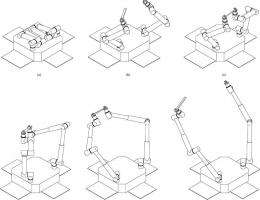
By connecting their endpoints, two reconfigurable robots autonomously change their configurations by altering the lengths of their arms and twisting their joints. Image credit: Aghili and Parsa. ©2009 IEEE.

A robot designed to work in space should ideally be a Jack of all trades, with the ability to perform a wide variety of tasks by itself. By having one robot that can handle many jobs, astronauts can cut down on weight in order to reduce launch cost. As presented in a recent study, a new type of reconfigurable robot can perform diverse tasks by changing its configuration, such as lengthening and twisting its “arms,” in a much simpler and more compact way than previous reconfigurable robots.

As Farhad Aghili of the Canadian Space Agency in Saint-Hubert, Quebec, and Kourosh Parsa of ESAB Cutting Systems in Florence, South Carolina, explain in a recent study, most conventional reconfigurable robots have a modular design. Although modular robots can change their size and shape, they require complex joints for connecting modules, as well as a docking system for exchanging modules.

Aghili and Parsa’s new design for a reconfigurable robot does away with modules, and instead uses passive joints that allow the arms to twist and change their length, depending on the task at hand. The cylindrical passive joints, i.e., joints that don’t use actuators or sensors, lie in between cylindrical telescopic arms. As the joints twist and turn and the telescopic arms extend or shrink, the robot looks a bit like one of Inspector Gadget’s bionic arms, but precisely controlled.

In order to reconfigure itself, the engineers explain that the robot must constrain the motion of the end of its arm in order to control its joint parameters. The robot can do this in several ways, such as when the arm grasps a fixed point or when two robot arms grasp the same object. In either case, the robot forms a closed chain. At this point, one or more of the brake mechanisms on the passive joints can be released by activating a solenoid, which allows the “elbows” of the robot to twist and lengthen or shorten its arms. When the system achieves its desired configuration, the joint brakes are locked, and the robot detaches itself from its constraining object.

The new “lockable joint” design offers several advantages compared with the conventional modular design of reconfigurable robots. The main advantage is simplicity, with the new design being compact and weighing less, which is important for launch considerations. The new design also enables the robot to autonomously reconfigure itself, since links and joints don’t need to be detached and reattached as in the modular design.

“In a nutshell, this work establishes a new concept of a reconfigurable robot with supporting mathematical analysis and control method,” Aghili told PhysOrg.com. “The conditions on the manipulator constraints and the passive joints to make it possible that the robot changes its current configuration to a desired one are derived. The control system then autonomously realizes the configuration change while demanding minimum actuation effort. Autonomous calibration of the manipulator after every configuration change is another significant aspect of this work.”

This kind of reconfigurable robot could have many uses in space, including performing inspections, assembling devices, and carrying objects. Aghili added that a reconfigurable robot like this one could also have applications in mining, nuclear power plants and the military. He noted that a team of students from McGill University has built a preliminarily prototype of a similar reconfigurable robot.

“The Space Shuttle manipulator has been served in numerous space missions for more than two decades,” he said. “However, the Shuttle is scheduled to be soon retired and the next generation of NASA spacecraft will not have a large cargo bay, such as the Shuttle’s, to accommodate a manipulator with long booms. In this retrospect, a reconfigurable robot with telescopic joints, which can be contained in a small volume that is suitable for launch, is seriously considered for the next generation of spacecraft manipulators.”

More information: Farhad Aghili and Kourosh Parsa. “A Reconfigurable Robot with Lockable Cylindrical Joints.” IEEE Transactions on Robotics. To be published.

Copyright 2009 PhysOrg.com.
All rights reserved. This material may not be published, broadcast, rewritten or redistributed in whole or part without the express written permission of PhysOrg.com.


print this article email this article download pdf blog this article bookmark this article     Stumble it Digg this share on Facebook retweet share on Reddit add to delicious
Rate this story - 4.6 /5 (14 votes)

Rank Filter

Move the slider to adjust rank threshold, so that you can hide some of the comments.


Display comments: newest first

  • N_O_M - Jun 15, 2009
    • Rank: 3.3 / 5 (3)
    I hope they name it "Bender"
  • Birger - Jun 16, 2009
    • Rank: 5 / 5 (1)
    Is this kind of device possibly able to make automated service trips to the Hubble telescope? It would be far, far cheaper than crewed missions, and could extend the life of Hubble even further.
  • jaggspb - Jun 16, 2009
    • Rank: 4.3 / 5 (3)
    bravo NOM - I second that notion
  • out7x - Jun 18, 2009
    • Rank: not rated yet
    Self replicating robots could also go to the nearest star on a laser light sail.
  • i2oi3 - Jun 19, 2009
    • Rank: 5 / 5 (1)
    Does anybody else feel that we are very close to creating genuinely intelligent machines? Just yesterday I was reading that bacteria have recently been found to be able to act in anticipation of future events, imagine combining something like that with a bit of nanotechnology....

    I just can't wait till we get hot cylons, like in Battlestar Gallactica. Robots need love too.

    ~Rob
    http://www.mytextsecret.com
  • Quantum_Conundrum - Jul 02, 2009
    • Rank: not rated yet
    If designing an ideal civilization in space, the bulk of the work and transports would be done through the usage of remotely operated vehicles and limited functionality "automatic" maintenance robots. This is facilitated by forward-thinking design such that maintenance rails run through all of the structures. I am here envisioning mega structures equal or larger than arcologies.

June 15, 2009 all stories

Comments: 6

4.6 /5 (14 votes)
  • Stumble this up

  • Digg this

  • share this

  • hide
  • Related Stories

  • The robot that climbs in the pipe
    created Jun 23, 2008 | popularity not rated yet | comments 0
  • Scientists study robot-human interactions
    created Aug 30, 2006 | popularity not rated yet | comments 0
  • Proving That Shape-Shifting Robots Can Get a Move On
    created Sep 16, 2004 | popularity not rated yet | comments 0
  • Koreans introduce 'talking' robots
    created Dec 01, 2005 | popularity not rated yet | comments 0
  • Korea to sell programmable robot
    created Aug 21, 2006 | popularity not rated yet | comments 0


  • hide
  • Relevant PhysicsForums posts

  • Relative pressure & specific volume
    created 6 hours ago
  • Making 4'x8' sign inkjet printer - need nozzles - help?
    created Nov 06, 2009
  • Calculating Velocity
    created Nov 06, 2009
  • shear stress distribution in triangular steel profile
    created Nov 06, 2009
  • More from Physics Forums - General Engineering

Other News

Samsung launches a new vacuuming robot

Samsung launches a new vacuuming robot

Electronics / Consumer & Gadgets

created Nov 06, 2009 | popularity 4.4 / 5 (7) | comments 8

(PhysOrg.com) -- Samsung Electronics has launched its latest autonomous robot vacuum cleaner, the Tango, which is capable of vacuuming hardwood floors, carpets, and even beds without human assistance.


new iphone

Touchscreen smartphones being snatched up in US

Electronics / Consumer & Gadgets

created Nov 03, 2009 | popularity 2.7 / 5 (3) | comments 3

US smartphone buyers can't wait to get their hands on touchscreen devices, according to figures released Tuesday by industry tracker comScore.


Robot fish could monitor water quality

Robot fish could monitor water quality

Electronics / Robotics

created Nov 02, 2009 | popularity not rated yet | comments 2

Nature inspires technology for an engineer and an ecologist teamed up at Michigan State University. They're developing robots that use advanced materials to swim like fish to probe underwater environments.


Review: Motorola's Droid is a serious smart phone (AP)

Review: Motorola's Droid is a serious smart phone

Electronics / Consumer & Gadgets

created Nov 04, 2009 | popularity 4.6 / 5 (5) | comments 0

(AP) -- Since its debut in 2007, millions of people have gravitated toward Apple's iPhone, wooed by its sleek hardware, simple user interface and abundance of applications.


UCI robot to aid brain research

UCI robot to aid brain research

Electronics / Robotics

created Nov 04, 2009 | popularity 5 / 5 (1) | comments 0

(PhysOrg.com) -- A robot powered by a computerized model of a rodent brain will help researchers from UC Irvine and UC San Diego understand how people recognize and adapt to change.