New exotic material could revolutionize electronics
June 15, 2009 New exotic material could revolutionize electronics

Enlarge

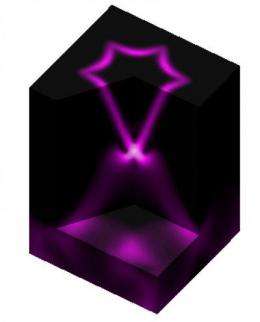
This is a surface electron band structure of bismuth telluride. Credit: Image courtesy of Yulin Chen and Z. X. Shen

Move over, silicon -- it may be time to give the Valley a new name. Physicists at the Department of Energy's (DOE) SLAC National Accelerator Laboratory and Stanford University have confirmed the existence of a type of material that could one day provide dramatically faster, more efficient computer chips.

Recently-predicted and much-sought, the material allows electrons on its surface to travel with no loss of energy at room temperatures and can be fabricated using existing semiconductor technologies. Such material could provide a leap in speeds, and even become the bedrock of an entirely new kind of computing industry based on spintronics, the next evolution of electronics.

Physicists Yulin Chen, Zhi-Xun Shen and their colleagues tested the behavior of electrons in the compound bismuth telluride. The results, published online June 11 in Science Express, show a clear signature of what is called a topological insulator, a material that enables the free flow of electrons across its surface with no loss of energy.

The discovery was the result of teamwork between theoretical and experimental physicists at the Stanford Institute for & Energy Science, a joint SLAC-Stanford institute. In recent months, SIMES theorist Shoucheng Zhang and colleagues predicted that several bismuth and antimony compounds would act as topological insulators at room-temperature. The new paper confirms that prediction in bismuth telluride. "The working style of SIMES is perfect," Chen said. "Theorists, experimentalists, and sample growers can collaborate in a broad sense."

The experimenters examined bismuth telluride samples using X-rays from the Stanford Synchrotron Radiation Lightsource at SLAC and the Advanced Light Source at Lawrence Berkeley National Laboratory. When Chen and his colleagues investigated the electrons' behavior, they saw the clear signature of a topological insulator. Not only that, the group discovered that the reality of bismuth telluride was even better than theory.

"The theorists were very close," Chen said, "but there was a quantitative difference." The experiments showed that bismuth telluride could tolerate even higher temperatures than theorists had predicted. "This means that the material is closer to application than we thought," Chen said.

This magic is possible thanks to surprisingly well-behaved electrons. The of each electron is aligned with the electron's motion—a phenomenon called the quantum spin Hall effect. This alignment is a key component in creating spintronics devices, new kinds of devices that go beyond standard electronics. "When you hit something, there's usually scattering, some possibility of bouncing back," explained theorist Xiaoliang Qi. "But the quantum spin Hall effect means that you can't reflect to exactly the reverse path." As a dramatic consequence, electrons flow without resistance. Put a voltage on a topological insulator, and this special spin current will flow without heating the material or dissipating.

Topological insulators aren't conventional superconductors nor fodder for super-efficient power lines, as they can only carry small currents, but they could pave the way for a paradigm shift in microchip development. "This could lead to new applications of spintronics, or using the electron spin to carry information," Qi said. "Whether or not it can build better wires, I'm optimistic it can lead to new devices, transistors, and spintronics devices."

Fortunately for real-world applications, bismuth telluride is fairly simple to grow and work with. Chen said, "It's a three-dimensional material, so it's easy to fabricate with the current mature semiconductor technology. It's also easy to dope—you can tune the properties relatively easily."

"This is already a very exciting thing," he said, adding that the material "could let us make a device with new operating principles."

More information: http://www.sciencemag.org/cgi/content/abstract/1173034

Source: SLAC National Accelerator Laboratory


print this article email this article download pdf blog this article bookmark this article     Stumble it Digg this share on Facebook retweet share on Reddit add to delicious
Rate this story - 4.8 /5 (50 votes)

Rank Filter

Move the slider to adjust rank threshold, so that you can hide some of the comments.


Display comments: newest first

  • makotech222 - Jun 15, 2009
    • Rank: 4.5 / 5 (2)
    wont see this again for another 10 years, as all great discoveries go...
  • eric96 - Jun 15, 2009
    • Rank: 5 / 5 (3)
    Forget 10 years, more like 30 years away


    Thankfully, other technologies are closer to reality

    - like toshiba's new 14nm process, expect that in
    4-6 years

    - Graphene chips in 10-12 years

    - Quantum computing, expect that to never reach

    consumers.
  • alexxx - Jun 15, 2009
    • Rank: 1 / 5 (3)
    too much money is invested in 'silicon' - thus, any new technology must be compatible with Si-based technology to 'survive'
  • LariAnn - Jun 15, 2009
    • Rank: 3 / 5 (4)
    These technologies will disappear into the military-industrial complex (MIC) and in some years, their technology will seem like extraterrestrial technology, or something out of Star Trek, when compared to our consumer-level "pedestrian" technology. Rule by technological superiority - bad news for politicians - and for us as well . . .

    The MIC will discover that profit by selling to consumers is eclipsed by the tremendous power to be gained by controlling availability of information and technology. Who wants to make mere billions when you can own the world itself?
  • holoman - Jun 15, 2009
    • Rank: 3 / 5 (2)
    Ferroelectric Bismuth Tellurium material around
    for many years.

    Of all the revolutionary, uniquie, exotic, never seen before claims. I would say very few are true.
  • NeilFarbstein - Jun 15, 2009
    • Rank: 2.3 / 5 (3)
    Anyone know why it cant carry a bigger amounts of current?
  • goldengod - Jun 15, 2009
    • Rank: not rated yet
    Chen said, "It's a three-dimensional material, so it's easy to fabricate with the current mature semiconductor technology. It's also easy to dope%u2014you can tune the properties relatively easily."

    looks like it will be easy to fabricate with existing technology...
  • guiding_light - Jun 16, 2009
    • Rank: not rated yet
    curious how clean the surface would have to be...I suspect pretty pristine.
  • E_L_Earnhardt - Jun 17, 2009
    • Rank: 2.3 / 5 (3)
    PLEASE DON'T LET THIS MATERIAL GET INTO THE "FOOD CHAIN" IT HAS ALL THE ELEMENTS OF A CANCER ACCELERANT! DANGER!!
  • nick7201969 - Jun 20, 2009
    • Rank: 5 / 5 (3)
    Oops, now you tell me! I just ordered some bismuth telluride toppings with my combination pizza. Now I have a free flow of electrons on my mustache. Oh well, anyhoo, I'm charged up for the day. So far, no loss of energy.


June 15, 2009 all stories

Comments: 10

4.8 /5 (50 votes)
  • Stumble this up

  • Digg this

  • share this

  • hide
  • Related Stories

  • Super-efficient Transistor Material Predicted
    created May 15, 2009 | popularity not rated yet | comments 0
  • Making magnetic monopoles, and other exotica, in the lab
    created Feb 05, 2009 | popularity not rated yet | comments 0
  • It's all in the spin: Quantum physics cools down computers
    created Sep 25, 2007 | popularity not rated yet | comments 0
  • Researchers predict a new state of matter in semiconductors
    created Dec 14, 2006 | popularity not rated yet | comments 0
  • Quantum Twist: Electrons Mimic Presence of Magnetic Field
    created Feb 12, 2009 | popularity not rated yet | comments 0


  • hide
  • Relevant PhysicsForums posts

  • wonder about atom characteristic
    created Nov 06, 2009
  • Proton mobility vs. conductance in ice
    created Nov 04, 2009
  • Transmission spectrum and DOS
    created Nov 04, 2009
  • monoatomic elements
    created Nov 04, 2009
  • About Davydov splitting
    created Nov 04, 2009
  • Density of States
    created Nov 03, 2009
  • More from Physics Forums - Atomic, Solid State, Comp. Physics

Other News

Stars Fueled by Dark Matter Could Hold Secrets to the Universe

Stars Fueled by Dark Matter Could Hold Secrets to the Universe

Physics / General Physics

created Nov 03, 2009 | popularity 4.5 / 5 (48) | comments 40

(PhysOrg.com) -- The first stars in the universe may have been very different from the stars we see today, yet they may hold clues to understanding some of the mysterious features of the universe. These "dark ...


Second Law of Thermodynamics May Explain Economic Evolution

Second Law of Thermodynamics May Explain Economic Evolution

Physics / General Physics

created Nov 02, 2009 | popularity 4.3 / 5 (29) | comments 29

(PhysOrg.com) -- Terms such as the "invisible hand," laissez-faire policy, and free-market principles suggest that economic growth and decline in capitalist societies seem to be somehow self-regulated. Now, ...


High-performance plasmas may make reliable, efficient fusion power a reality

High-performance plasmas may make reliable, efficient fusion power a reality

Physics / Plasma Physics

created Nov 02, 2009 | popularity 4.7 / 5 (36) | comments 32

In the quest to produce nuclear fusion energy, researchers from the DIII-D National Fusion Facility have recently confirmed long-standing theoretical predictions that performance, efficiency and reliability ...


'Teapot effect' solved

Solving Teapot Effect

Physics / General Physics

created Nov 02, 2009 | popularity 4.9 / 5 (10) | comments 10

(PhysOrg.com) -- A team of scientists from France have worked out why teapots dribble at low flow rates, and how to stop them. The effect is called the "teapot effect", and solving it could finally put an ...


Laser accelerated protons to the highest energies so far

Researchers use trident laser to accelerate protons to record energies

Physics / General Physics

created Nov 02, 2009 | popularity 4.3 / 5 (3) | comments 10

An international team of physicists at Los Alamos National Laboratory has succeeded in using intense laser light to accelerate protons to energies never before achieved. Using this technique, scientists can ...