Scientists discover magnetic superatoms
June 15, 2009 Scientists discover magnetic superatoms

Enlarge

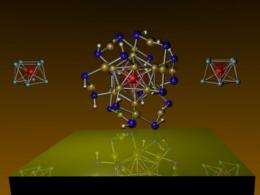
These are VCs8 and MnAu24(SH)18 magnetic superatoms that mimic a manganese atom. The MnAu24 cluster is surrounded by sulfur and hydrogen atoms to protect it against outside attack, thus making it valuable for use in biomedical applications. Credit: Image courtesy of Ulises Reveles, Ph.D, VCU.

A team of Virginia Commonwealth University scientists has discovered a 'magnetic superatom' - a stable cluster of atoms that can mimic different elements of the periodic table - that one day may be used to create molecular electronic devices for the next generation of faster computers with larger memory storage.

The newly discovered cluster, consisting of one vanadium and eight , acts like a tiny magnet that can mimic a single manganese atom in magnetic strength while preferentially allowing electrons of specific spin orientation to flow through the surrounding shell of cesium atoms. The findings appear online in the journal Nature Chemistry.

Through an elaborate series of theoretical studies, Shiv N. Khanna, Ph.D., professor in the VCU Department of Physics, together with VCU postdoctoral associates J. Ulises Reveles, A.C. Reber, and graduate student P. Clayborne, and collaborators at the Naval Research Laboratory in D.C., and the Harish-Chandra Research Institute in Allahabad, India, examined the electronic and magnetic properties of clusters having one vanadium atom surrounded by multiple cesium atoms.

They found that when the cluster had eight cesium atoms it acquired extra stability due to a filled electronic state. An atom is in a stable configuration when its outermost shell is full. Consequently, when an atom combines with other atoms, it tends to lose or gain valence electrons to acquire a stable configuration.

According to Khanna, the new cluster had a magnetic moment of five Bohr magnetons, which is more than twice the value for an iron atom in a solid iron magnet. A magnetic moment is a measure of the internal magnetism of the cluster. A manganese atom also has a similar magnetic moment and a closed electronic shell of more tightly bound electrons, and Khanna said that the new cluster could be regarded as a mimic of a manganese atom.

"An important objective of the discovery was to find what combination of atoms will lead to a species that is stable as we put multiple units together. The combination of magnetic and conducting attributes was also desirable. Cesium is a good conductor of electricity and hence the superatom combines the benefit of magnetic character along with ease of conduction through its outer skin," Khanna said.

"A combination such as the one we have created here can lead to significant developments in the area of "molecular electronics," a field where researchers study electric currents through small molecules. These molecular devices are expected to help make non-volatile data storage, denser integrated devices, higher data processing and other benefits," he said.

Khanna and his team are conducting preliminary studies on molecules composed of two such superatoms and have made some promising observations that may have applications in spintronics. Spintronics is a process using electron spin to synthesize new devices for memory and data processing.

The researchers have also proposed that by combining gold and manganese, one can make other superatoms that have magnetic moment, but will not conduct electricity. These superatoms may have potential biomedical applications such as sensing, imaging and drug delivery.

Source: Virginia Commonwealth University (news : web)


print this article email this article download pdf blog this article bookmark this article     Stumble it Digg this share on Facebook retweet share on Reddit add to delicious
Rate this story - 4.6 /5 (27 votes)

Rank Filter

Move the slider to adjust rank threshold, so that you can hide some of the comments.


Display comments: newest first

  • Nik_2213 - Jun 15, 2009
    • Rank: 3.8 / 5 (4)
    Could this trick be used to study synthetic transuranics ?? There's long been speculation about the extrapolated properties of the 'island of stability' circa 120...

    Must also wonder if analogues of superconducting elements behave in same way...
  • holoman - Jun 15, 2009
    • Rank: 2 / 5 (4)
    Nothing new here. Multiferroics.
  • timefighter - Jun 16, 2009
    • Rank: 1 / 5 (3)
    I think, if this really worked, the Earth would use very less from the electric energy.
    In addition, scientist have also discovered years before the working of electricity by solar cells using the sun's light, which would, maybe, help risk the loss of an energic resource.
  • el_gramador - Jun 16, 2009
    • Rank: 2.5 / 5 (2)
    @timefighter - True. But the idea here is the study of foreign exotic states of matter. That one large grouping of atoms can mimic another in property is of immense importance. Not because it could've been done in nature, but because of the fact that from our current understanding nature chose the simpler path.
  • solidspin - Jun 17, 2009
    • Rank: 4 / 5 (3)
    Nik - in principle, yes - you're right, except for the fact that they would only mimic the non-radioactive isotopes. For example, 238U, which is not fissile.

    holoman - you are incorrect. I study multiferroics in the course of my PhD work. These clusters are mimicking the same molecular-orbital electronic configuration of high-spin d-orbital Mn. In other words, they are behaving electronically like ferromagnetic Mn (high-spin), but are obviously not. It's mathematically feasible to have spherical harmonics add in this manner, but it is NOT trivial to do it.
  • out7x - Jun 18, 2009
    • Rank: 1 / 5 (3)
    hey solidspin, get your phd in something useful. High mag. moment - big deal.
  • nxtr - Jun 21, 2009
    • Rank: not rated yet
    I wish I could predict the future and be able to determine what will and will not be useful.

June 15, 2009 all stories

Comments: 7

4.6 /5 (27 votes)
  • Stumble this up

  • Digg this

  • share this

  • hide
  • Related Stories


  • hide
  • Relevant PhysicsForums posts

  • Where'd the energy come from?
    created 1hour ago
  • Need help understanding negative pressure
    created 2 hours ago
  • Creating Lift?
    created 4 hours ago
  • Age of the universe
    created 4 hours ago
  • More from Physics Forums - General Physics

Other News

Stars Fueled by Dark Matter Could Hold Secrets to the Universe

Stars Fueled by Dark Matter Could Hold Secrets to the Universe

Physics / General Physics

created Nov 03, 2009 | popularity 4.5 / 5 (49) | comments 40

(PhysOrg.com) -- The first stars in the universe may have been very different from the stars we see today, yet they may hold clues to understanding some of the mysterious features of the universe. These "dark ...


Second Law of Thermodynamics May Explain Economic Evolution

Second Law of Thermodynamics May Explain Economic Evolution

Physics / General Physics

created Nov 02, 2009 | popularity 4.3 / 5 (29) | comments 29

(PhysOrg.com) -- Terms such as the "invisible hand," laissez-faire policy, and free-market principles suggest that economic growth and decline in capitalist societies seem to be somehow self-regulated. Now, ...


High-performance plasmas may make reliable, efficient fusion power a reality

High-performance plasmas may make reliable, efficient fusion power a reality

Physics / Plasma Physics

created Nov 02, 2009 | popularity 4.7 / 5 (36) | comments 32

In the quest to produce nuclear fusion energy, researchers from the DIII-D National Fusion Facility have recently confirmed long-standing theoretical predictions that performance, efficiency and reliability ...


'Teapot effect' solved

Solving Teapot Effect

Physics / General Physics

created Nov 02, 2009 | popularity 4.9 / 5 (11) | comments 10

(PhysOrg.com) -- A team of scientists from France have worked out why teapots dribble at low flow rates, and how to stop them. The effect is called the "teapot effect", and solving it could finally put an ...


Laser accelerated protons to the highest energies so far

Researchers use trident laser to accelerate protons to record energies

Physics / General Physics

created Nov 02, 2009 | popularity 4.6 / 5 (5) | comments 10

An international team of physicists at Los Alamos National Laboratory has succeeded in using intense laser light to accelerate protons to energies never before achieved. Using this technique, scientists can ...