Stress puts double whammy on reproductive system, fertility
University of California, Berkeley, researchers have found what they think is a critical and, until now, missing piece of the puzzle about how stress causes sexual dysfunction and infertility.
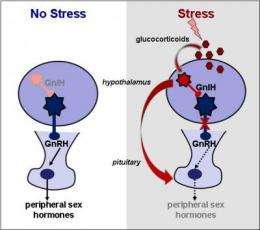
Scientists know that stress boosts levels of stress hormones - glucocorticoids such as cortisol - that inhibit the body's main sex hormone, gonadotropin releasing hormone (GnRH), and subsequently suppresses sperm count, ovulation and sexual activity.
The new research shows that stress also increases brain levels of a reproductive hormone named gonadotropin-inhibitory hormone, or GnIH, discovered nine years ago in birds and known to be present in humans and other mammals. This small protein hormone, a so-called RFamide-related peptide (RFRP), puts the brakes on reproduction by directly inhibiting GnRH.
The common thread appears to be the glucocorticoid stress hormones, which not only suppress GnRH but boost the suppressor GnIH - a double whammy for the reproductive system.
"We know stress affects the top-tier reproductive hormone, GnRH, but we show, in fact, that stress also affects another high-level hormone, GnIH, to cause reproductive dysfunction," said lead author Elizabeth Kirby, a graduate student at UC Berkeley's Helen Wills Neuroscience Institute. "This work provides a new target for researchers, a new way to think about infertility and dysfunction. The more we know, the more we can look for ways to treat it."
The results will be published the week of June 15 in the Online Early Edition of the journal Proceedings of the National Academy of Sciences (PNAS)
The conclusions are based on experiments in rats and inferences from the effects of the hormone in birds. But if this new reproductive hormone acts the same way in all mammals, researchers say the finding could not only change the way physicians look at human reproductive problems, but also affect how breeders approach animal husbandry and captive breeding programs for endangered species.
"There is a growing body of work that points to GnIH as being a big player in the inhibition of reproduction in mammals," said co-author George Bentley, UC Berkeley assistant professor of integrative biology. "We didn't have any hint of this stress effect nine years ago, when GnIH was first discovered."
In humans, chronic stress can lead to a drop in sex drive as well as a drop in fertility. Even the stress of infertility treatments can block their effectiveness, as evidenced by many anecdotes about couples conceiving children after the failure of assisted reproduction.
Animal breeding also is affected by stress. Zoos, in particular, have difficulty getting some animals to reproduce in captivity, Bentley said.
Based on animal experiments, researchers attribute much of this stress effect on sexual function to an increase in glucocorticoids - stress hormones - produced by the adrenal gland. In the brain, these glucocorticoids suppress the main reproductive hormone, GnRH, which in turn causes a shut-down of the release of the gonadotropins luteinizing hormone and follicle-stimulating hormone by the pituitary, and then a suppression of testosterone, estradiol and sexual behavior.
In 2000, however, a new reproductive hormone was discovered in birds and dubbed gonadotropin-inhibitory hormone (GnIH) because it had the opposite effect of GnRH - it inhibited release of gonadotropins, thereby suppressing reproduction.
"It's very adaptive to not be wasting resources on reproduction during times of acute stress, to just shut down reproduction for 24 hours or so until the stress is gone," said co-author Daniela Kaufer, a UC Berkeley assistant professor of integrative biology who looks at how stress affects molecular processes in the brain. "These functions go back in evolution a long way."
Because of the negative effects of GnIH on reproduction, Bentley, who helped establish the critical role played by GnIH in birds, teamed up with Kaufer and Kirby to explore whether stress might affect GnIH levels in the brain. The homologous hormones in mammals have been dubbed RFamide-related peptides, or RFRPs.
Kirby showed that acutely stressed rats showed increased RFRP levels for several hours, but that levels returned to normal by the next day. Chronically stressed rats, however, were left with longer-term elevations of RFRP levels in the dorsomedial hypothalamus area of the brain, and suppression of activity in the reproductive axis - the hypothalamus-pituitary-gonadal hormone cascade - that is associated with lowered sexual activity.
"With chronic stress, glucocorticoids went sky high," Kirby said.
To determine the role of glucocorticoids, Kirby removed the adrenal glands of male rats, eliminating the source of the hormone. Without adrenals, stress no longer affected RFRP levels in the brain. The researchers also showed that the cells that produce RFRP have receptors for glucocorticoids, a clear indication that these stress hormones can directly affect the cells that produce RFRP.
"Critically, we show that RFRP neurons express the receptors for glucocorticoids, which are released from the adrenal glands in response to stress, and that removal of the adrenal glands prevents the stress-induced, up-regulation of RFRP," Bentley said. "Thus, we believe we have identified an entirely novel pathway for stress-induced reproductive dysfunction."
Kirby noted that adrenal hormones are critical to survival, so removing the gland and thus glucocorticoids is not a solution to chronic stress.
However, Kaufer said, it may be possible to block GnIH to reduce some of the effects of stress on reproduction.
The researchers plan to confirm the results in female rats and investigate further the role of GnIH in reproduction.
Source: University of California - Berkeley (news : web)


