Scientists create hybrid system of human-machine interaction
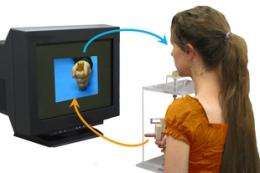
In a groundbreaking study, scientists at Florida Atlantic University have created a "hybrid" system to examine real-time interactions between humans and machines (virtual partners).
For more than 25 years, scientists in the Center for Complex Systems and Brain Sciences (CCSBS) in Florida Atlantic University’s Charles E. Schmidt College of Science, and others around the world, have been trying to decipher the laws of coordinated behavior called “coordination dynamics”.
Unlike the laws of motion of physical bodies, the equations of coordination dynamics describe how the coordination states of a system evolve over time, as observed through special quantities called collective variables. These collective variables typically span the interaction of organism and environment. Imagine a machine whose behavior is based on the very equations that are supposed to govern human coordination. Then imagine a human interacting with such a machine whereby the human can modify the behavior of the machine and the machine can modify the behavior of the human.
In a groundbreaking study published in PLoS One and titled “Virtual Partner Interaction (VPI): exploring novel behaviors via coordination dynamics,” an interdisciplinary group of scientists in the CCSBS created VPI, a hybrid system of a human interacting with a machine. These scientists placed the equations of human coordination dynamics into the machine and studied real-time interactions between the human and virtual partners. Their findings open up the possibility of exploring and understanding a wide variety of interactions between minds and machines. VPI may be the first step toward establishing a much friendlier union of man and machine, and perhaps even creating a different kind of machine altogether.
“With VPI, a human and a ‘virtual partner’ are reciprocally coupled in real-time,” said Dr. J. A. Scott Kelso, the Glenwood and Martha Creech Eminent Scholar in Science at FAU and the lead author of the study. “The human acquires information about his partner’s behavior through perception, and the virtual partner continuously detects the human’s behavior through the input of sensors. Our approach is analogous to the dynamic clamp used to study the dynamics of interactions between neurons, but now scaled up to the level of behaving humans.”
In this first ever study of VPI, machine and human behaviors were chosen to be quite simple. Both partners were tasked to coordinate finger movements with one another. The human executed the task with the intention of performing in-phase coordination with the machine, thereby trying to synchronize his/her flexion and extension movements with those of the virtual partner’s. The machine, on the other hand, executed the task with the competing goal of performing anti-phase coordination with the human, thereby trying to extend its finger when the human flexed and vice versa. Pitting machine against human through opposing task demands was a way the scientists chose to enhance the formation of emergent behavior, and also allowed them to examine each partner’s individual contribution to the coupled behavior. An intriguing outcome of the experiments was that human subjects ascribed intentions to the machine, reporting that it was “messing” with them.
“The symmetry between the human and the machine, and the fact that they carry the same laws of coordination dynamics, is a key to this novel scientific framework,” said co-author Dr. Gonzalo de Guzman, a physicist and research associate professor at the FAU center. “The design of the virtual partner mirrors the equations of motion of the human neurobehavioral system. The laws obtained from accumulated studies describe how the parts of the human body and brain self-organize, and address the issue of self-reference, a condition leading to complexity.”
One ready application of VPI is the study of the dynamics of complex brain processes such as those involved in social behavior. The extended parameter range opens up the possibility of systematically driving functional process of the brain (neuromarkers) to better understand their roles. The scientists in this study anticipate that just as many human skills are acquired by observing other human beings; human and machine will learn novel patterns of behavior by interacting with each other.
“Interactions with ever proliferating technological devices often place high skill demands on users who have little time to develop these skills,” said Kelso. “The opportunity presented through VPI is that equally useful and informative new behaviors may be uncovered despite the built-in asymmetry of the human-machine interaction.”
While stable and intermittent coordination behaviors emerged that had previously been observed in ordinary human social interactions, the scientists also discovered novel behaviors or strategies that have never previously been observed in human social behavior. The emergence of such novel behaviors demonstrates the scientific potential of the VPI human-machine framework. Modifying the dynamics of the virtual partner with the purpose of inducing a desired human behavior, such as learning a new skill or as a tool for therapy and rehabilitation, are among several applications of VPI.
“The integration of complexity in to the behavioral and neural sciences has just begun,” said Dr. Emmanuelle Tognoli, research assistant professor in FAU’s CCSBS and co-author of the study. “VPI is a move away from simple protocols in which systems are ‘poked’ by virtue of ‘stimuli’ to understanding more complex, reciprocally connected systems where meaningful interactions occur.”
Research for this study was supported by the National Science Foundation program “Human and Social Dynamics,” the National Institute of Mental Health’s “Innovations Award,” “Basic and Translational Research Opportunities in the Social Neuroscience of Mental Health,” and the Office of Naval Research Code 30. Kelso’s research is also supported by the Pierre de Fermat Chaire d’Excellence and Tognoli’s research is supported by the Davimos Family Endowment for Excellence in Science.
Source: Florida Atlantic University


