Same-sex behavior seen in nearly all animals
June 16, 2009 Same-sex behavior seen in nearly all animals, review finds

Enlarge

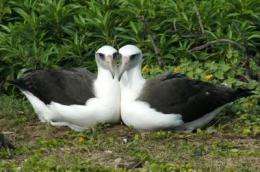
This photo shows a female-female pair of Laysan Albatross. Females cooperatively build nests and rear young when males are scarce. Credit: Eric VanderWerf.

Same-sex behavior is a nearly universal phenomenon in the animal kingdom, common across species, from worms to frogs to birds, concludes a new review of existing research.

"It's clear that same-sex sexual behavior extends far beyond the well-known examples that dominate both the scientific and popular literature: for example, bonobos, , and fruit flies," said Nathan Bailey, the first author of the review paper and a postdoctoral researcher in the Department of Biology at UC Riverside.

There is a caveat, however. The review also reports that same-sex behaviors are not the same across species, and that researchers may be calling qualitatively different phenomena by the same name.

"For example, male fruit flies may court other males because they are lacking a gene that enables them to discriminate between the sexes," Bailey said. "But that is very different from male bottlenose dolphins, who engage in same-sex interactions to facilitate group bonding, or female Laysan Albatross that can remain pair-bonded for life and cooperatively rear young."

Published June 16 in the journal Trends in Ecology & Evolution, the review by Bailey and Marlene Zuk, a professor of biology at UCR, also finds that although many studies are performed in the context of understanding the evolutionary origins of same-sex sexual behavior, almost none have considered its evolutionary consequences.

"Same-sex behaviors—courtship, mounting or parenting—are traits that may have been shaped by natural selection, a basic mechanism of evolution that occurs over successive generations," Bailey said. "But our review of studies also suggests that these same-sex behaviors might act as selective forces in and of themselves."

A selective force, which is a sudden or gradual stress placed on a population, affects the reproductive success of individuals in the population.

"When we think of selective forces, we tend to think of things like weather, temperature, or geographic features, but we can think of the social circumstances in a population of animals as a selective force, too," Bailey said. "Same-sex behavior radically changes those social circumstances, for example, by removing some individuals from the pool of animals available for mating."

Bailey, who works in Zuk's lab, noted that researchers in the field have made significant strides in the past two and a half decades studying the genetic and neural mechanisms that produce same-sex behaviors in individuals, and the ultimate reasons for their existence in populations.

"But like any other behavior that doesn't lead directly to reproduction—such as aggression or altruism—same-sex behavior can have evolutionary consequences that are just now beginning to be considered," he said. "For example, male-male copulations in locusts can be costly for the mounted male, and this cost may in turn increase selection pressure for males' tendency to release a chemical called panacetylnitrile, which dissuades other males from mounting them."

The review paper:

  • Examines work done to test hypotheses about the origins of same-sex behavior in animals.
  • Provides a framework for categorizing same-sex behavior, for example, is it adaptive, not adaptive, occurs often, infrequently?
  • Discusses what has been discovered about the genetics of same-sex behavior, especially in the model organism, the fruit fly Drosophila, and in human beings.
  • Examines connections between human sexual orientation research, and research on non-human animals, and highlights promising avenues of research in non-human systems.

The reviewers expected the research papers they read for their article would give them a better understanding of the degree to which same-sex behaviors are heritable in animals.

"How important are genes to the expression of these behaviors, compared to environmental factors?" Bailey said. "This is still unknown. Knowing this information would help us better understand how the behaviors evolve, and how they affect the evolution of other traits. It could also help us understand whether they are something that all individuals of a species are capable of, but only some actually express."

Bailey recommends that fellow evolutionary biologists studying same-sex behavior in animals adopt some of the research approaches that have been successful in human studies.

"We have estimates, for example, of the heritability of sexual orientation in humans, but none that I know of in other animals," he said. "Scientists have also targeted locations on the human genome that may contribute to , but aside from the fruit fly, we have no such detailed knowledge of the genetic architecture of same-sex behavior in other animals."

Next in their research, Bailey and Zuk plan to begin experimentally addressing some of the many issues raised in their review.

Said Bailey, "We want to get at this question: what are the evolutionary consequences of these behaviors? Are they important in the evolution of mating behavior, or do they just add extra 'background noise'? We are pursuing work on the Laysan Albatross, in which females form same-sex pairs and rear young together. Same-sex behavior in this species may not be aberrant, but instead can arise as an alternative reproductive strategy."

Source: University of California - Riverside (news : web)


print this article email this article download pdf blog this article bookmark this article     Stumble it Digg this share on Facebook retweet share on Reddit add to delicious
Rate this story - 4.2 /5 (21 votes)

Rank Filter

Move the slider to adjust rank threshold, so that you can hide some of the comments.


Display comments: newest first

  • frogz - Jun 16, 2009
    • Rank: 1.4 / 5 (9)
    Same sex behavior occurs when either there is a missing or defective gene or under environmental stress. The repetitive use of loose terminology to describe such conditions degrades this article to a status of a hit piece.
  • x646d63 - Jun 16, 2009
    • Rank: 4.3 / 5 (6)
    Same sex behavior occurs when either there is a missing or defective gene or under environmental stress. The repetitive use of loose terminology to describe such conditions degrades this article to a status of a hit piece.


    Where is your research?
  • forsaken - Jun 17, 2009
    • Rank: not rated yet
    frogz comment smells homophobia, any sources?
  • croghan27 - Jun 17, 2009
    • Rank: 5 / 5 (1)
    I may be misreadin the article but to me it says there has been no research into the cause of same-sex behaviours, just into the actions themselves in various species and their evolutionary effect.

    Even if it is caused by a 'defective' gene it appears that possibility has been taken into account by evolution and the behaviour is a fact - not an aberation.

    It is there.
    It is there in many (if not all) species. Live with it.
  • freethinking - Jun 17, 2009
    • Rank: 1 / 5 (1)
    But in humans we see same sex behaviour that has nothing to do with sex. IE. brothers living together, friends living together (stickly platonic). So when we see two animals staying together why do we assume they are gay?

    As for animals attempting to mate the same sex, they are animals with an urge to mate and they will mate with anything they can. Dogs going after a leg. On farms, bulls mounting fake cows.

    So it does make sence that same sex behaviour occurs when an animal is under environmental stress. It has the urge to mate and will mate with anything.

    With humans, same sex attractions and homosexuality is shown to increase when there is a father absent or abusive. It increases amoung children raised in same sex households.

    http://www.family...xual.htm
  • mjar - Jun 17, 2009
    • Rank: 3 / 5 (2)
    freethinking... the source you link to isn't supported by any reputable studies and is nothing more than homophobic dribble, everyone is entitled to their own opinion but not their own facts.
  • Lazlor - Jun 17, 2009
    • Rank: 1 / 5 (1)
    Examine dolphins and bonobos and you'll see plenty of homosexual acts. The homosexual acts are not mindless humping like dogs that can't control themselves, they do this to resolve social conflicts and also just for fun.

    This is besides the point since humans, being the self aware animals that they are, are always doing "unnatural" things.

    And 'Freethinking', familyaction.org is an organization that pushes their government to control who gets married to whom. Besides what your opinion may be should the government really have this power?

June 16, 2009 all stories

Comments: 7

4.2 /5 (21 votes)
  • Stumble this up

  • Digg this

  • share this

  • hide
  • Related Stories

  • Study: Social influence on teen sex global
    created Nov 03, 2006 | popularity not rated yet | comments 0
  • Researcher finds Laysan albatross employs 'dual mommies'
    created May 28, 2008 | popularity not rated yet | comments 0
  • Teenagers attending college less likely to engage in risky sexual behavior
    created Jun 05, 2008 | popularity not rated yet | comments 0
  • Remembrance of Things Past Influences How Female Field Crickets Select Mates
    created Apr 22, 2009 | popularity not rated yet | comments 0
  • Mating that causes injuries
    created Feb 20, 2009 | popularity not rated yet | comments 0


  • hide
  • Relevant PhysicsForums posts

Other News

Prized mushroom collection returns to China

Biology / Plants & Animals

created 14 hours ago | popularity 5 / 5 (1) | comments 0

(AP) -- A Chinese scholar persecuted during the Cultural Revolution for smuggling a rare collection of mushrooms out of China before World War II was honored Saturday when the collection was returned more than 70 years later.


Sea lions killed, but Columbia salmon toll rises (AP)

Sea lions killed, but Columbia salmon toll rises

Biology / Ecology

created 14 hours ago | popularity not rated yet | comments 1

(AP) -- Killing or removing 25 California sea lions over the past two years has not reduced the toll on salmon at the base of Bonneville Dam in the Columbia River.


Laser etching safe alternative for labeling grapefruit

Laser etching safe alternative for labeling grapefruit

Biology / Other

created Nov 03, 2009 | popularity 4.3 / 5 (13) | comments 8

Laser labeling of fruit and vegetables is a new, patented technology in which a low-energy carbon dioxide laser beam is used to label, or "etch" information on produce, thereby eliminating the need for common ...


Wolves, moose and biodiversity: An unexpected connection

Wolves, moose and biodiversity: An unexpected connection

Biology / Ecology

created Nov 02, 2009 | popularity 4.8 / 5 (6) | comments 4

Moose eat plants; wolves kill moose. What difference does this classic predator-prey interaction make to biodiversity?


Caught in the act: Butterfly mate preference shows how 1 species can become 2

Caught in the act: Scientists find butterflies splitting into two species

Biology / Plants & Animals

created Nov 05, 2009 | popularity 4.5 / 5 (8) | comments 2

(PhysOrg.com) -- Breaking up may actually not be hard to do, say scientists who've found a population of tropical butterflies that may be on its way to a split into two distinct species.