Beating the radar: Getting a jump on storm prediction
June 16, 2009
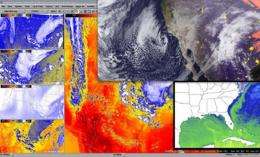
Sample meteorological satellite images like those analyzed during this year’s annual Hazardous Weather Testbed, held from May 4 through June 5. The HWT is organized by the National Oceanic and Atmospheric Administration to accelerate the transition of new meteorological technologies into advance forecasting and warnings for hazardous weather events throughout the U.S. UW-Madison Space Science and Engineering Center.
Satellite observation of cloud temperatures may be able to accurately predict severe thunderstorms up to 45 minutes earlier than relying on traditional radar alone, say researchers at UW-Madison's Space Science and Engineering Center.
Scientists from the Cooperative Institute for Meteorological Satellite Studies (CIMSS) have developed a way to measure temperature changes in the tops of clouds to improve forecast times for rapidly growing storms.
"The value of detecting and analyzing these changes is that we can get up to a 45-minute jump on radar detection of the same storm system. A 'nowcast' becomes a 'forecast,'" says CIMSS scientist Wayne Feltz.
Clouds start cooling long before radar can identify them as storms. As a warm cumulus cloud grows and expands upward into higher altitudes, it will rapidly cool. Rapid cloud-top cooling indicates that a cloud top is rising into the frigid upper reaches of the atmosphere and can reveal the formation of a severe storm.
Cloud temperatures can be measured by the wavelengths of light they radiate in the near-infrared and infrared frequencies. Current geostationary satellites — satellites that stay over the same location on Earth — over the U.S. can discern five different bands in these frequencies, each band revealing a different state of cloud development. Looking down from space, the satellite can determine whether the cloud top consists of liquid water, supercooled water or even ice.
By running high-speed five-minute satellite scans through a carefully designed computer algorithm, the scientists can quickly analyze cloud top temperature changes to look for signs of storm formation. "We are looking for transitions," says Feltz. "Does the cloud top consist of liquid water that is cooling rapidly? That could signal a possible convective initiation."
Feltz and other CIMSS colleagues, including Kris Bedka and National Oceanic and Atmospheric Administration (NOAA) scientist Tim Schmit, demonstrated their "Convective Initiation Nowcast" and "Cloud Top Cooling Rate" products at NOAA's annual Hazardous Weather Testbed (HWT), held May 4-June 5 at the Storm Prediction Center in Norman, Okla.
The HWT is designed to accelerate the transition of promising new meteorological insights and technologies into advance forecasting and warnings for hazardous weather events throughout the United States.
"The Hazardous Weather Testbed brings in outside experts in all areas, a melting pot of people to encourage collaboration and interactions and proposal opportunities," Feltz says. "The point of this is working with forecasters in the field — the Weather Service, the Storm Prediction Center, the Hurricane Center — whoever is interested in looking at more advanced satellite products."
Source: University of Wisconsin
-
Satellite view of cloud tops might warn of storms brewing
Jul 08, 2008 |
not rated yet |
0
-
African dust forecast may help hurricane season predictions
May 20, 2008 |
not rated yet |
0
-
Fay Comes Ashore in Florida
Aug 19, 2008 |
not rated yet |
0
-
NASA Data May Help Improve Estimates of a Hurricane's Punch
Nov 01, 2007 |
not rated yet |
0
-
Scientists seek clear-sky definition of clouds
Dec 06, 2005 |
not rated yet |
0
-
Fast photon control brings quantum photonic technologies closer
1 hour ago |
5 / 5 (2) |
0
-
Engineers build first sub-10-nm carbon nanotube transistor
Feb 01, 2012 |
4.9 / 5 (33) |
30
-
Something old, something new: Evolution and the structural divergence of duplicate genes
Jan 31, 2012 |
4.6 / 5 (7) |
1
-
The hidden nanoworld of ice crystals: Revealing the dynamic behavior of quasi-liquid layers
Jan 30, 2012 |
5 / 5 (5) |
1
-
Stock market network reveals investor clustering
Jan 27, 2012 |
3.9 / 5 (23) |
8
-
Do some geologists actually act a lot like Randy Marsh?
Feb 11, 2012
-
Discrepancy between oxygen and carbon-dioxide levels
Feb 09, 2012
-
where gems are found in the world
Feb 09, 2012
-
Wind Waves in Reservoir ~ Wind run-up and Wind set-up
Feb 08, 2012
-
Balance of oxygen in the atmosphere
Feb 01, 2012
-
The case for a methanol-based economy
Jan 30, 2012
- More from Physics Forums - Earth
More news stories
Planck mission steps closer to the cosmic blueprint
(PhysOrg.com) -- ESA's Planck mission has revealed that our Galaxy contains previously undiscovered islands of cold gas and a mysterious haze of microwaves. These results give scientists new treasure to mine ...
32 minutes ago |
5 / 5 (1) |
0
|
New European rocket lifts off on maiden flight
Europe on Monday successfully launched a new lightweight rocket carrying a test payload, culminating a more than 12-year quest to master the entire range of space launchers.
Space & Earth / Space Exploration
4 hours ago |
5 / 5 (5) |
2
Transforming galaxies
(PhysOrg.com) -- Many of the Universe's galaxies are like our own, displaying beautiful spiral arms wrapping around a bright nucleus. Examples in this stunning image, taken with the Wide Field Camera 3 on ...
1 hour ago |
5 / 5 (1) |
0
|
Alien matter in the solar system: A galactic mismatch
This just in: The Solar System is different from the space just outside it.
Space & Earth / Space Exploration
2 hours ago |
4 / 5 (5) |
7
|
Scientists drill two miles down to ancient Lake Vostok
(PhysOrg.com) -- Russian scientists last week finished penetrating more than two miles through the Antarctic ice sheet to Lake Vostok, a huge freshwater lake that has been buried under the ice for millions ...
Space & Earth / Earth Sciences
1 hour ago |
4.5 / 5 (2) |
0
Fast photon control brings quantum photonic technologies closer
(PhysOrg.com) -- Using photons instead of electrons to transmit information could lead to faster and more secure ways to communicate, among other advantages. Now a team of physicists has taken another step toward realizing ...
New ability to regrow blood vessels holds promise for treatment of heart disease
(Medical Xpress) -- University of Texas at Austin researchers have demonstrated a new and more effective method for regrowing blood vessels in the heart and limbs a research advancement that could have ...
Myths and shame keep many from seeking bankruptcy protection
(PhysOrg.com) -- Two interesting facts that may counter modern ideas about bankruptcy: The overwhelming majority of U.S. filings belong to individuals rather than corporations or entities, and most of these ...
Big Society could threaten biodiversity conservation
A study of the Moray Firth Seal Management Plan (MFSMP), in north-east Scotland, identified four key conditions for long-term success, three of which pointed to the importance of direct government involvement.
Motivation to exercise affects behavior
(Medical Xpress) -- For many people, the motivation to exercise fluctuates from week to week, and these fluctuations predict whether they will be physically active, according to researchers at Penn State. In an effort to ...
'It's not nutritious until it's eaten'
As part of her "Let's Move! Initiative," First Lady Michelle Obama unveiled a new web resource highlighting new changes in the Chefs Move to Schools, during a CMST gathering in Dallas, TX today. CMTS advocates ...