Shuttle launch delayed to July by hydrogen leak
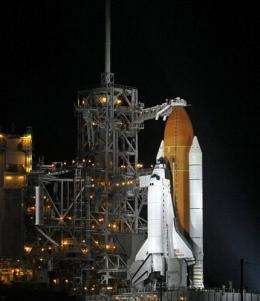
(AP) -- For the second time in less than a week, a potentially dangerous hydrogen gas leak early Wednesday forced NASA to delay shuttle Endeavour's launch to the international space station, this time until July at the earliest.
Launch officials waited almost an hour after the leak appeared during fueling, trying to fix it through remote commands, before calling off the predawn launch.
The leak occurred in the same place as one that cropped up Saturday, in the hydrogen gas vent line that hooks up to the external fuel tank. A similar problem stalled a shuttle flight three months ago.
"We're going to step back and figure out what the problem is and go fix it," said deputy space shuttle program manager LeRoy Cain. "And then we'll fly as soon as we're ready to safely go do that."
Mission managers had ordered repairs following Saturday's delay. The hookup itself and two seals were replaced. The same repair worked back in March, but engineers never found the cause of the problem.
Launch officials said they were proud of the way the team hustled over the past four days trying to get Endeavour to the space station, with a new outdoor addition for the Japanese lab.
"I sure wish we could have rewarded them and the astronauts and everybody else with a launch this morning," said Mike Leinbach, who was serving as assistant launch director for this mission. "But the leak was way out of spec again, and so we were just not comfortable pressing on."
Even before hydrogen gas began leaking - a serious situation because of its flammability - NASA was up against a tight deadline for making the 5:40 a.m. launch. Fueling was delayed three hours by thunderstorms Tuesday night, and the launch team was racing against the clock to catch up.
The seven astronauts were still in crew quarters when the leak was detected. It was a keen disappointment considering that they had just gotten a chance, with the start of fueling, at making the launch.
"I'm sure you all know that we postponed again," commander Mark Polansky wrote in a Twitter update. "It's a reminder that spaceflight is NOT routine. We will fly home to Houston this morning."
Noted Cain: "This business that we're in is not for the faint of heart."
NASA bumped an unmanned moon shot - its first in a decade - to give Endeavour this second chance of flying before a thermal blackout period kicks in.
That moon mission, featuring two science probes, is now scheduled for a Thursday or Friday launch. After Saturday, unfavorable sun angles prevent Endeavour from taking off before July 11.
Cain said it was too soon to know whether NASA would be able to make a July 11 launch.
The baffling leak - which has struck two of the past three shuttle flights - is about the size of the point of a ball point pen. Something has changed in the techniques or materials for the parts, and an engineering investigation hopefully will find out once and for all, Cain said.
The latest leak occurred a little earlier in the fueling and had different characteristics.
Endeavour was set to deliver the third and last segment of Japan's massive space station lab along with hundreds of pounds of food for the six space station occupants. A new space station resident also was supposed to go up and swap places with a Japanese astronaut who's been up there since March.
The space station crew doubled in size late last month.
When Endeavour finally flies, it will be one of the longer international space station visits - nearly two weeks docked at the orbiting outpost - and include five spacewalks.
Once the shuttle pulls up at the space station, there will be 13 people together in space for the first time ever.
Delaying until July is expected to push back the next few shuttle flights.
NASA is up against a 2010 deadline for carrying out its final eight shuttle flights, all of them trips to the space station. The White House wants the three remaining shuttles retired and the space station completed by the end of next year.
The two launch scrubs cost NASA at least $1 million, primarily in fuel costs.
They could not have come at a worse time. An independent committee that will review the space agency's plans to build a successor to the shuttle and return astronauts to the moon by 2020 holds its first public meeting Wednesday in Washington.
---
On the Net:
NASA: http://spaceflight.nasa.gov
©2009 The Associated Press. All rights reserved. This material may not be published, broadcast, rewritten or redistributed.


