Sands of Gobi Desert yield new species of nut-cracking dinosaur
June 17, 2009 Sands of Gobi Desert yield new species of nut-cracking dinosaur

Enlarge

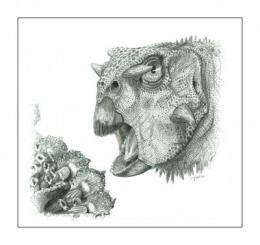
Artistic rendering of a newly discovered species of parrot-beaked dinosaur, Psittacosaurus gobiensis. Scientists first discovered psittacosaurs in the Gobi Desert in 1922, calling them "parrot-beaked" for their resemblance to parrots. Psittacosaurs evolved their strong-jawed, nut-eating habits 60 million years before the earliest parrot. Credit: Todd Marshall

Plants or meat: That's about all that fossils ever tell paleontologists about a dinosaur's diet. But the skull characteristics of a new species of parrot-beaked dinosaur and its associated gizzard stones indicate that the animal fed on nuts and/or seeds. These characteristics present the first solid evidence of nut-eating in any dinosaur.

"The parallels in the skull to that in parrots, the descendants of dinosaurs most famous for their nut-cracking habits, is remarkable," said Paul Sereno, a paleontologist at the University of Chicago and National Geographic Explorer-in-Residence. Sereno and two colleagues from the People's Republic of China announce their discovery June 17 in the Proceedings of the Royal Society B.
Sands of Gobi Desert yield new species of nut-cracking dinosaur
Enlarge

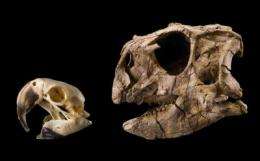
Skull of the parrot-beaked dinosaur, Psittacosaurus gobiensis, next to that of a living macaw. Credit: Mike Hettwer

The paleontologists discovered the new dinosaur, which they've named Psittacosaurus gobiensis, in the of Inner Mongolia in 2001, and spent years preparing and studying the specimen. The dinosaur is approximately 110 million years old, dating to the mid-Cretaceous Period.

The quantity and size of gizzard stones in birds correlates with dietary preference. Larger, more numerous gizzard stones point to a diet of harder food, such as nuts and seeds. "The psittacosaur at hand has a huge pile of stomach stones, more than 50, to grind away at whatever it eats, and this is totally out of proportion to its three-foot body length," Sereno explained.

Technically speaking, the dinosaur is also important because it displays a whole new way of chewing, which Sereno and co-authors have dubbed "inclined-angle" chewing. "The jaws are drawn backward and upward instead of just closing or moving fore and aft," Sereno said. "It remains to be seen whether some other plant-eating dinosaurs or other reptiles had the same mechanism."

The unusual chewing style has solved a major mystery regarding the wear patterns on psittacosaur teeth. Psittacosaurs sported rigid skulls, but their teeth show the same sliding wear patterns as plant-eating with flexible skulls.

Source: University of Chicago (news : web)


print this article email this article download pdf blog this article bookmark this article     Stumble it Digg this share on Facebook retweet share on Reddit add to delicious
Rate this story - 4.3 /5 (4 votes)


June 17, 2009 all stories

Comments: 0

4.3 /5 (4 votes)
  • Stumble this up

  • Digg this

  • share this

  • hide
  • Related Stories

  • Dinosaur from Sahara ate like a 'Mesozoic cow'
    created Nov 15, 2007 | popularity not rated yet | comments 0
  • New meat-eating dinosaur duo from Sahara ate like hyenas, sharks
    created Feb 14, 2008 | popularity not rated yet | comments 0
  • Meat-eating dinosaur from Argentina had bird-like breathing system
    created Sep 29, 2008 | popularity not rated yet | comments 0
  • Unusual fish-eating dinosaur had crocodile-like skull
    created Jan 14, 2008 | popularity not rated yet | comments 0
  • Student identifies enormous new dinosaur
    created Dec 12, 2007 | popularity not rated yet | comments 0


  • hide
  • Relevant PhysicsForums posts

  • Meaning of term Sustainable Harvest
    created 1hour ago
  • Echolocation
    created Nov 06, 2009
  • DNA getting smaller everytime it replicates??
    created Nov 05, 2009
  • Question about Genetic Engineering in general
    created Nov 04, 2009
  • More from Physics Forums - Biology

Other News

70 million-year-old dinosaur footprints have been found in various locations in New Zealand

Dinosaur prints found on NZealand's South Island

Other Sciences / Archaeology & Fossils

created 19 hours ago | popularity 4 / 5 (2) | comments 0

Scientists have discovered the first evidence that dinosaurs roamed the South Island of New Zealand with 70-million-year-old footprints found in six locations.


Growth in secular attitudes leaves Americans room for belief in God

Other Sciences / Social Sciences

created Oct 31, 2009 | popularity 4 / 5 (5) | comments 110

(PhysOrg.com) -- The nature of the American religious experience is changing as a rising number of people report having no formal religious affiliation, even though the number of Americans who say they pray is increasing, ...


Forest clearances sealed ancient civilisation's downfall

Forest clearances sealed ancient civilisation's downfall

Other Sciences / Archaeology & Fossils

created Nov 02, 2009 | popularity 4.9 / 5 (8) | comments 5

(PhysOrg.com) -- An ancient South American civilisation which disappeared around 1,500 years ago helped to cause its own demise by damaging the fragile ecosystem that held it in place, a study has found. ...


Oscar Pistorius

New study further disputes notion that amputee runners gain advantage from protheses

Other Sciences / Other

created Nov 04, 2009 | popularity 5 / 5 (4) | comments 5

A study by six researchers, including a University of Colorado at Boulder associate professor and his former doctoral student, shows that amputees who use running-specific prosthetic legs have no performance ...


New theory on fairness in economics targets CEO pay

Other Sciences / Economics

created Nov 03, 2009 | popularity 4.3 / 5 (11) | comments 2

(PhysOrg.com) -- Chief executives in 35 of the top Fortune 500 companies were overpaid by about 129 times their "ideal salaries" in 2008, according to a new type of theoretical analysis proposed by a Purdue University researcher ...