Shape matters in the case of cobalt nanoparticles
June 17, 2009 Shape matters in the case of cobalt nanoparticles

Enlarge

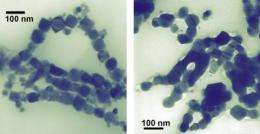
These cubes of cobalt (left/top), measuring about 50 nanometers wide, are showing scientists that, on the nanoscale, a change in shape is a change in property. Unlike smaller spherical cobalt nanoparticles, nanocubes melt and fuse (right/bottom) when illuminated by a transmission electron microscope and possess different magnetic characteristics than the nanospheres as well. Credit: NIST

Shape is turning out to be a particularly important feature of some commercially important nanoparticles—but in subtle ways. New studies* by scientists at the National Institute for Standards and Technology (NIST) show that changing the shape of cobalt nanoparticles from spherical to cubic can fundamentally change their behavior.

Building on a previous paper** that examined the properties of cobalt formed into spheres just a few nanometers in diameter, the new work explores what happens when the cobalt is synthesized instead as nanocubes. Nanoparticles of possess large magnetic moments—a measure of magnetic strength—and unique catalytic properties, and have potential applications in information storage, energy and medicine.

One striking difference is the behavior of the two different particle types when external magnetic fields are applied and then removed. In the absence of a magnetic field, both the spherical and cubic nanoparticles spontaneously form chains—lining up as a string of microscopic magnets. Then, when placed in an external magnetic field, the individual chains bundle together in parallel lines to form thick columns aligned with the field. These induced columns, says NIST physicist Angela Hight Walker, imply that the external magnetic fields have a strong impact on the magnetic behavior of both nanoparticle shapes.

But their group interactions are somewhat different. As the strength of the external field is gradually reduced to zero, the magnetization of the spherical nanoparticles in the columns also decreases gradually. On the other hand, the magnetization of the cubic particles in the columns decreases in a much slower fashion until the particles rearrange their magnetic moments from linear chains into small circular groups, resulting in a sudden drop in their magnetization.

The team also showed that the cubes can be altered merely by observing with one of nanotechnology’s microscopes of choice. After a few minutes’ exposure to the illuminating beam of a transmission electron microscope, the nanocubes melt together, forming “nanowires” that are no longer separable as individual nanoparticles. The effect, not observed with the spheres, is surprising because the cubes average 50 nm across, much larger than the spheres’ 10 nm diameters. “You might expect the smaller objects to have a lower melting point,” Hight Walker says. “However, the sharp edges and corners in the nanocubes could be the locations to initiate melting.”

While Walker says that the melting effect could be a potential method for fabricating nanostructures, it also demands further attention. “This newfound effect demonstrates the need to characterize the physico-chemical properties of extremely well in order to pursue their applications in biology and medicine,” she says.

Source: National Institute of Standards and Technology (NIST)


print this article email this article download pdf blog this article bookmark this article     Stumble it Digg this share on Facebook retweet share on Reddit add to delicious    
Rate this story - not rated yet


June 17, 2009 all stories

Comments: 0

not rated yet
  • Stumble this up

  • Digg this

  • share this

  • hide
  • Related Stories

  • Magnetic nanoparticles assembled into long chains
    created Oct 20, 2005 | popularity not rated yet | comments 0
  • Nanocaps help scientists control magnetism reversal
    created Mar 03, 2006 | popularity not rated yet | comments 0
  • Creating Highly Sought Magnetic Nanoparticles in One Step
    created May 02, 2008 | popularity not rated yet | comments 0
  • New Nanoparticle Structure Boosts Magnetic Properties
    created Dec 19, 2005 | popularity not rated yet | comments 0
  • Mass-Producing Tunable Magnetic Nanoparticles
    created May 21, 2008 | popularity not rated yet | comments 0


  • hide
  • Relevant PhysicsForums posts

  • Fatigue Properties of Chinese steel
    created Nov 04, 2009
  • Finding Hardness values
    created Nov 04, 2009
  • Fluid flow, pressure drop simulation in Comsol
    created Nov 04, 2009
  • units of vickers,brinell and rockwell . . .
    created Nov 04, 2009
  • More from Physics Forums - Materials & Chemical Engineering

Other News

New Digital 'Electronics' Concept May Continue Moore's Law

New Digital 'Electronics' Concept May Continue Moore's Law

Nanotechnology / Nanophysics

created Nov 05, 2009 | popularity 4.6 / 5 (50) | comments 8

(PhysOrg.com) -- Computers of the future could be operating not on electrons, but on tiny waves traveling through an electron "fluid," if a new proposal is successful. The new circuit design, recently introduced ...


Nanoparticles for gene therapy improve

Nanoparticles for gene therapy improve

Nanotechnology / Bio & Medicine

created Nov 06, 2009 | popularity 5 / 5 (4) | comments 3

(PhysOrg.com) -- About five years ago, Professor Janet Sawicki at the Lankenau Institute in Pennsylvania read an article about nanoparticles developed by MIT's Robert Langer for gene therapy, the insertion ...


Breakthrough in industrial-scale nanotube processing

Breakthrough in industrial-scale nanotube processing

Nanotechnology / Nanomaterials

created Nov 02, 2009 | popularity 4.9 / 5 (20) | comments 3

(PhysOrg.com) -- Rice University scientists today unveiled a method for the industrial-scale processing of pure carbon-nanotube fibers that could lead to revolutionary advances in materials science, power ...


Scientists witness nature's complexity unfold in self-assembling quasicrystals

Scientists witness nature's complexity unfold in self-assembling quasicrystals

Nanotechnology / Nanomaterials

created Oct 31, 2009 | popularity 4.9 / 5 (16) | comments 3

(PhysOrg.com) -- Just a few decades ago, scientists believed that all ordered matter consists of self-repeating building blocks -- atoms, ions or molecules. In this view, the ordinary solids of everyday life ...


Nanoparticles may cause DNA damage across a cellular barrier

Nanoparticles may cause DNA damage across a cellular barrier

Nanotechnology / Bio & Medicine

created Nov 05, 2009 | popularity 4.3 / 5 (9) | comments 1

(PhysOrg.com) -- Scientists have shown in the laboratory that metal nanoparticles damaged the DNA in cells on the other side of a cellular barrier. The research, by the University of Bristol, is published ...