NIST finds 'a touch of glass' in metal, settles century-old question
June 17, 2009
NIST finds 'a touch of glass' in metal, settles century-old question

Enlarge

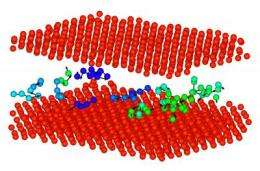
Between a polycrystalline material's grains (saffron layers) exist disorderly areas called grain boundaries, the behavior of which has been difficult to understand. The green and blue objects in the boundary are string-like collections of atoms that NIST scientists have recently shown behave like glass-forming liquids, a similarity that should help scientists analyze a wide range of materials. Credit: NIST

Better predictions of how many valuable materials behave under stress could be on the way from the National Institute of Standards and Technology (NIST), where scientists have recently found evidence of an important similarity between the behavior of polycrystalline materials—such as metals and ceramics—and glasses.

Most metals and ceramics used in manufacturing are polycrystals. The steel in a bridge girder is formed from innumerable tiny metal crystals that grew together in a patchwork as the molten steel cooled and solidified. Each crystal, or “grain,” is highly ordered on the inside, but in the thin boundaries it shares with the grains around it, the molecules are quite disorderly. Because grain boundaries profoundly affect the mechanical and of polycrystalline materials, engineers would like a better understanding of grain boundaries’ formation and behavior. Unfortunately, grain boundary formation in most technically useful alloys has eluded efforts to observe it for a century.

“You’d like to have simple engineering rules regarding how a material’s going to break,” says NIST materials scientist Jack Douglas. “For example, corrosion typically travels along grain boundaries, so polycrystals usually fracture along them. But metals melt and deform at very , so observing them under those conditions is a challenge.”

While some scientists had speculated that the molecules in grain boundaries behave similarly to the way molecules do in glass-forming liquids, whose properties are well understood, none had found conclusive evidence to back up such a claim. That started to change when NIST theorist James Warren saw a conference presentation by the University of Alberta’s Hao Zhang concerning some odd “strings” of atoms in his simulation of grain boundary motion using a simulation technique called molecular dynamics. The collective atomic behavior observed in grain boundaries reminded the team of prior findings made at NIST about glass-forming liquids, whose atoms also form strings.

Subsequently, the team showed that the strings of atoms arising in grain boundaries are strikingly similar in form, distribution and temperature dependence to the string-like collective atomic motions generally found in glass-forming liquids—and that properties for both types of substances change with temperature in virtually the same way. “This work represents a paradigm shift in our understanding of grain boundaries,” Douglas says. “All the important qualities relating to atomic motion in both of these types of materials—the development of these string-like atomic motions, or the amplitude at which their atoms rattle—are strikingly similar. For all intents and purposes, grain boundaries are a type of glass.”

Douglas says the findings could permit substantial progress in predicting the failure of many materials important in construction and manufacturing and could improve our understanding of how crystals form boundaries with one another.

Citation: H. Zhang, D.J. Srolovitz, J.F. Douglas and J.A. Warren. exhibit the dynamics of glass-forming liquids. Proceedings of the National Academy of Sciences. Vol.106, No. 10 (2009).

Source: National Institute of Standards and Technology (NIST)

3.8 /5 (5 votes)  

Filter


Move the slider to adjust rank threshold, so that you can hide some of the comments.


Display comments: newest first

jselin
Jun 17, 2009

Rank: 5 / 5 (1)
I was under the impression this was already known, although maybe not conclusively. TEM images of grain boundaries show the disorder very plainly (in the cases were the boundary has a width > 0) It should be noted that there are many cases where grain boundaries are absolutely known to be very ordered over a wide range of alignment angles.
Rank 3.8 /5 (5 votes)
Related Stories
Relevant PhysicsForums posts
  • Doubts about surface plasmons
    createdFeb 11, 2012
  • excited U-236 decay time in the U235 fission chain
    createdFeb 09, 2012
  • Polar catastrophe?
    createdFeb 09, 2012
  • Large scale field sonication
    createdFeb 09, 2012
  • states and energy of paired electrons in BCS
    createdFeb 08, 2012
  • difference between longitudinal and transverse refractive indices
    createdFeb 08, 2012
  • More from Physics Forums - Atomic, Solid State, Comp. Physics

More news stories

Explained: Sigma

It's a question that arises with virtually every major new finding in science or medicine: What makes a result reliable enough to be taken seriously? The answer has to do with statistical significance -- but ...

Physics / General Physics

created Feb 09, 2012 | popularity 5 / 5 (20) | comments 76

Quantum physicist explains $100K offer for proof scaled-up quantum computing is impossible

(PhysOrg.com) -- MIT researcher Scott Aaronson has certainly riled the physics community with his offer this past Friday, of $100,000 to anyone who can prove that scaled-up quantum computing is impossible. ...

Physics / Quantum Physics

created Feb 08, 2012 | popularity 4.3 / 5 (14) | comments 36 | with audio podcast weblog

Diamond light, brighter than the sun

It’s the size of five football pitches and generates light 10 billion times brighter than the sun. As the Diamond Light Source celebrates its tenth anniversary this year, Penny Bailey visits one of the ...

Physics / General Physics

created Feb 07, 2012 | popularity 4.4 / 5 (9) | comments 18 | with audio podcast

Physicists 'record' magnetic breakthrough

An international team of scientists has demonstrated a revolutionary new way of magnetic recording which will allow information to be processed hundreds of times faster than by current hard drive technology.

Physics / General Physics

created Feb 07, 2012 | popularity 4.6 / 5 (43) | comments 14 | with audio podcast

Hints of the Higgs - papers are submitted

Back in December 2011, the ATLAS and CMS experiments at CERN presented some exciting results that provided tantalising hints of the Higgs boson.

Physics / General Physics

created Feb 08, 2012 | popularity 4.3 / 5 (8) | comments 10


Scientists discover molecular secrets of 2,000-year-old Chinese herbal remedy

For roughly two thousand years, Chinese herbalists have treated Malaria using a root extract, commonly known as Chang Shan, from a type of hydrangea that grows in Tibet and Nepal. More recent studies suggest that halofuginone, ...

New method to examine batteries -- MRI from the inside

There is an ever-increasing need for advanced batteries for portable electronics, such as phones, cameras, and music players, but also to power electric vehicles and to facilitate the distribution and storage of energy derived ...

Lab study raises questions over nano-particle impact

Tests involving chickens have raised questions about the impact on health from engineered nano-particles, the ultra-fine grains commonly used in drugs and processed foods, scientists said on Sunday.

Google might launch Drive for cloud storage soon

(PhysOrg.com) -- Google's next big move, according to the Wall Street Journal, is a cloud storage service called Drive. Hardly first to the plate, Google is simply catching up to introducing its cloud reposi ...

A mitosis mystery solved: How chromosomes align perfectly in a dividing cell

Although the process of mitotic cell division has been studied intensely for more than 50 years, Whitehead Institute researchers have only now solved the mystery of how cells correctly align their chromosomes during symmetric ...

Starve a virus, feed a cure? Findings show how some cells protect themselves against HIV

A protein that protects some of our immune cells from the most common and virulent form of HIV works by starving the virus of the molecular building blocks that it needs to replicate, according to research published online ...