Structures from the human immune system's oldest branch shed light on a range of diseases
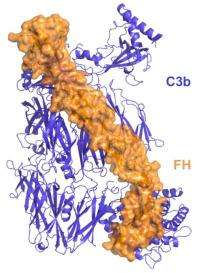
How molecules of the oldest branch of the human immune system have interconnected has remained a mystery. Now, two new structures, both involving a central component of an enzyme important to the complement system of the immune response, reveal how this system fights invading microbes while avoiding problems of the body attacking itself.
The structures may pave the way to more efficient therapeutics for such complement-mediated diseases as age-related macular degeneration, rheumatoid arthritis, or systemic lupus erythematosus, as well as give insight into the pathogenesis of other immune and inflammatory diseases.
The complement system, an evolutionarily old arm of the immune system, comprises a network of proteins that "complement" the work of antibodies in destroying foreign invaders. They serve as a rapid defense mechanism in most species, from primitive sponges to humans. When complement proteins are triggered into action by a microbe, the proteins ultimately form a complex enzyme called C3 convertase, initiating a cascade of immune and inflammatory reactions. In order to avoid self-attack, regulatory proteins such as factor H bind with C3b, a central component of C3, to help the immune system recognize the body's own tissue and keep complement in check.
Researchers at the University of Pennsylvania School of Medicine, in collaboration with colleagues at Utrecht University in the Netherlands, have determined the structure of C3 convertase and of the C3b fragment in complex with factor H. The work appears this month in two companion papers in Nature Immunology.
"Research on the complement system has waited more than 30 years for these structures," says senior author John Lambris, PhD, the Dr. Ralph and Sallie Weaver Professor of Research Medicine at Penn.
In the case of the C3 convertase structure, the researchers were able to make crystals by stabilizing the convertase complex with an inhibitor from the Staphylococcus aureus bacteria, called SCIN. SCIN freezes C3 convertase in an inactive state, preventing complement proteins from working further, and in turn, protecting the bacteria from attacking immune cells.
As a central component of C3 convertase, C3b forms an enzyme complex that cleaves its parent molecule C3, which leads to the generation and deposition of more C3b on the bacterial surface. The structure of C3 convertase provides important details about the molecular mechanisms behind these activation and amplification processes. When SCIN is bound to C3 convertase, the enzyme can no longer generate C3b and amplify the complement response, which likely renders the immune system less effective against staphylococcal infections.
"We plan to look for potential drugs that mimic the interaction of SCIN and C3 convertase and inhibit complement without triggering an adverse immune response," says Lambris. The crystals were therefore examined for critical interaction points between the SCIN inhibitor and C3 convertase.
The second study, describing the structure formed between C3b and factor H, a key regulator of the complement system, is important because of its suspected involvement in a number of immune-related diseases. "It was a surprise to see that the factor H fragment is spread across the entire C3b complex," notes Lambris.
Factor H binding inhibits C3 convertase activity and prevents the complement response from attacking the host's own cells. "This gives us a structural model for designing new therapies for several immune-mediated diseases," said Lambris.
Mutations in factor H are associated with age-related macular degeneration, the major cause of blindness in elderly people in the U.S; atypical hemolytic uremic syndrome, a rare but severe kidney disease that causes acute renal failure and high blood pressure; and membranoproliferative glomerulonephritis type II, another rare, progressive renal disorder also known as dense deposit disease.
"We observed that mutations in factor H could weaken its binding activity to C3b, and thus may lead to a loss of regulatory activity in the disease states," explains Lambris. Correlating disease-related mutations with functional consequences is likely to give insight into the pathogenesis of these and other diseases with immune or inflammatory components.
Current work is focused on designing drugs to counter the effect of SCIN or use it as a template for complement system-targeting therapeutics that target complement-mediated diseases: understanding the implications of the various factor H mutations on diseases, and developing an updated and more dynamic model of complement regulation.
Source: University of Pennsylvania School of Medicine (news : web)


