Passing cars to generate energy for new UK supermarket
June 17, 2009 by Lisa Zyga
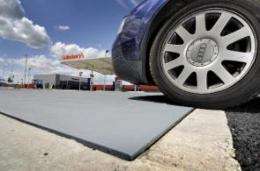
"Kinetic Road Plates" are expected to generate 30 kW per hour, enough to power the store's checkouts. Credit: J Sainsbury plc.
A new grocery store in the UK opening today will generate energy every time a customer drives into the parking lot. Sainsbury's, located in Gloucester, is the first European store to feature "Kinetic Road Plates" - thin, flexible plates that capture energy as cars drive over them.
The system is expected to produce about 30 kW of energy per hour, which is more than enough energy to power the store's checkouts. As designer Peter Hughes of Highway Energy Systems explains, as a vehicle passes over the plates, the plates are pushed down by the weight of the vehicle. The pushed plates create rocking motions under the road's surface that turn generators, which is redirected back to the store. Drivers feel no disturbance when driving over the rounded-edge plates, and the system does not affect vehicles' fuel efficiency.
"This is revolutionary, not only are we the first to use such cutting-edge technology with our shoppers, but customers can now play a very active role in helping to make their local shop greener, without extra effort or cost," said Alison Austin, Sainsbury's environment manager. "We want to continue offering great value but we also want to make the weekly shop sustainable. Using amazing technology like this helps us reduce our use of carbon and makes Sainsbury's a leading energy-efficient business."
The kinetic road plates are one of many energy-saving measures at the new Sainsbury's store. Other environmental features include harvesting rainwater to flush toilets, solar panels to heat up to 100% of the store's hot water during the summer, floor-to-ceiling windows and sun pipes in the roof to maximize natural light, automatic dimmers for electric lights, and retrieving cold air from refrigerators to keep the checkout area cool.
More information: www.j.sainsbury.co.uk


good point - that basically means more fuel consumption => more CO2 => more environmental damage
30 kW/h = 30 000 watts generated per hour.
It's quite a lot of power though- it's an average of 40 horsepower.
Paulo and moj85 are both correct. The energy harvested is pretty high, but it isn't free, of course. The plates are either set a little higher than the surrounding pavement, forcing the driver to give a touch more gas to climb the small incline, or they're level when the car begins to pass over them, and they sink a little, forcing the driver to give a little gas to climb out of the 'depression'. Either way, they're converting the chemical energy of the gas into mechanical energy to drive a linear or axial generator. It is a novel idea, but there are no free rides. And overall, the conversion efficiency would be equal to that of the car itself, (say, 25% tops) minus the generator and transmission losses. There are lots of other ways to produce so-called 'green' energy that have much higher efficiencies, but upfront costs might be higher.
Also, contrary to the statements in the article, it would indeed affect the vehicle's fuel efficiency, but averaged over a tank full of gas, it would be negligible. (Unless all the driver did was go back and forth over the plates all day).
I commend this business for at least trying and caring to be green. Not every answer is perfect but at least they care to actually do something.
It's great to see a post with some common sense.
Sorry. No common sense. I'm a physicist and this is a VERY inefficient petrol powered generator.
I find this interesting. I remember reading or seeing something about this idea being used for a sidewalk or something like that, but that each person in a city of millions over their entire lifetime would generate only enough electricity to light a decent wattage light bulb for like 1 second. I know the weight and speed increases from driving over these panels in a vehicle would obviously generate more power using this method, however, it seems like a huge jump to generate that much more power than the last capabilities I heard of. If its true, bravo, great strides were made in this, and where can I get these panels to do my house and garage flooring in for cheap :)
corban-its a measure of the tiem it takes to produce 30KW of power potentially. You are thinking of kwh (kilowatt hours) I think....which is absolutely fine since you are giht I think, and they are using the phrase "30KW per hour" in place of the proper way of waying it as 30kwh...from my limited electrical non expertise...
lord jag-i hear that kind of statement alot...and this is my response to your particular statement...it does not matter where the energy comes from because it is free energy no matter which way you slice it or dice it. Yes, in one frame of mind you can say the energy comes from the engine because the engine drives the car that is going over the panels, right, I agree, in that mindset. However, if you really look at it, and this is the point I can never seem to get across to anyone correctly, so I try yet again...
the engine is already driving the car, you are already using its power for another use..if you were on the road and not in this stores parking lot, then you would still be using your engine right...so, if these panels were not in the parking lot here, you would still have to use your engine to drive onto the parking lot to park and get your smokes (or fags if your english..lol) right, so if those panels are there, they are collecting power from an action that your engine would be performing whether or not they were there. In my thinking, this therefore equates to the engine utilization being null and void, and the panels are collecting absolutely, positively free power by making use of what is in todays day and age, a natural event. No different than using the wind or sun for power. In fact solar power is a DAMN good example here to use too...the sun gives off what, 9 fkn trillion hiroshima bombs per second of energy in the form of light...under your thinking, if i understood your thinking right that is, that would mean that solar power is not free because the sun has to exert energy for us to collect it.
To me, this isnt a cause and effect thing, this is an effect and effect thing. Using the solar example, the cause is the sun burns its fuel, the effect is energy in the form of heat and light, and the effect of that is we can gather that energy using solar panels to generate electricity at no cost for power generation.
My thinking on the parking lot panels here is the same...the cause is that you needed to go to the store for diapers, cigarettes, beer, and a porno magazine right, the effect of which is you have to drive to the store (and through their parking lot), the effect of which, with the panels in place, is that electrical energy is gathered via kinetic means...another effect and effect, which equals free to me :)
Ok...shit...I think I confused myself now....
alex-electric or hydrogen powered vehicles, which will be here in full force sooner rather than later....there is no output from those as you describe...
Moj-why does the car need to be slowed? power doesnt need to be withdrawn from the engine necessarily...a simple magnet and coil design could do this without withdrawing power form the engine providing enough pressure is exerted to move the magnet through or over the wire coils...aka, it seems like its been possible for a century...
Hell to make it shorter than it wouldve been, and sweeter, yes, of course you need an input ot get an ouput, BUT, if it is something that is going to be done anyways (such as the fact the sun IS going to shine on a clear day), that effectively makes it free energy.
This is sad reflection of the state of our educational system.
Watts are already a derivative of energy with respect to time. If you are generating one watt of power you're generating 1 joule of energy every second.
The only way to make sense of 30 kW/h is as an accelerating energy production, for each hour that passes your power generation increases by 30 kW. If you start at 0 watt you're expecting to generate as much power as a 1 GW nuclear reactor in just 3 years and 10 months.
An interesting idea which points out as well as anything I've seen lately that the devil is in the details.
Properly done, this basically amounts to regenerative braking, just an external version rather than on-board like on a hybrid vehicle.
***
It's nice to see I'm not alone in the dismay over many writers showing no ability to grasp the whole power = KW and energy = KW-hr thing. Even physorg, sigh.
Based on what I've seen going in and out of the parking lots in my area, I wouldn't necessarily make this assumption! ;)
kW h, or Kilowatt hours is the product of power in kilowatts and time in hours.
The electricity company where I live charges 18 cents per kW h, meaning they charge 18 cents for every hour you use 1 kW of electricity (a kilowatt is 1000 watts, btw) - if you have a 1000 watt heater running for 1 hour it will cost you 18 cents. Understand? This is how they measure electricity usage. Kilowatt hour, or kW h. It is equal to 3.6 megajoules.
Why don't you have a look at your electricity bill.
And have a look at this while you're at it...
http://en.wikiped...att-hour
Then don't respond. You're clearly too incompetent.
What does this have to do with ANYTHING? We're talking about kilowatts PER hour.
As anyone can see you yourself said: "30 kW/h = 30 000 watts generated per hour."
Either your reading comprehension is lacking or you're so embarrassed to admit that you said kW/h that you have to resort to lying.
That's nice dear, but would you mind calling them up and asking what the take for a kilowatt PER hour?
http://opening-ti...oucester
you will see that they are not a 24 hour branch so PERHAPS they are saying that sufficient energy is accumulated to power their check-outs with 30 kW over the 11 hour shopping day. There again PERHAPS the writer doesn't have her Physics "O" level.
Not really.
In a normal shop the energy needed for running it is funded by the customer by adding a little on top of the price of the products.
In this shop, they get the this by borrowing a little energy from the cars of the customers by using this system.
So the customer can buy the products e bit cheaper but pays more for running the car.
But now the system has to be bought, installed and maintained and that has to be funded by ... indeed, the customer.
So now the customer pays 2 times for the energy and the electricity is now produced by inefficient engine in stead of an efficient powerplant.
So both the customer and the environment are worse off by using this system.
Well, just imagine this scenario: locate the parking lot on a decline. The cars come in on a movable long ramp initially held up by springs - the weight of the car would cause the ramp to descend and run a generator. Being a long ramp, the car would not have to stop and would continue and would not have to brake as much because the decline is not as severe as without the moveable ramp.
Practical problems aside - and yes there are many for this to be workable - if a plate raised by 1/2" generates as much energy as the article indicates, with a sufficient slope, this baby should make enough to power the market and sell back to the grid :-)
Are you stealing energy?
Not really, because the cars would have to use brakes to keep from speeding down the slope.
I did indeed put a slash where there should be no slash.
So you can walk away with your head held high knowing that you have won this online argument. You are indeed the chest-beating male monkey of far superior intellect, and I, the submissive monkey, will crawl away to the other side of the pen to eat my fleas, and watch you have intercourse with your harem of females, and bash all other male monkeys into submission.
As a positive side-effect of our little tete a tete I have learned something.... and I'm sure that it will give you a warm inner glow to know that you have saved me from the ignominy of ignorance as regards the Kilowatt hour.
Thank you, my friend, I have learned the error of my ways. My infinite gratitude goes out to you.
Much love, Paolo.
That kilowatt-hours convention ALWAYS bugged me. I guess it makes sense for the power companies to bill me in terms of their rate of production... but couldn't you just tell me how many joules I used in the month?! And charge me based on that? Or maybe eVs, just for shits and giggles? :)
water : electricity
gallons : kilowatt-hours
gallons per minute : kilowatts
From which one can you see that the term 'hours' shows up in the opposite case, which is very much counter-intuitive for most everyone.
[Way to go paulo, nice post - I've seen a LOT of well-qualified engineers make the same mistake. I once had a Mech Engr'g professor spend an entire hour on this subject and end up confusing almost everyone by the time he finished. :-) ]
That portion of industry which deals with kilowatts is focused on amps and volts. Joules and J/s are rarely used as units.