Biomimetic-engineering design can replace spaghetti tangle of nanotubes in thermal material
June 17, 2009
Biomimetic-engineering design can replace spaghetti tangle of nanotubes in thermal material

Enlarge

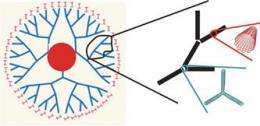
The figure illustrates a hierarchical network of carbon nanotubes mimicking a cell's protein network to connect a small heat source (red area) to a larger area that serves as a heat sink.

Nanoelectromechanical systems (NEMS) devices have the potential to revolutionize the world of sensors: motion, chemical, temperature, etc. But taking electromechanical devices from the micro scale down to the nano requires finding a means to dissipate the heat output of this tiny gadgetry.

In a paper that recently appeared in the journal Nano Letters, Professor Markus Buehler and postdoctoral associate Zhiping Xu of MIT's Department of Civil and Environmental Engineering say the solution is to build these devices using a thermal material that naturally dissipates heat from the device's center through a hierarchical branched network of carbon nanotubes. The template for this thermal material's design is a living cell, specifically, the hierarchical protein networks that allow a cell's nucleus to communicate with the cell's outermost regions.

"The structure now used when designing materials with carbon nanotubes resembles spaghetti," said Buehler, who studies protein-based materials at the nano and atomistic scales with the goal of using biomimetic-engineering principles to design human-made materials. "We show that a precise arrangement of carbon nanotubes similar to those found in the cytoskeleton of cells will create a thermal material that effectively dissipates heat, which could prevent a NEMS device from failing or melting."

NEMS devices are characterized by extremely small, high-density heat sources that can't be cooled by traditional means. Even the microelectromechanical systems (MEMS) devices used in automobiles and electronics are hard to cool, because conventional thermal management strategies such as fans, fluids, pastes and wiring often don't work at these small scales; heat buildup in MEMS frequently leads to catastrophic device failure, which limits the reliability of larger systems.

But the number of heat-conducting fibers or carbon nanotubes () that can be connected to the heat source at the center of a NEMS device is limited by the physical size of the heat source itself. Buehler and Xu demonstrate that a simple geometric structure - a branched-tree hierarchy of at least two branches sprouting off each branch - is far more effective at heat dissipation than the non-hierarchical "spaghetti" of most existing CNT-based material.

They show that a single fiber (or branch) connected to the heat source, with 99 additional branched links between it and the heat sink, will provide the same dissipation effect as if 50 long fibers were connected directly to the heat source. If five carbon nanotubes are arranged in direct connection to the heat source, each of which uses this branched-tree hierarchical structure, the heat dissipation will be the equivalent of 250 direct connections from the heat source to an external heat sink.

"Our paper provides a breakthrough in the understanding of how nanostructural elements can be utilized effectively to bridge scales from the nano to macro through formation of hierarchical structures," said Xu. "The results could change the way nanodevices are designed and fabricated by enabling technological innovations for highly integrated systems."

Source: Massachusetts Institute of Technology (news : web)


Rank 5 /5 (2 votes)
Relevant PhysicsForums posts
  • Thermodynamics q
    created2 hours ago
  • what is electricity???
    created6 hours ago
  • Can Plasma Be Solid
    created7 hours ago
  • What is delta Δ ?
    created7 hours ago
  • Need some help understanding HertzĀ–Knudsen formula
    created8 hours ago
  • Anatomy of Fat man: implosion-critical bomb
    created10 hours ago
  • More from Physics Forums - General Physics

More news stories

Lab study raises questions over nano-particle impact

Tests involving chickens have raised questions about the impact on health from engineered nano-particles, the ultra-fine grains commonly used in drugs and processed foods, scientists said on Sunday.

Nanotechnology / Bio & Medicine

created 12 hours ago | popularity 5 / 5 (7) | comments 2

New kind of solar cell could capture significantly more energy than current cells

New solar cells could increase the maximum efficiency of solar panels by over 25%, according to scientists from the University of Cambridge.

Nanotechnology / Nanophysics

created Feb 08, 2012 | popularity 4.5 / 5 (13) | comments 14 | with audio podcast

Nanoshell whispering galleries improve thin solar panels

Visitors to Statuary Hall in the U.S. Capitol Building may have experienced a curious acoustic feature that allows a person to whisper softly at one side of the cavernous, half-domed room and for another on ...

Nanotechnology / Nanomaterials

created Feb 07, 2012 | popularity 4.4 / 5 (7) | comments 6 | with audio podcast

'Dark plasmons' transmit energy

Microscopic channels of gold nanoparticles have the ability to transmit electromagnetic energy that starts as light and propagates via "dark plasmons," according to researchers at Rice University.

Nanotechnology / Nanophysics

created Feb 09, 2012 | popularity 4.8 / 5 (10) | comments 1 | with audio podcast

Revealing how a battery material works

Since its discovery 15 years ago, lithium iron phosphate (LiFePO4) has become one of the most promising materials for rechargeable batteries because of its stability, durability, safety and ability to deliver ...

Nanotechnology / Nanomaterials

created Feb 08, 2012 | popularity 5 / 5 (6) | comments 0 | with audio podcast


Scientists discover molecular secrets of 2,000-year-old Chinese herbal remedy

For roughly two thousand years, Chinese herbalists have treated Malaria using a root extract, commonly known as Chang Shan, from a type of hydrangea that grows in Tibet and Nepal. More recent studies suggest that halofuginone, ...

New method to examine batteries -- MRI from the inside

There is an ever-increasing need for advanced batteries for portable electronics, such as phones, cameras, and music players, but also to power electric vehicles and to facilitate the distribution and storage of energy derived ...

A mitosis mystery solved: How chromosomes align perfectly in a dividing cell

Although the process of mitotic cell division has been studied intensely for more than 50 years, Whitehead Institute researchers have only now solved the mystery of how cells correctly align their chromosomes during symmetric ...

Google might launch Drive for cloud storage soon

(PhysOrg.com) -- Google's next big move, according to the Wall Street Journal, is a cloud storage service called Drive. Hardly first to the plate, Google is simply catching up to introducing its cloud reposi ...

Starve a virus, feed a cure? Findings show how some cells protect themselves against HIV

A protein that protects some of our immune cells from the most common and virulent form of HIV works by starving the virus of the molecular building blocks that it needs to replicate, according to research published online ...

Researchers find extensive RNA editing in human transcriptome

In a new study published online in Nature Biotechnology, researchers from BGI, the world's largest genomics organization, reported the evidence of extensive RNA editing in a human cell line by analysis of RNA-seq data, demons ...