First direct evidence of lightning on Mars detected
June 17, 2009
First direct evidence of lightning on Mars detected

Enlarge

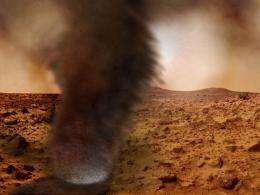
An illustration of a dust storm on Mars. Credit: Brian Grimm and Nilton Renno

For the first time, direct evidence of lightning has been detected on Mars, say University of Michigan researchers who found signs of electrical discharges during dust storms on the Red Planet.

The bolts were dry lightning, says Chris Ruf, a professor in the departments of Atmospheric, Oceanic and Space Sciences and Electrical Engineering and Computer Sciences.

"What we saw on was a series of huge and sudden electrical discharges caused by a large dust storm," Ruf said. "Clearly, there was no rain associated with the electrical discharges on Mars. However, the implied possibilities are exciting."

Electric activity in Martian dust storms has important implications for Mars science, the researchers say.

"It affects atmospheric chemistry, habitability and preparations for human exploration. It might even have implications for the , as suggested by experiments in the 1950s," said Nilton Renno, a professor in the Department of Atmospheric, Oceanic and Space Sciences.

The findings are based on observations made using an innovative microwave detector developed at the U-M Space Physics Research Laboratory. The kurtosis detector, which is capable of differentiating between thermal and non-thermal radiation, took measurements of microwave emissions from Mars for approximately five hours a day for 12 days between May 22 and June 16, 2006.

On June 8, 2006 both an unusual pattern of non-thermal radiation and an intense Martian dust storm occurred, the only time that non-thermal radiation was detected. Non-thermal radiation would suggest the presence of lightning.

The researchers reviewed the data to determine the strength, duration and frequency of the non-thermal activity, as well as the possibility of other sources. But each test led to the conclusion that the dust storm likely caused dry lightning.

This work confirms soil measurements from the Viking landers 30 years ago, and it challenges 2006 experiments that suggested otherwise.

Data from the Viking landers raised the possibility that Martian dust storms might be electrically active like Earth's thunderstorms and thus, might be a source of reactive chemistry. But the hypothesis was untestable. In 2006, using theoretical modeling, laboratory experiments and field studies on Earth, a group of planetary scientists suggested that there was no direct evidence that lightning occurred on Mars. This new research refutes those findings.

"Mars continues to amaze us. Every new look at the planet gives us new insights," said Michael Sanders, manager of the exploration systems and technology office at Jet Propulsion Laboratory and a researchers involved in this study.

Source: University of Michigan (news : web)

4.5 /5 (14 votes)  

Filter


Move the slider to adjust rank threshold, so that you can hide some of the comments.


Display comments: newest first

LuckyBrandon
Jun 17, 2009

Rank: not rated yet
"In 2006, using theoretical modeling, laboratory experiments and field studies on Earth, a group of planetary scientists suggested that there was no direct evidence that lightning occurred on Mars. This new research refutes those findings."

WTF!

Ok for one, using purely theoretical modeling really isn't for shit if youre playing a guessing game, which it sounds like they were. Now, theoretical modeling combined with lab testing such as a sealed chamber with sand and dust in it placed at martian atmospheric pressure, and then winds equating on a small scale to the winds on a large scale on mars......if thats the case, then I'll take back my first statement :)

2. Direct evidence - ok, so nobody has taken a picture...that is direct evidence...was it even being looked for intensively, or was it just a little side task no1 gave a shite about?

3. It seems to me that this makes sense...if you rub 2 solid objects together, you get friction, which gives off energy in the form of a static discharge...well hell, an electrical current


Now my real question here:

Could this "dry lightning" be harnassed for addition power supplies at a Mars colony? Granted, it wouldnt be much, and would only be sporadic, but hell, why not throw some lightening rods onto our dome :)
Mercury_01
Jun 17, 2009

Rank: 1 / 5 (1)
Oh great, now every expedition to mars will have to be equipped with $13,000,000 worth of lightning protection equipment.
LuckyBrandon
Jun 18, 2009

Rank: not rated yet
teh bad part of that being only 1 million of that would go to the equipment, and the rest to top secret research :)
Rank 4.5 /5 (14 votes)
Related Stories
Relevant PhysicsForums posts

More news stories

Amasia: As next supercontinent forms, Arctic Ocean, Caribbean will vanish first

(PhysOrg.com) -- Geologists at Yale University have proposed a new theory to describe the formation of supercontinents, the epic process by which Earth’s major continental blocks combine into a single ...

Space & Earth / Earth Sciences

created 19 minutes ago | popularity not rated yet | comments 0 | with audio podcast

New images capture 'stealth merger' of dwarf galaxies

New images of a nearby dwarf galaxy have revealed a dense stream of stars in its outer regions, the remains of an even smaller companion galaxy in the process of merging with its host. The host galaxy, known ...

Space & Earth / Astronomy

created 45 minutes ago | popularity not rated yet | comments 0 | with audio podcast

Chandra finds Milky Way's black hole grazing on asteroids

(PhysOrg.com) -- The giant black hole at the center of the Milky Way may be vaporizing and devouring asteroids, which could explain the frequent flares observed, according to astronomers using data from NASA's ...

Space & Earth / Astronomy

created 51 minutes ago | popularity 5 / 5 (1) | comments 2 | with audio podcast

In scientific coup, Russians reach Antarctic lake

After more than two decades of drilling in Antarctica, Russian scientists have reached a gigantic freshwater lake hidden under miles of ice for some 20 million years - a pristine body of water that may hold ...

Space & Earth / Earth Sciences

created 42 minutes ago | popularity 4 / 5 (1) | comments 0

VLT takes most detailed infrared image of the Carina Nebula

(PhysOrg.com) -- ESO's Very Large Telescope has delivered the most detailed infrared image of the Carina Nebula stellar nursery taken so far. Many previously hidden features, scattered across a spectacular ...

Space & Earth / Astronomy

created 8 hours ago | popularity 5 / 5 (5) | comments 3 | with audio podcast


Windows 8 preview set for February 29

Microsoft on Wednesday revealed plans to unveil a test version of its latest Windows computer operating software later this month.

European Internet campaigners battle ACTA

A controversial international accord billed as a way to beat online piracy has sparked a fightback led by Internet users in ex-communist countries who say the region's past underlines the need to defend freedom.

Phelps using hyperbaric chamber to aid recovery

(AP) -- Michael Phelps is the latest athlete to use a hyperbaric chamber to aid his recovery from training.

No anorexia emergency, La Scala ballerinas claim

The ballet company at Milan's famous La Scala opera house fought back Wednesday, after one of their leading dancers was fired for giving interviews in which she said the industry has an anorexia problem.

Washington Post offering buyout to news staff

The Washington Post announced a voluntary buyout for some newsroom staff on Wednesday, citing the difficult economic climate for the newspaper industry.

Quantum physicist explains $100K offer for proof scaled-up quantum computing is impossible

(PhysOrg.com) -- MIT researcher Scott Aaronson has certainly riled the physics community with his offer this past Friday, of $100,000 to anyone who can prove that scaled-up quantum computing is impossible. ...