Jatropha Helps Air New Zealand Cut Its CO2 Emissions by More Than 60%
June 17, 2009 by Miranda Marquit
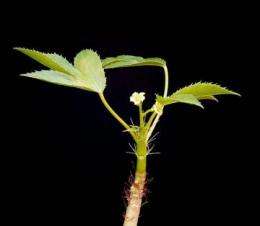
Jatropha can provide a biofuel that may help improve jet performance while reducing CO2 emissions. Image credit: Frank Vincentz via Wikimedia Commons
Recently, Air New Zealand ran a test flight of a jet plane fueled with a biofuel blend made with jatropha. The results showed a fuel savings of 1.2%, amounting to more than a ton of fuel over the course of a 12-hour flight. The CO2 emissions from the airplane were reduced by an even more impressive amount -- in excess of 60%. The flight is one that offers some evidence that perhaps it is feasible for airlines to adopt biofuels in order to reduce the emission of greenhouse gases.
Jatropha has been recognized recently as a viable alternative to many biofuels. Gas 2.0 reports on the reasons that jatropha seems to show such promise:
"A second generation biofuel, jatropha is grown on land that doesn't compete with food. It requires almost no care and very little water. Another major benefit of jatropha is that, due to its ability to take hold in harsh wastelands, it can be used to help stop erosion in these areas and reclaim them for agricultural production."
Air New Zealand worked with Rolls-Royce, Boeing and Honeywell's UOP to develop drop-in biofuel technology, which involves a commercial Boeing 747 carrying a Rolls Royce engine. The fuel used is a blend of standard jet fuel and kerosene derived from jatropha oil.
Of course, the main concern is cost. With oil prices so low right now, jet fuel is relatively inexpensive. The cost-efficiency of the process of producing the biofuel is not as competitive as it could be. However, if oil prices rise again in the future, such biofuels may become more desirable from a cost standpoint -- as they already are from an environmental standpoint.
© 2009 PhysOrg.com


Unfortunately it only requires very little water if you want to produce very little oil. To a get good commercial yield of oil it requires a lot of water. Ofcourse it is possible NZ has places with a lot of water it is not using food crops in which case for NZ this may still be a reasonable option.
NZ's nickname is the 'land of the long white cloud'; it rains quite a bit of the year. It has plenty of water, and I'm sure they can find some non arable land for this.
http://www.physor...585.html
From another website
http://www.biofue...duction/
"In Ethiopia, the Minister of Mines and Energy said that government%u2019s allocation of 24 million hectares for jatropha cultivation will not affect food production. He said the land selected was unsuitable for food production."
Not that it matters since we want a reliable source of fuel and energy not some magic solution to the non problem of plants being allowed too much access to the nutrient CO2. The Earth is not a greenhouse.
That being said, the headline claims: "Jatropha Helps Air New Zealand Cut Its CO2 Emissions by More Than 60%". Firstly I don't know if this should read in the present tense and secondly NZ creates emmissions from things other than air plane fuel.
What a ridiculous statement.
This incidentally referred to the entire LOWLAND belt of Ethiopia (I have seen the map in a presentation by an African NGO), being nearly 1/4 of the land area of the country, both biodiverse and populated by traditional farming communities.
This incidentally referred to **virtually** the entire LOWLAND belt of Ethiopia (I have seen the map in a presentation by an African NGO), being nearly 1/4 of the land area of the country, both biodiverse and populated by traditional farming communities.
Because Jatropha can apparently withstand three years of drought I suppose there's some merit to it being used in Ethiopia, but it still seems weird to me that Air NZ, which must be predominately for tourism, can get involved with this. For a broader view of Jatropha/Biofuels, which has many illuminating reader comments, see -
http://www.timeso...5351.ece
My family's gardens have invasive wild strawberry plants all over the place but only in limited conditions will fruit grow, less still to over 6mm diameter. Then again who knows what will come of Jatropha domestication, like strawberries?