Clones of 9/11 hero dog unveiled in Los Angeles
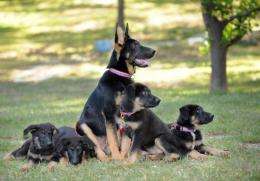
June 18, 2009 Clone puppies Trust, Solace, Prodigy, Valor and Dejavu

Trust, Solace, Prodigy, Valor and Dejavu in Los Angeles, California to present the cloned puppies of Trakr, a German shepherd, who sniffed out survivors from under the rubble of New York's World Trade Center after the 2001 terror strikes. Trakr was cloned in South Korea under the direction of Doctor Hwang Woo-Suk. AFP PHOTO / GABRIEL BOUYS

Five clones of a search and rescue dog which helped locate people trapped in the rubble of the 9/11 attacks were formally presented to their ancestor's former handler.

James Symington, a former Canadian police officer, choked back tears as he formally took possession of the five descendants of his beloved German shepherd named Trakr, who died in April.

Symington was presented with Trakr's offspring after winning a competition organized by California firm BioArts International -- the "Golden Clone Giveaway" -- to find the world's most "cloneworthy" dog.

Symington said he hopes the puppies -- Trustt, Valor, Prodigy, Solace and Deja Vu -- will go on to follow in Trakr's footsteps.

"We're here to celebrate that Trakr's legacy lives on in these five beautiful puppies," he told reporters. "If they have the same attributes Trakr did, then hopefully they'll develop into world class search and rescue dogs."

Symington and Trakr arrived at the site of the World Trade Center collapse, commonly referred to as Ground Zero, on September 12, 2001 and were one of the first K9 search and rescue teams on the scene.

After working nearly non-stop for 48 hours, Trakr located the last human survivor found in the rubble of the twin towers.

"Trakr was an extraordinary search and rescue dog. His work at Ground Zero was the culmination of his career," Symington said.

BioArts International, which says it offers the world's first commercial dog service, partnered with South Korea's SooAm Biotech Research Foundation to clone Trakr under the direction of scientist Hwang Woo-Suk.

BioArts International chief executive Lou Hawthorne said canine cloning would remain beyond the reach of ordinary pet lovers, with cloned dogs costing an average 144,000 dollars each.

Hawthorne defended the right of people to clone their dogs instead of obtaining new pets from rescue shelters.

"I think 99 percent of the time people should get their pets from shelters," he told AFP.

"But can we agree though that one percent of the time if you have a one in a million dog and you have the money to pay for it, you should be able to go to either a breeder or a cloner?"

Hawthorne said Trakr had been chosen for cloning because of his heroics on 9/11. "We received many very touching submissions to our contest, describing some truly amazing dogs," he said. "But Trakr's story blew us away."

Symington meanwhile said that one member of his new litter -- Trustt -- was an exact replica of Trakr.

"The physical similarities are uncanny," he told AFP. "He's the spitting image of the Trakr that I first met in 1995. He has exactly the same markings, the way he moves, everything. Very alert, very intelligent and intuitive.

"I respect that cloning's not for everyone. But there are few dogs that are born with extraordinary abilities and Trakr was one of those dogs," he said.

"I look forward to the day that these puppies can follow in Trakr's footsteps and play an important role in other rescues, like Trakr did."

(c) 2009 AFP


print this article email this article download pdf blog this article bookmark this article     Stumble it Digg this share on Facebook retweet share on Reddit add to delicious
Rate this story - 1.3 /5 (3 votes)

Rank Filter

Move the slider to adjust rank threshold, so that you can hide some of the comments.


Display comments: newest first

  • Bob_Kob - Jun 18, 2009
    • Rank: 5 / 5 (3)
    Now we have 5x the dogs to help people in the next 9/11!
  • Egnite - Jun 19, 2009
    • Rank: not rated yet
    Hope they aren't all diseased with respiratory problems like all the other 911 rescuers ^^

June 18, 2009 all stories

Comments: 2

1.3 /5 (3 votes)
  • Stumble this up

  • Digg this

  • share this

  • hide
  • Related Stories

  • Couple welcomes home cloned dog
    created Jan 28, 2009 | popularity not rated yet | comments 0
  • SKorean experts claim to have cloned glowing dogs
    created Apr 28, 2009 | popularity not rated yet | comments 0
  • Dog 'laugh' silences other dogs
    created Dec 05, 2005 | popularity not rated yet | comments 0
  • Children should not be left unsupervised with dogs, say experts
    created Feb 23, 2007 | popularity not rated yet | comments 0
  • Right, left makes a difference in tail wag
    created Mar 25, 2007 | popularity not rated yet | comments 0


  • hide
  • Relevant PhysicsForums posts

  • Breeding program
    created Nov 20, 2009
  • How does a concentration gradient provide energy?
    created Nov 20, 2009
  • Eyesight and Neural Damage from Electronics
    created Nov 19, 2009
  • Quick question about the Golgi Apparatus?
    created Nov 19, 2009
  • More from Physics Forums - Biology

Other News

The Monarchs' annual migration ritual has yet to be scientifically explained

Tree-eating bugs threaten Monarch butterfly in Mexico

Biology / Ecology

created 1hour ago | popularity not rated yet | comments 0

The mysterious Monarch butterfly, which migrates en masse annually between Canada and Mexico, is now facing a new peril: another insect thriving in Western Mexican forests.


Extinct goat Myotragus balearicus

Extinct goat was cold-blooded

Biology / Plants & Animals

created Nov 18, 2009 | popularity 4.9 / 5 (29) | comments 10

(PhysOrg.com) -- An extinct goat that lived on a barren Mediterranean island survived for millions of years by reducing in size and by becoming cold-blooded, which has never before been discovered in mammals.


Bigger not necessarily better, when it comes to brains

Bigger not necessarily better, when it comes to brains

Biology / Plants & Animals

created Nov 17, 2009 | popularity 4.4 / 5 (15) | comments 10

(PhysOrg.com) -- Tiny insects could be as intelligent as much bigger animals, despite only having a brain the size of a pinhead, say scientists at Queen Mary, University of London.


Right-handed chimpanzees provide clues to the origin of human language

Biology / Plants & Animals

created Nov 16, 2009 | popularity 3 / 5 (1) | comments 7

Most of the linguistic functions in humans are controlled by the left cerebral hemisphere. A study of captive chimpanzees at the Yerkes National Primate Research Center (Atlanta, Georgia), reported in the January 2010 issue ...


The creature was found at a depth of 161 metres

Japanese researchers film rare baby fish 'fossil'

Biology / Plants & Animals

created Nov 17, 2009 | popularity 4.7 / 5 (7) | comments 4

Japanese marine researchers said Tuesday they had found and successfully filmed a young coelacanth -- a rare type of fish known as "a living fossil" -- in deep water off Indonesia.